
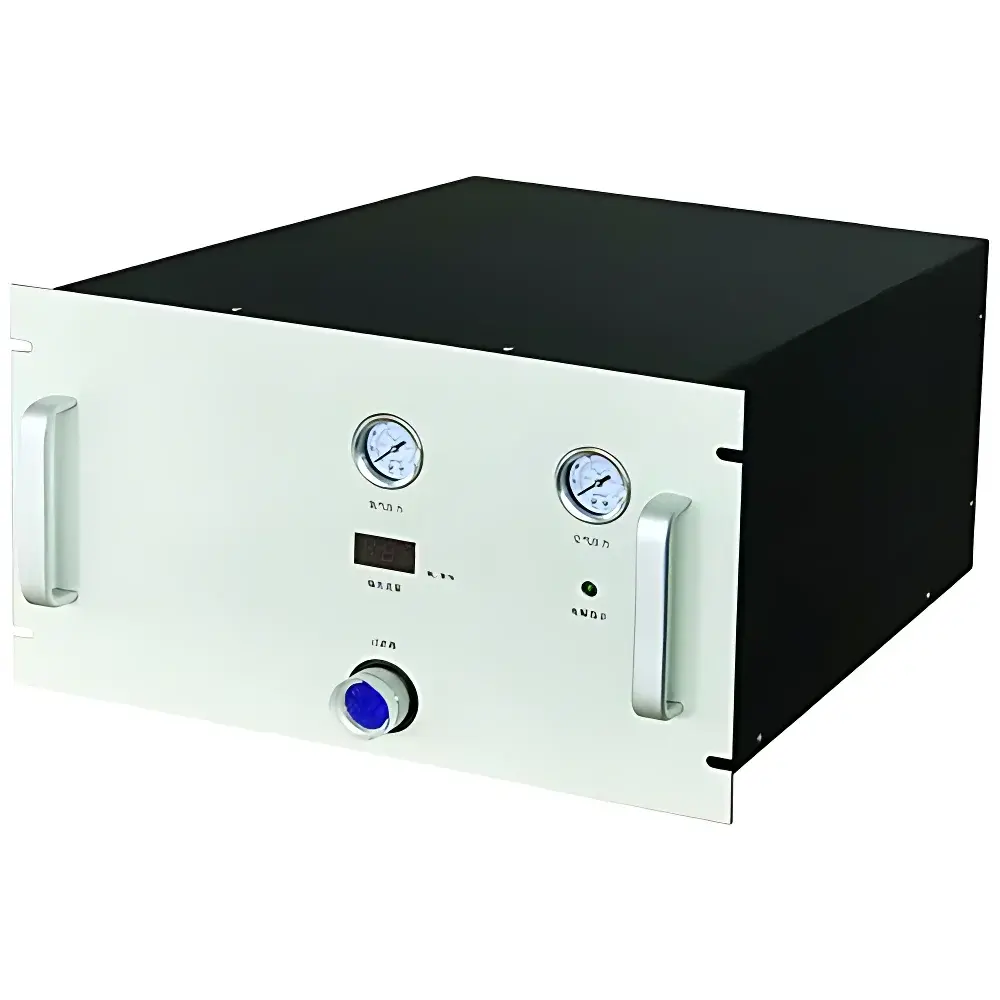
Zhonghui Pu HA2300 Rack-Mounted Integrated Hydrogen & Air Generator
| Brand | Zhonghui Pu |
|---|---|
| Origin | Beijing, China |
| Manufacturer Type | Direct Manufacturer |
| Model | HA2300 |
| Hydrogen Purity | >99.999% |
| Hydrogen Flow Rate | 0–300 mL/min |
| Hydrogen Output Pressure | 0.4 MPa |
| Air Flow Rate | 2000 mL/min |
| Air Output Pressure | 0.4 MPa (max 0.6 MPa) |
| Power Consumption | 480 W |
| Dimensions (L×W×H) | 520 × 430 × 268 mm |
| Net Weight | ~30 kg |
Overview
The Zhonghui Pu HA2300 is a rack-mountable, integrated hydrogen and air gas generator engineered for continuous, on-demand supply of ultra-high-purity hydrogen and instrument-grade compressed air to analytical instruments—primarily gas chromatographs (GC), GC-MS systems, and flame-based detectors (e.g., FID, NPD). Unlike conventional cylinder-based gas delivery, the HA2300 eliminates logistical constraints, safety hazards associated with high-pressure gas storage, and variability in gas quality. Its core architecture combines proton-exchange membrane (PEM)-compatible alkaline electrolysis for hydrogen generation and a dual-stage, oil-free diaphragm compressor system for air production. Hydrogen purity exceeds 99.999% (5.0 grade), meeting stringent requirements for trace-level analysis and compliant with ASTM D7212 and ISO 8573-1 Class 1 for particulate and moisture content in instrument gases.
Key Features
- Rack-mount design (19″ EIA standard) enables seamless integration into centralized laboratory utility cabinets or analytical instrument racks—optimizing floor space and improving system modularity.
- Integrated oil-free air compression system featuring a stainless-steel pressure vessel and pressure-swing adsorption (PSA) desiccant drying, enabling automatic condensate removal without manual intervention or consumable desiccant replacement.
- Stainless-steel alkaline electrolyzer cell with optimized electrode geometry and thermal management, delivering stable hydrogen output across the full 0–300 mL/min range while maintaining consistent pressure regulation at 0.4 MPa (±0.02 MPa).
- Dual-layer anti-backflow protection: mechanical liquid trap combined with real-time electrolyte level monitoring and electronic anti-alkaline backflow control—preventing electrolyte carryover under transient load conditions or shutdown sequences.
- Intelligent water-level sensing with audible/visual alarm and automatic power cutoff if deionized water falls below operational threshold—ensuring safe, unattended 24/7 operation.
- Low thermal signature and acoustic noise (<52 dB(A) at 1 m), suitable for placement inside analytical labs without dedicated ventilation or remote utility rooms.
Sample Compatibility & Compliance
The HA2300 is designed for direct coupling with GC ovens, detector modules, and auxiliary gas inlets requiring stable, low-particulate, low-moisture gas streams. It supports both single- and multi-instrument configurations via optional manifold kits. All wetted materials—including electrolyzer housing, gas lines, filters, and pressure regulators—are constructed from 316L stainless steel or electropolished SS304 to prevent catalytic degradation or metal ion leaching. The unit complies with IEC 61010-1 for electrical safety and meets CE marking requirements for EMC (EN 61326-1) and Low Voltage Directive (2014/35/EU). Hydrogen output conforms to ISO 8573-1:2010 Class 1 (solid particles ≤0.1 µm, dew point ≤−70 °C), and air output satisfies Class 2 (dew point ≤−40 °C, oil content <0.01 mg/m³).
Software & Data Management
While the HA2300 operates as a standalone analog-controlled generator, it includes digital status outputs (0–10 V DC or 4–20 mA) for integration into centralized lab monitoring systems (e.g., LabVantage, Thermo Fisher SampleManager). Optional RS-485 Modbus RTU interface enables remote readout of operating parameters—including real-time flow, pressure, water level, temperature, and fault codes—for inclusion in GLP/GMP audit trails. All operational logs are timestamped and stored onboard for ≥30 days, supporting FDA 21 CFR Part 11-compliant data integrity when paired with validated third-party SCADA platforms.
Applications
- Hydrogen carrier gas for capillary GC and GC-MS where helium scarcity or cost drives substitution strategies.
- Fuel gas for flame ionization detectors (FID), nitrogen-phosphorus detectors (NPD), and flame photometric detectors (FPD) requiring precise stoichiometric ratios.
- Zero-air supply for gas-phase calibration standards, ambient air monitoring analyzers, and ozone generators.
- On-site air source for pneumatic actuators, purge-and-trap systems, and sample introduction modules requiring clean, dry compressed air.
- Research environments requiring long-duration unattended operation—such as environmental monitoring stations, pharmaceutical stability chambers, and academic method development labs.
FAQ
What is the recommended feed water specification?
Deionized water with resistivity ≥1 MΩ·cm and total organic carbon (TOC) <50 ppb is required. Tap water or distilled water must not be used.
Can the HA2300 supply multiple GCs simultaneously?
Yes—when configured with a calibrated distribution manifold and pressure-regulated branch lines, it supports up to three GC systems operating at ≤150 mL/min H₂ each, provided total demand remains within 300 mL/min and pressure drop across the manifold is compensated.
Is routine maintenance required beyond water refills?
No scheduled maintenance is needed; the PSA dryer regenerates automatically, and the electrolyzer requires no periodic cleaning or electrode replacement under normal operating conditions (typical service life >15,000 hours).
Does the unit support external pressure regulation for variable instrument demands?
Yes—the built-in precision pressure regulators are adjustable (0.2–0.6 MPa for air; 0.2–0.4 MPa for H₂) and compatible with downstream secondary regulators for fine-tuned instrument inlet control.
How does the HA2300 ensure compliance with laboratory safety protocols?
It incorporates hydrogen leak detection circuitry (optional add-on), automatic shutoff upon overpressure (>0.45 MPa), and certified explosion-proof solenoid valves per ATEX Category 3G (IIIC T4), making it suitable for installation in non-classified laboratory zones per NFPA 55 and local fire codes.



