
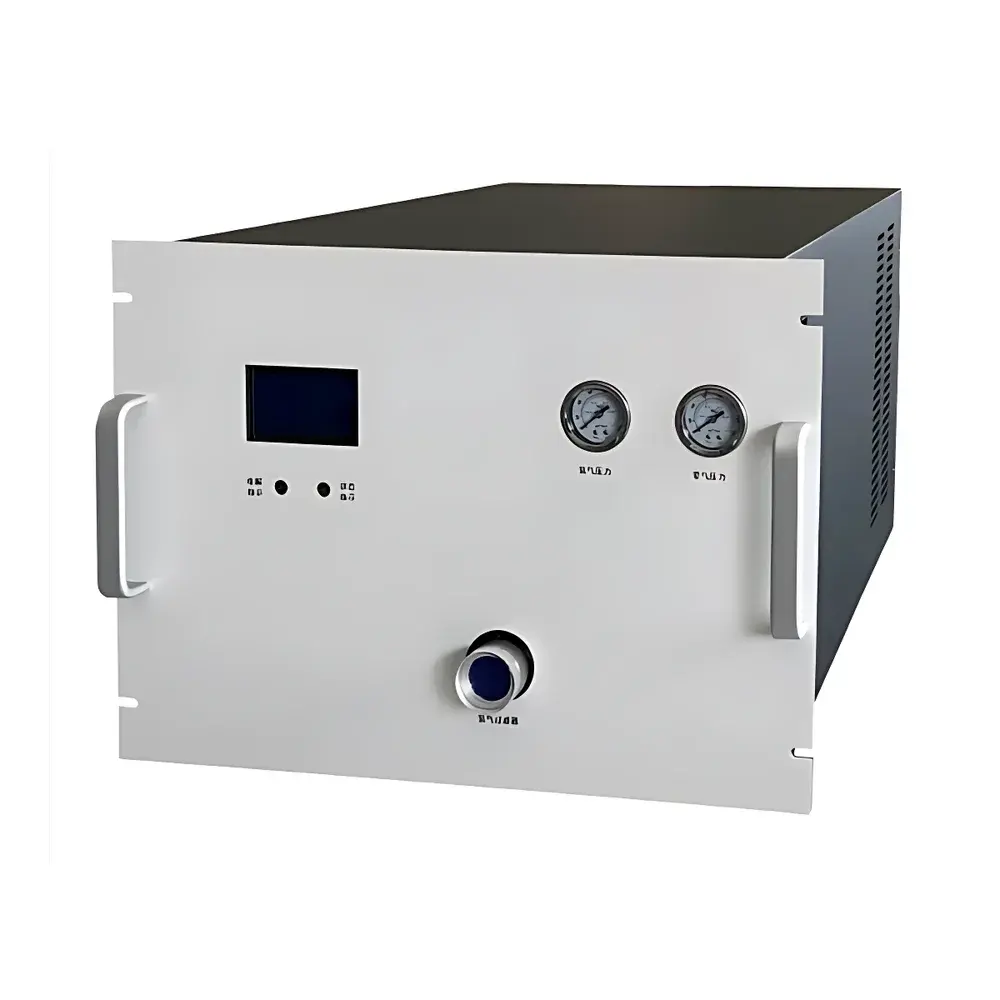
Zhonghui Pu HA3500 Rack-Mounted Integrated Hydrogen & Air Generator
| Brand | Zhonghui Pu |
|---|---|
| Model | HA3500 |
| Output Flow (H₂) | 0–300/500 mL/min |
| Purity (H₂) | 99.999% |
| H₂ Pressure | 0–0.4 MPa |
| H₂ Pressure Stability | < 0.001 MPa |
| Air Flow | 0–2/5/10 L/min |
| Air Pressure | 0–0.4 MPa |
| Air Pressure Stability | < 0.003 MPa |
| Air Dew Point | −10 °C |
| Operating Ambient | 5–40 °C, ≤85% RH |
| Max Power Consumption | 650/750 W |
| Input Voltage | 220 V ±10% |
| Dimensions (L×W×H) | 600 × 430 × 355 mm (8U rack height) |
| Net Weight | ~40 kg |
| Construction | Stainless steel filtration modules and storage tank |
| Control Interface | RS232 serial port |
| Safety Features | H₂ leak detection with automatic shutoff, dry-run protection, auto-refill electrolyte system |
| Optional Upgrades | PSA-based H₂ drying module, activated carbon filter, hydrocarbon removal furnace |
Overview
The Zhonghui Pu HA3500 is a rack-mountable, integrated hydrogen and compressed air generator engineered for continuous, reliable operation in analytical laboratories—particularly those supporting gas chromatography (GC), GC–MS, flame ionization detection (FID), thermal conductivity detection (TCD), and nitrogen–phosphorus detection (NPD). Unlike conventional cylinder-based gas supply systems, the HA3500 eliminates logistical constraints, safety hazards, and purity variability by generating high-purity hydrogen (99.999%) and clean, dry compressed air on-demand via electrochemical and mechanical compression principles. Hydrogen is produced through solid polymer electrolyte (SPE) membrane electrolysis using transition-metal catalyzed electrodes, followed by multi-stage purification—including optional pressure swing adsorption (PSA) dehydration—to achieve ultra-low moisture and hydrocarbon content. Compressed air is generated by a maintenance-free, oil-free rotary vane compressor, conditioned via PSA desiccant beds to −10 °C dew point, and further filtered through SMC-certified particulate traps and optional activated carbon or catalytic hydrocarbon removal modules.
Key Features
- Rack-mount form factor (8U height, 600 × 430 × 355 mm) optimized for integration into centralized lab utility cabinets or analytical instrument racks.
- Stainless steel construction for critical fluid-path components—including electrolyzer housing, buffer tanks, and filtration manifolds—ensuring corrosion resistance and long-term structural integrity under continuous operation.
- Microprocessor-controlled operation with real-time LCD display (Chinese interface), comprehensive fault diagnostics, and RS232 communication for remote status monitoring and integration with laboratory information management systems (LIMS).
- Hydrogen subsystem includes automated electrolyte level sensing and refill, over-pressure cutoff, hydrogen leak detection with immediate shutdown, and dry-run prevention logic to protect the PEM cell.
- Air subsystem employs a sealed, lubrication-free compressor with integrated thermal overload protection, delivering stable flow across 2/5/10 L/min selectable ranges at ≤0.4 MPa with pressure fluctuation <0.003 MPa.
- Modular upgrade path: PSA-based hydrogen drying module for 24/7 unattended operation; activated carbon filter or catalytic hydrocarbon scrubber for zero-air compliance in trace-level environmental or pharmaceutical analysis.
Sample Compatibility & Compliance
The HA3500 is designed for compatibility with all major GC manufacturers’ instruments requiring ultra-high-purity hydrogen carrier or fuel gas and low-dew-point compressed air as FID oxidant or detector make-up gas. Its output specifications meet or exceed requirements defined in ASTM D6299 (precision and bias of GC methods), ISO 8573-1 Class 2:2:2 for compressed air quality (particulates, water, oil), and USP for residual hydrocarbon limits in pharmaceutical-grade gases. While not certified to FDA 21 CFR Part 11 out-of-the-box, its RS232 interface supports audit-trail-capable data logging when paired with validated third-party software compliant with GLP/GMP documentation standards. The unit operates within ambient conditions specified by IEC 61010-1 for laboratory electrical equipment safety.
Software & Data Management
The HA3500 features embedded firmware with non-volatile memory storing operational logs—including runtime hours, pressure anomalies, leak events, and electrolyte refill cycles. Through the RS232 interface, users can retrieve status reports, configure alarm thresholds, and synchronize timestamps with host GC systems. Although no proprietary PC software is bundled, the ASCII-based command protocol is fully documented and compatible with Python, LabVIEW, or custom SCADA implementations. For regulated environments, integration with electronic lab notebooks (ELNs) or LIMS platforms enables full traceability of gas supply parameters per analytical run—supporting audit readiness under ISO/IEC 17025 or CAP accreditation requirements.
Applications
- GC carrier gas (H₂) and FID support gas (air) for routine petrochemical, environmental, food safety, and clinical toxicology testing.
- Hydrogen fuel source for portable GC–MS field deployments where cylinder logistics are prohibitive.
- Zero-air generation (when equipped with hydrocarbon removal furnace) for calibration gas dilution systems and ambient air monitoring analyzers.
- Continuous hydrogen supply for electrochemical sensors, fuel cell R&D, and catalyst evaluation reactors requiring stable, low-oxygen-recombination gas streams.
- Backup or primary gas source in GLP-compliant QC labs performing method validation per ICH Q2(R2), where gas consistency directly impacts retention time precision and peak symmetry.
FAQ
What is the expected service life of the PEM electrolyzer stack under continuous operation?
With proper maintenance (annual deionized water replenishment, quarterly particulate filter replacement), the electrolyzer stack demonstrates >15,000 hours of operational lifetime based on accelerated aging tests conducted per IEC 62282-6-100.
Can the HA3500 be installed in an enclosed cabinet without active ventilation?
Yes—provided the cabinet meets minimum free-air volume requirements (≥0.5 m³) and ambient temperature remains within 5–40 °C; internal heat dissipation is managed via passive convection and low-power fan-assisted cooling.
Is the RS232 interface compatible with modern USB-to-serial adapters and Windows/Linux drivers?
Yes—the interface uses standard TTL-level UART signaling (3.3 V logic, 9600 bps default) and is interoperable with FTDI-based or CH340G USB adapters running native OS drivers.
Does the unit require periodic calibration of gas purity or flow sensors?
No—hydrogen purity is inherently determined by the SPE membrane selectivity and post-electrolysis purification design; flow and pressure transducers are factory-calibrated and do not drift under normal operating conditions.
How does the HA3500 handle power interruptions during electrolysis?
Upon AC loss, the control system initiates safe shutdown: hydrogen valves close, electrolyte pump stops, and stored gas in the stainless steel buffer tank provides up to 90 seconds of residual supply to prevent GC column backflow or detector quenching.



