
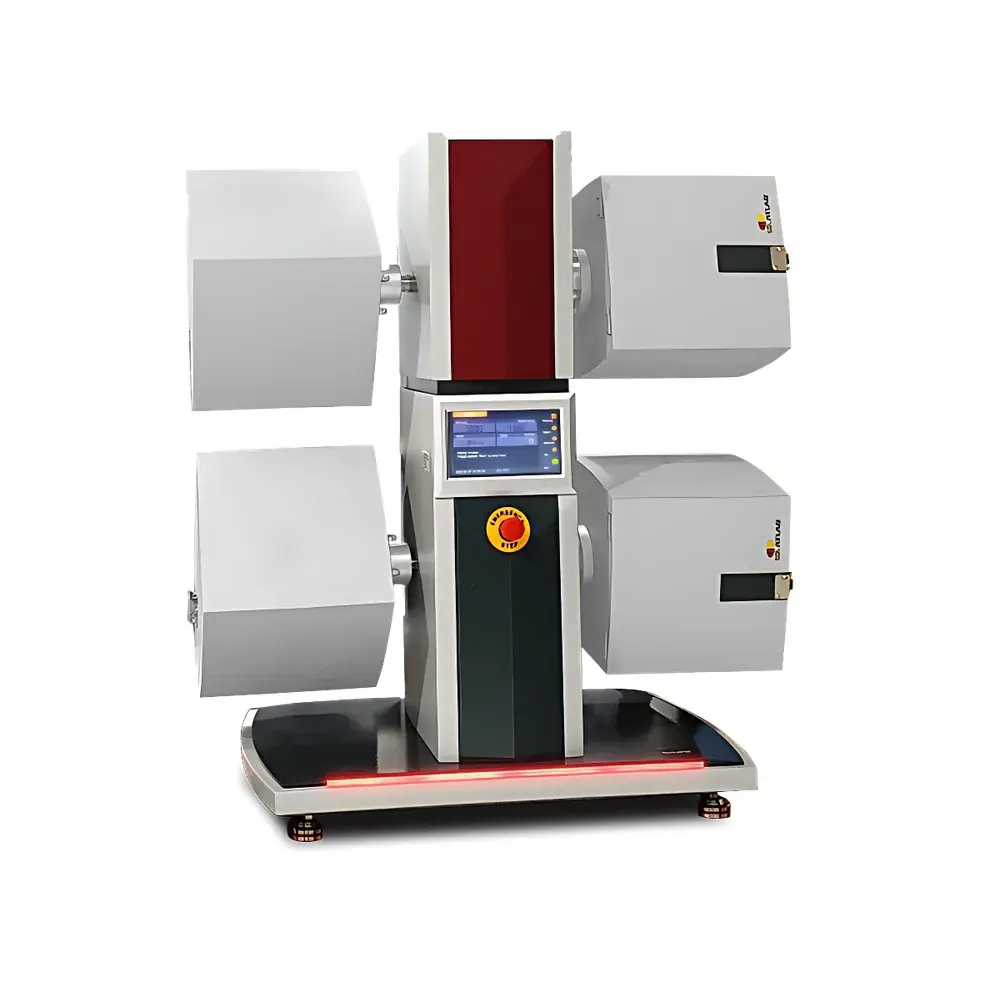
RotaPill M227A/B Pilling and Snagging Tester by SDL Atlas
| Brand | SDL Atlas |
|---|---|
| Origin | Shenzhen, China |
| Manufacturer Type | Direct Manufacturer |
| Country of Origin | China |
| Model | M227A/B |
| Price Range | USD 14,000 – 42,000 (FOB) |
| Test Configurations | Dual-capacity drum (2-position or 4-position) |
| Control Interface | Full-color capacitive touchscreen |
| Preloaded Standards | ISO 12945-1/-2, BS EN ISO 12945, BS 5811, M&S Test Method A13/A14, GB/T 4802.1–4802.3, NEXT Standard 21, adidas TM001 |
| Language Support | English, Chinese, Spanish, Turkish |
| Snagging Pin Mounting | Integrated magnetic pin holder on snagging box |
| Liner Replacement | Magnetic cork liner — tool-free exchange |
| Remote Monitoring | Compatible with RemoteAccess™ mobile app (iOS/Android) for real-time test status, run history, and instrument diagnostics |
Overview
The RotaPill M227A/B Pilling and Snagging Tester is an engineered textile durability assessment platform designed for reproducible, standards-compliant evaluation of fabric surface degradation under controlled mechanical stress. Operating on the principle of rotational abrasion and directional snagging action, the instrument simulates real-world wear mechanisms—namely fiber migration, entanglement, and surface pilling—as well as localized yarn displacement caused by hook-like contact (snagging). Its dual-configurable drum architecture supports both standardized pilling protocols (e.g., Martindale-style tumbling in enclosed chambers) and regulated snagging procedures (e.g., rotating drum with fixed snagging pins), enabling laboratories to execute parallel or sequential tests per multiple international specifications without hardware reconfiguration. The system is purpose-built for textile quality control labs, third-party testing facilities, and brand compliance centers requiring audit-ready traceability and method flexibility.
Key Features
- Dual-capacity test drum options: Selectable 2-position or 4-position configurations to optimize throughput while maintaining inter-test consistency.
- Modular drive base compatible with ICI-type pilling drums, octagonal snagging cylinders, and M&S-specific test fixtures—enabling cross-standard validation within a single footprint.
- Full-color capacitive touchscreen controller with intuitive icon-driven navigation and embedded firmware logic for automatic parameter enforcement per selected standard.
- Preloaded test programs for ISO 12945-1 (pilling resistance), ISO 12945-2 (snagging resistance), BS 5811, GB/T 4802 series, M&S A13/A14, NEXT 21, and adidas TM001—each enforcing correct rotation speed, cycle count, load mass, and drum geometry.
- Real-time countdown timer with audible alert and on-screen notification ensures operator awareness at test termination without manual supervision.
- Magnetic cork liner system allows rapid, tool-free replacement of chamber linings—minimizing downtime and eliminating calibration drift associated with mechanical fasteners or adhesive-based substrates.
- Integrated snagging pin mounting interface eliminates need for auxiliary test boxes; pins are secured directly onto the snagging drum housing via precision-machined magnetic retention points.
Sample Compatibility & Compliance
The RotaPill M227A/B accommodates flat fabric specimens (typically 100 mm × 100 mm or 125 mm × 125 mm depending on standard), knits, wovens, nonwovens, and coated textiles. Specimen clamping uses standardized spring-loaded frames conforming to ISO and ASTM dimensional tolerances. All preloaded methods enforce specimen conditioning per ISO 139 (standard atmosphere: 20 ± 2°C, 65 ± 4% RH) and include mandatory pre-test stabilization steps. The instrument meets mechanical and functional requirements outlined in ISO/IEC 17025:2017 for test equipment used in accredited laboratories. It supports GLP-compliant operation through user-accessible audit logs, electronic signature prompts, and timestamped test records exportable in CSV or PDF format.
Software & Data Management
Firmware includes built-in data logging with automatic timestamping, operator ID capture, and test parameter verification prior to initiation. Results—including cycle count, elapsed time, drum RPM deviation (< ±1%), and pass/fail status per visual grading scale (e.g., ISO 105-X12 or M&S 5-point scale)—are stored locally and exportable via USB or network interface. RemoteAccess™ integration provides secure TLS-encrypted connectivity for remote monitoring: users can view live RPM, remaining cycles, thermal status, and error flags from iOS or Android devices. The application maintains a synchronized history log compliant with FDA 21 CFR Part 11 requirements when paired with enterprise identity management systems.
Applications
- Pre-production validation of knitwear, sportswear, and outerwear fabrics for pilling resistance under repeated laundering and wear simulation.
- Supplier qualification testing against retailer-specific protocols (e.g., M&S A14, NEXT 21, adidas TM001).
- Comparative analysis of anti-pilling finishes (e.g., enzymatic bio-polishing, plasma treatment, silicone softeners) using matched control/reference samples.
- Root-cause investigation of snagging failure modes in technical textiles, including automotive upholstery and medical gowns.
- Supporting ISO 9001 internal audits and customer-facing compliance documentation packages for global supply chain transparency.
FAQ
What standards does the RotaPill M227A/B natively support?
ISO 12945-1/-2, BS EN ISO 12945, BS 5811, GB/T 4802.1–4802.3, M&S Test Methods A13 and A14, NEXT Standard 21, and adidas TM001.
Can the same instrument perform both pilling and snagging tests simultaneously?
Yes—the modular drive base allows concurrent operation of a 2-position pilling drum and a separate snagging cylinder, provided physical space and electrical load permit.
Is calibration traceable to national metrology institutes?
Rotation speed and cycle counters are factory-calibrated against NIST-traceable reference tachometers; annual verification kits and certified calibration services are available through SDL Atlas regional service centers.
Does the system support automated reporting for ISO/IEC 17025 accreditation?
Yes—test reports include instrument ID, operator ID, environmental conditions, raw data tables, pass/fail determinations, and digital signatures, all exportable in audit-ready formats.
How is software updated and validated after firmware changes?
Updates are delivered via signed firmware packages; version history, change logs, and IQ/OQ documentation are provided to support GxP-regulated environments.





