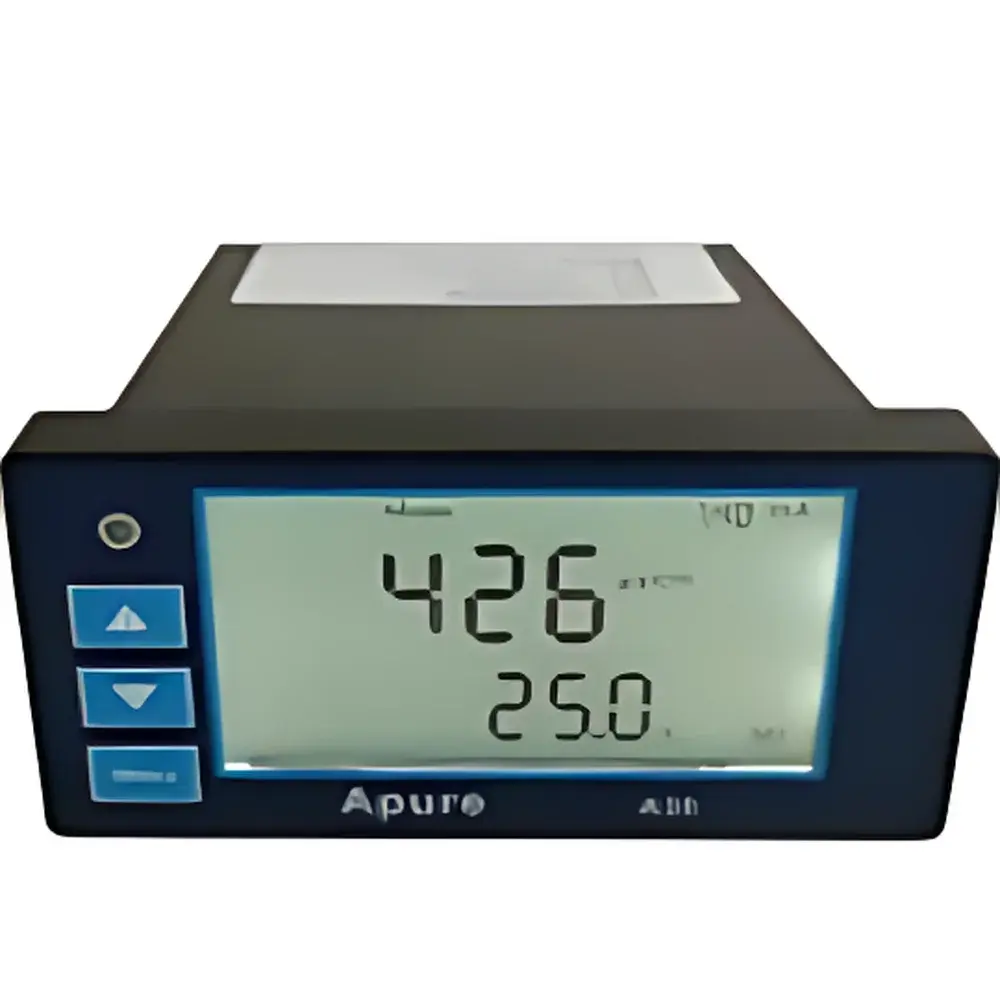
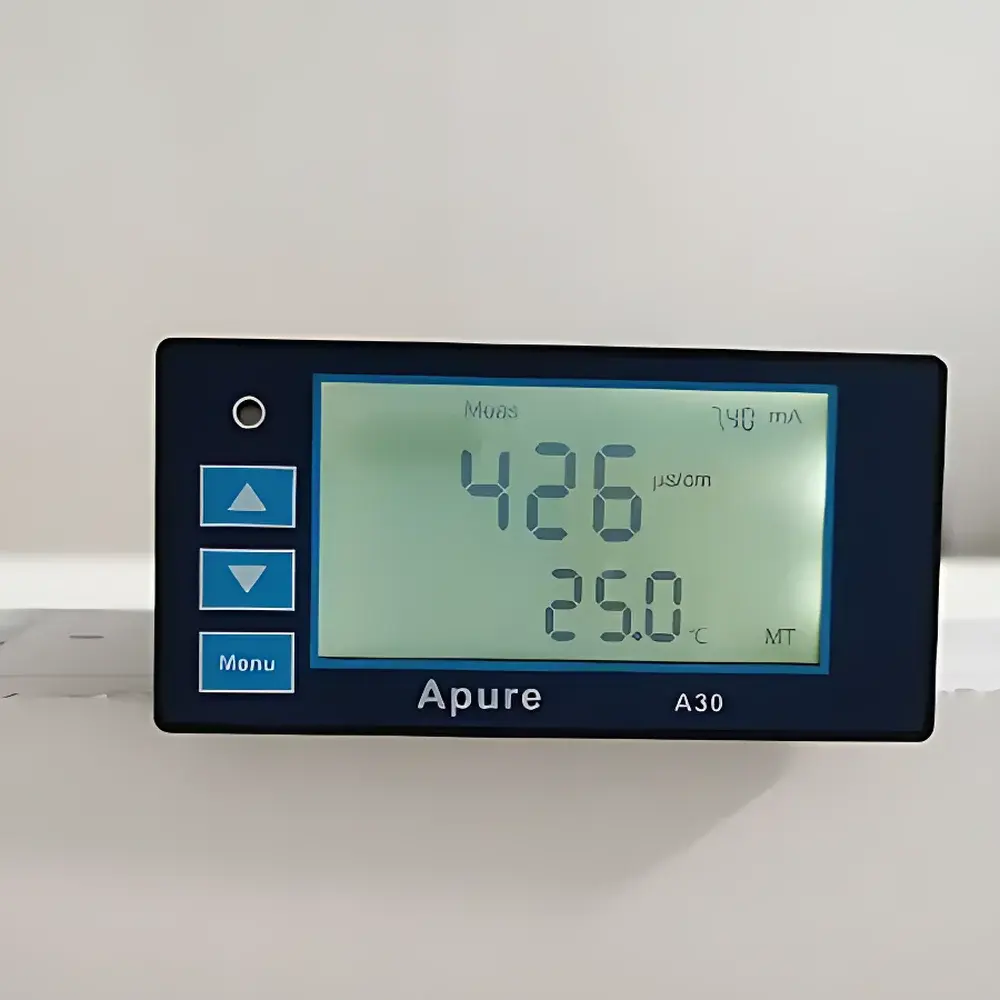
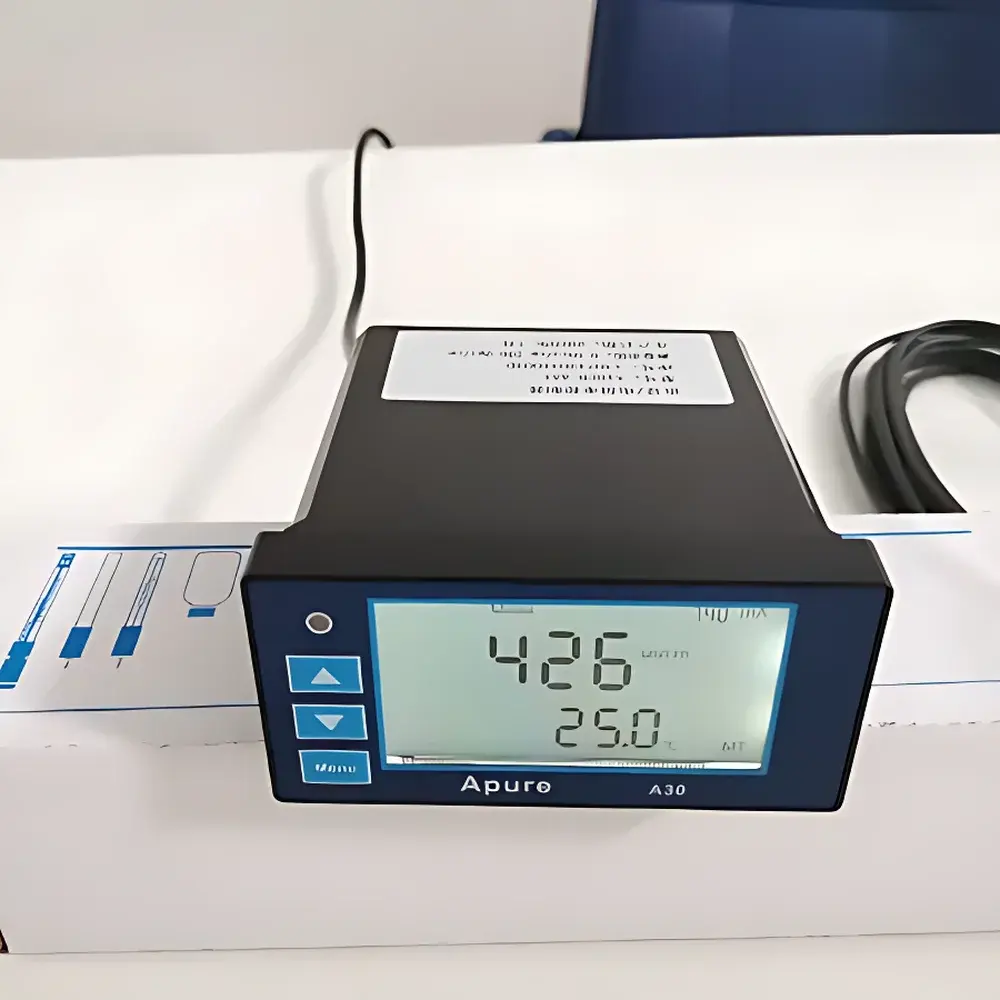
APURE A30CD-AA1 Online Conductivity and Resistivity Controller
| Brand | APURE |
|---|---|
| Origin | Shanghai, China |
| Manufacturer Type | Direct Manufacturer |
| Model | A30CD-AA1 |
| Conductivity Range | 0.05 µS/cm – 200 mS/cm |
| Resistivity Range | 0.00 – 20.00 MΩ·cm |
| Temperature Range | 0–100 °C |
| Basic Accuracy | ±0.01 µS/cm |
| Resolution | 0.01 µS/cm |
| Dimensions (H×W×D) | 48 × 96 × 110 mm |
| Mounting Cutout | 42 × 90 mm |
| Output | Isolated 4–20 mA (configurable for conductivity, resistivity, or temperature) |
| Relay Output | 1 × SPDT, 3 A / 250 V AC, programmable high/low alarm with adjustable hysteresis |
| Power Supply | AC 220 V ±10% or DC 24 V ±10% |
| Power Consumption | ≤15 W |
| Operating Environment | 0–60 °C, ≤85% RH (non-condensing) |
Overview
The APURE A30CD-AA1 Online Conductivity and Resistivity Controller is an industrial-grade process analyzer engineered for continuous, real-time monitoring of aqueous solution conductivity and resistivity in demanding production and treatment environments. Based on two-electrode or four-electrode conductivity measurement principles—compatible with standard industrial sensors—the controller delivers stable, traceable readings across a wide dynamic range (0.05 µS/cm to 200 mS/cm) and corresponding resistivity (0.00–20.00 MΩ·cm). Its dual-parameter capability—simultaneous conductivity/resistivity and temperature acquisition—enables precise temperature-compensated calculations per ASTM D1125 and ISO 7888 standards. Designed for panel-mount installation in control cabinets or field enclosures, the A30CD-AA1 operates reliably under variable ambient conditions (0–60 °C, ≤85% RH), supporting uninterrupted operation in municipal water treatment, chemical dosing systems, boiler feedwater monitoring, and semiconductor rinse-loop applications.
Key Features
- Triple-mode temperature compensation: Automatic compensation using PT1000 or NTC10K sensors, plus manual offset adjustment for legacy or non-standard sensor configurations
- Isolated 4–20 mA analog output with full channel independence—configurable to transmit conductivity, resistivity, or temperature values; maximum load capacity: 500 Ω
- Programmable relay output (SPDT, 3 A / 250 V AC) with user-defined setpoints and adjustable hysteresis to prevent chattering during threshold transitions
- Custom segment LCD display with high-contrast, backlit characters optimized for readability under low-light or glare-prone industrial lighting
- Dual power input flexibility: Accepts either AC 220 V ±10% (50/60 Hz) or DC 24 V ±10%, enabling integration into both utility-powered and PLC-controlled plant infrastructures
- Compact DIN-rail compatible housing (48 × 96 × 110 mm) with standardized 42 × 90 mm cutout for rapid field retrofitting without structural modification
Sample Compatibility & Compliance
The A30CD-AA1 interfaces with industry-standard conductivity cells—including stainless steel, graphite, titanium, and platinum electrodes—supporting both inline flow-through and immersion-style sensor configurations. It complies with electromagnetic compatibility requirements per IEC 61326-1 (industrial environment), and its electrical safety design conforms to IEC 61010-1. While not certified for hazardous areas (e.g., ATEX or IECEx), the unit meets IP20 ingress protection specifications suitable for indoor control panels. Its measurement methodology aligns with reference methods defined in USP , ASTM D5391, and ISO 7888 for purified water and process stream validation. Data integrity is maintained through hardware-level isolation between signal input, output, and power circuits—minimizing ground loop interference in electrically noisy facilities.
Software & Data Management
As a dedicated hardware controller, the A30CD-AA1 does not incorporate embedded firmware-based data logging or network connectivity (e.g., Modbus TCP, Ethernet/IP). However, its isolated 4–20 mA output is fully compatible with distributed control systems (DCS), SCADA platforms, and PLC analog input modules for centralized trending and alarm aggregation. The device supports manual calibration verification via front-panel navigation, with all configuration parameters—including sensor constant, temperature coefficient (α), and alarm thresholds—stored in non-volatile memory. Audit trails are maintained through physical logbooks or external historian systems; while the unit itself does not implement FDA 21 CFR Part 11 electronic signature or audit trail functionality, its analog output architecture ensures seamless integration into validated GMP/GLP environments when paired with compliant upstream data acquisition infrastructure.
Applications
- Municipal wastewater treatment: Monitoring influent/effluent conductivity for salinity estimation and membrane fouling early detection
- Industrial cooling tower management: Tracking cycles of concentration and detecting chloride ingress or chemical imbalance
- Pharmaceutical purified water (PW) and water-for-injection (WFI) distribution loops: Continuous verification against USP conductivity limits at point-of-use
- Chemical manufacturing: Process endpoint detection in neutralization, dilution, or desalination steps
- Power plant boiler feedwater systems: Detection of condenser tube leakage via sudden resistivity drop
- Food & beverage CIP (clean-in-place) rinse monitoring: Confirming detergent removal by verifying return rinse water conductivity returns to baseline
FAQ
What temperature sensors are supported for automatic compensation?
The A30CD-AA1 accepts PT1000 (IEC 60751 Class B) and NTC10K (3950 K coefficient) sensors. Manual temperature offset entry is also available for systems where direct sensor integration is impractical.
Can the 4–20 mA output be assigned to both conductivity and temperature simultaneously?
No—only one parameter (conductivity, resistivity, or temperature) may be assigned to the analog output at a time. Dual-output functionality requires external signal splitters or multi-channel controllers.
Is the relay output suitable for direct pump or valve actuation?
Yes, provided the connected load remains within the rated 3 A / 250 V AC limit and inductive loads are protected with appropriate flyback diodes or RC snubbers.
Does the unit support two-point calibration out of the box?
Yes—calibration routines include zero-point (e.g., deionized water) and span-point (e.g., 1413 µS/cm KCl standard) verification, with user-adjustable cell constant correction.
What is the maximum cable length between the controller and conductivity sensor?
For shielded twisted-pair cable, lengths up to 30 meters are recommended. Beyond this, signal degradation may occur unless active signal conditioning or 4–20 mA transmitter-equipped sensors are used.
Related Products