
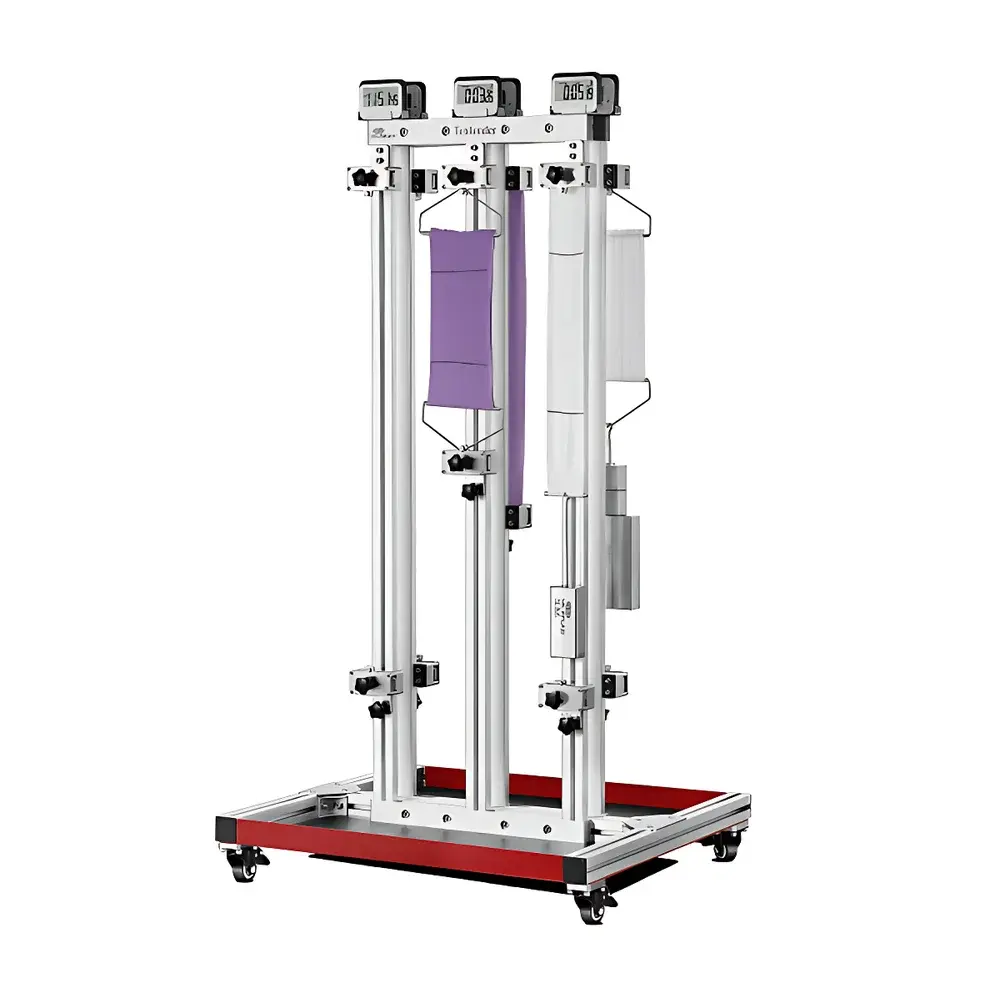
SDL Atlas Textender Static Fabric Stretch Tester M032
| Brand | SDL Atlas |
|---|---|
| Origin | Shenzhen, China |
| Manufacturer Type | Direct Manufacturer |
| Regional Classification | Domestic (China) |
| Model | M032 |
| Pricing | Upon Request |
Overview
The SDL Atlas Textender Static Fabric Stretch Tester M032 is an engineered solution for quantitative evaluation of static tensile deformation, elastic recovery, and permanent set behavior in knitted and woven textiles—particularly those incorporating elastomeric yarns (e.g., spandex, elastane, or polyurethane blends). Operating on the principle of controlled dead-weight loading under standardized dwell time conditions, the instrument applies calibrated mechanical force to fabric specimens while precisely measuring elongation and dimensional recovery. Unlike dynamic or servo-controlled tensile testers, the Textender M032 implements a true static methodology: load is applied via gravity-driven weights, held for user-defined durations (typically 30 s to 5 min per ASTM protocols), and displacement is recorded before and after relaxation periods. This approach directly correlates with real-world garment performance—especially critical for activewear, athleisure, compression apparel, and technical outerwear where stretch responsiveness, shape retention, and long-term resilience define functional integrity.
Key Features
- Single-instrument compliance with both ASTM D2594 (Stretch and Recovery of Knit Fabrics) and ASTM D3107 (Elasticity of Woven Fabrics Containing Elastomeric Fibers), eliminating the need for dual-tester setups previously mandated by legacy workflows.
- Dual independent test stations, each equipped with a dedicated digital timer featuring three operational modes: precision stopwatch, programmable alarm clock, and timed hold-to-alarm activation—enabling unattended testing with audible completion notification.
- Modular weight system supporting interchangeable stainless-steel masses: optional 1 lb, 3 lb, and 8 lb weights allow precise load configuration across ASTM-specified ranges (e.g., 0.5–8.0 lbf per specimen width), accommodating varied fabric basis weights and elasticity profiles.
- Removable timers permit operator mobility during extended relaxation phases; test station ergonomics support seated or standing operation without compromising repeatability.
- Integrated calibration reference scale (optional) ensures consistent specimen dimensioning pre- and post-test, minimizing measurement uncertainty introduced by manual ruler placement.
- Robust aluminum frame with corrosion-resistant surface treatment, designed for high-cycle laboratory use in QC environments adhering to ISO/IEC 17025 requirements.
Sample Compatibility & Compliance
The Textender M032 accommodates standard specimen dimensions per ASTM D2594 (50 mm × 150 mm) and ASTM D3107 (25 mm × 150 mm), with adjustable clamping jaws suitable for fabrics ranging from lightweight mesh (≥30 g/m²) to heavy-duty stretch denim (≤400 g/m²). It supports both warp- and weft-oriented testing, as well as bias-cut evaluation when required by internal specifications. Instrument validation documentation includes traceable NIST-calibrated weight certificates and mechanical alignment verification reports. The system meets essential elements of GLP-compliant textile testing workflows and supports audit-ready recordkeeping when paired with laboratory information management systems (LIMS).
Software & Data Management
While the Textender M032 operates as a standalone mechanical instrument, its modular design enables seamless integration into digitally governed quality systems. All timing events—including load application onset, dwell duration, and relaxation interval—are logged via the embedded timer’s non-volatile memory (retains settings through power cycles). Timer data export (via USB or RS-232 interface on optional firmware upgrade) supports synchronization with external LIMS or Excel-based reporting templates. For regulated environments, the device satisfies foundational requirements of FDA 21 CFR Part 11 when used with validated electronic records—specifically, operator identification, timestamped event logging, and immutable audit trails for test initiation, parameter setting, and result capture.
Applications
- Quantitative assessment of stretch recovery ratio (%) and residual elongation (%) in sportswear fabrics subjected to repeated mechanical stress.
- Pre-production validation of elastane content efficacy in blended knits (e.g., nylon/spandex, polyester/elastane).
- Quality conformance testing against retailer-specific stretch performance thresholds (e.g., Nike AWM, Adidas FABRIC-STD-001, Lululemon Technical Fabric Specification).
- Comparative analysis of aging effects on elastic recovery after laundering, dry cleaning, or UV exposure per AATCC TM135 and ISO 6330.
- Supporting R&D efforts in developing next-generation biostretch fibers and thermoplastic elastomer-integrated weaves.
FAQ
Does the Textender M032 require external power for basic operation?
No—the core stretching mechanism is gravity-driven and fully mechanical; only the digital timers require AA batteries or optional AC adapter.
Can the instrument be used for non-textile materials such as elastic bands or medical tapes?
It is optimized for planar fabric substrates per ASTM textile standards; non-fabric specimens may yield non-compliant results due to clamping geometry and gauge length constraints.
Is calibration certification included with shipment?
Yes—each unit ships with a factory calibration report referencing NIST-traceable mass standards and mechanical alignment verification.
What maintenance is recommended for long-term accuracy?
Biannual verification of weight mass tolerance (±0.1%) and jaw parallelism using certified feeler gauges; no lubrication or sensor recalibration is required under normal usage.
How does the Textender M032 support ISO/IEC 17025 accreditation?
Through documented measurement uncertainty budgets, traceable calibration artifacts, defined operator training protocols, and built-in procedural controls for test sequence adherence and environmental monitoring linkage.





