
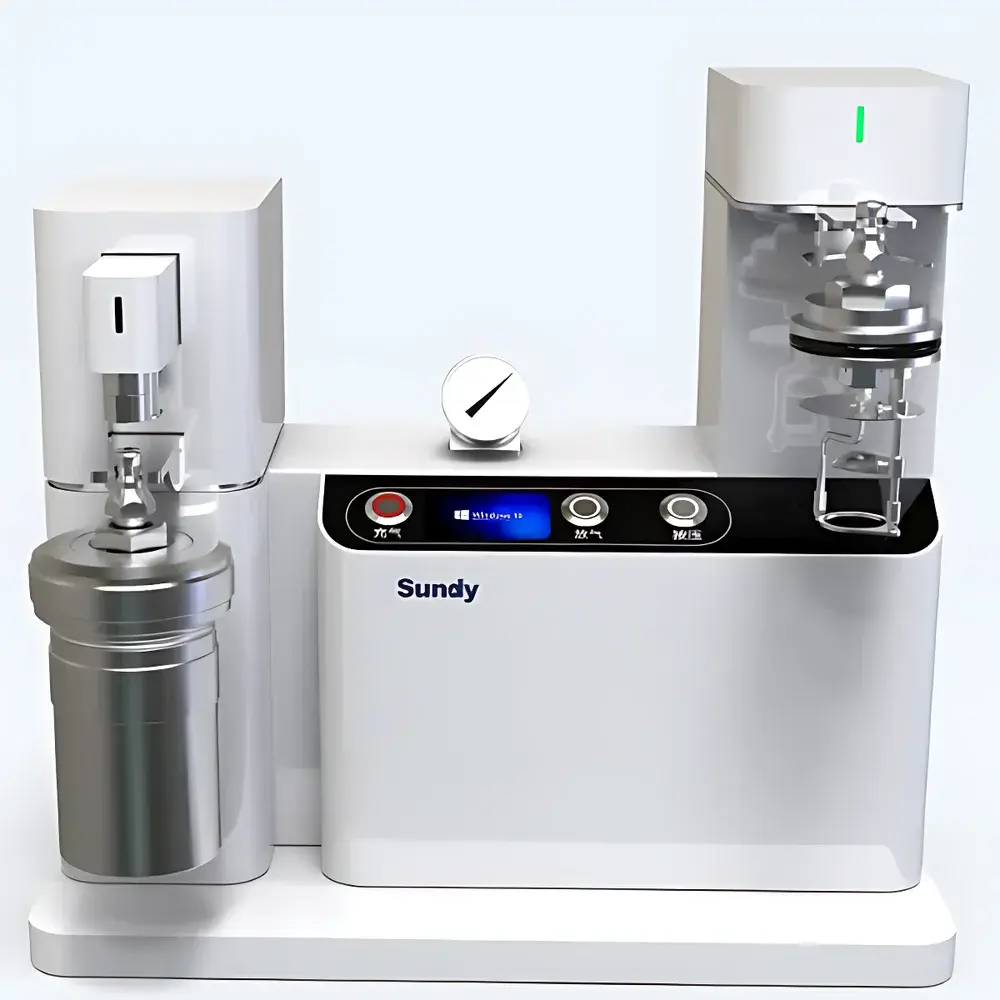
Sundys SDACY16 Fully Automatic Oxygen Charging and Discharging Unit for Coal Calorimetry
| Brand | Sundy |
|---|---|
| Origin | Hunan, China |
| Manufacturer Type | Authorized Distributor |
| Country of Origin | China |
| Model | SDACY16 Fully Automatic Oxygen Charging and Discharging Unit |
| Quotation | Available Upon Request |
| Dimensions (L×W×H) | 420 mm × 245 mm × 390 mm |
| Net Weight | ~20 kg |
| Oxygen Purity Requirement | ≥99.5% (cylinder-sourced, electrolytic oxygen strictly prohibited) |
| Regulated Oxygen Pressure | 2.8–3.0 MPa (via dedicated pressure regulator) |
| Configurable Parameters | Oxygen charging pressure & duration, venting duration, over/under-pressure alarm thresholds |
| Max Power Consumption | 0.02 kW |
| Electrical Supply | AC 220 V ±10%, 50 Hz ±1 Hz |
Overview
The Sundys SDACY16 Fully Automatic Oxygen Charging and Discharging Unit is an engineered subsystem designed exclusively for integration with isoperibol or adiabatic coal calorimeters used in compliance with ASTM D5865, ISO 1928, and GB/T 213 standards. It executes precise, repeatable oxygen pressurization and controlled venting of bomb calorimeter vessels—critical pre- and post-combustion steps in gross calorific value (GCV) determination of solid fuels. Unlike manual or semi-automated alternatives, the SDACY16 eliminates operator-dependent variability in oxygen handling by automating pressure regulation, leak verification, ignition circuit continuity checking, and real-time status feedback. Its architecture adheres to fundamental safety principles for high-pressure oxygen systems: double-stage pressure reduction, non-lubricated stainless-steel internal pathways, and fail-safe interlocks preventing operation outside validated pressure bands.
Key Features
- Fully automated oxygen charging and venting sequence with programmable pressure setpoints (2.8–3.0 MPa) and dwell times, ensuring consistent bomb pressurization across batches.
- Integrated oxygen bomb recognition via mechanical keying and electrical handshake protocol—compatible with all standard ASTM/ISO-compliant bomb designs including Parr 1108, IKA C 2000, and domestic equivalents (e.g., SDACM series).
- Real-time pneumatic integrity verification: performs automatic pressure-hold testing (typically 60–90 s at target pressure) and triggers audible/visual alarms if leakage exceeds 0.1 MPa/min decay—meeting ISO 1928 Annex B requirements for bomb seal validation.
- Ignition circuit continuity detection prior to pressurization, confirming proper installation of Ni-Cr or Fe-Cr ignition wires and eliminating false-negative ignition failures.
- On-device LCD interface displaying live pressure curves, step-by-step process progression, and diagnostic codes for rapid troubleshooting—no external PC required for basic operation.
- Embedded safety logic prevents initiation if oxygen purity falls below 99.5%, if supply pressure deviates beyond ±0.1 MPa of setpoint, or if ambient temperature exceeds 40°C—mitigating risks associated with oxygen-enriched combustion environments.
Sample Compatibility & Compliance
The SDACY16 interfaces seamlessly with standardized oxygen bombs rated for ≥3.5 MPa working pressure and equipped with ISO-standard M27×2 or 1/2″-14 NPT inlet ports. It supports both constant-volume (bomb) and constant-pressure (flow-through) calibration configurations when paired with certified benzoic acid reference materials. All operational parameters—including pressure ramp rate, hold duration, and venting profile—are configurable to align with laboratory-specific SOPs and regulatory audit trails. The unit complies with general electrical safety requirements per IEC 61010-1 and incorporates oxygen service-rated components conforming to CGA G-4.1 guidelines. While not a standalone measuring instrument, its performance directly impacts measurement uncertainty in calorimetric GCV results—making it subject to GLP documentation protocols under ISO/IEC 17025-accredited coal testing laboratories.
Software & Data Management
The SDACY16 operates autonomously via embedded firmware without mandatory software dependency. However, optional RS-232 or USB-C serial output enables bidirectional communication with calorimeter control software (e.g., Sundys SDACM Suite, Parr 6400 Control Center). Logged events—including timestamped pressure profiles, pass/fail leak test outcomes, ignition wire resistance values, and alarm history—are exportable as CSV files for inclusion in electronic lab notebooks (ELN) or LIMS integration. Audit trail functionality satisfies FDA 21 CFR Part 11 requirements when deployed within validated workflows, provided user access controls and electronic signature mechanisms are implemented at the host system level.
Applications
- Routine gross calorific value (GCV) testing of bituminous, anthracite, lignite, and coke samples per ASTM D5865 and GB/T 213.
- Quality assurance in coal trading, power plant fuel acceptance, and cement industry raw material specification.
- Research applications involving alternative solid fuels (e.g., biomass pellets, refuse-derived fuel) where reproducible oxygen dosing is critical to combustion stoichiometry.
- Calibration verification of calorimeter systems using certified reference materials requiring strict adherence to oxygen pressurization protocols.
- Supporting ISO/IEC 17025 accreditation audits through documented traceability of oxygen handling parameters and system integrity checks.
FAQ
Why is electrolytic oxygen prohibited for use with the SDACY16?
Electrolytic oxygen may contain trace hydrogen or moisture that compromises bomb seal integrity and introduces uncontrolled combustion variables—violating ASTM D5865 Section 7.2 and ISO 1928 Clause 6.3.
Can the SDACY16 be used with non-Sundys calorimeters?
Yes—it is mechanically and electrically agnostic to calorimeter brand, provided the oxygen bomb conforms to ISO 3453 or ASTM D2013 dimensional and port specifications.
Does the unit store historical pressure data internally?
No; internal memory retains only the most recent 10 operational cycles. Full data persistence requires connection to external logging software or LIMS.
What maintenance intervals are recommended?
O-ring replacement every 6 months or 500 cycles, pressure regulator calibration annually, and full functional verification before each accreditation audit.
Is CE or UKCA marking applicable?
The SDACY16 is supplied as a component for industrial instrumentation—not a standalone CE-marked device—but meets essential safety requirements referenced in the Machinery Directive 2006/42/EC when installed per manufacturer instructions.





