
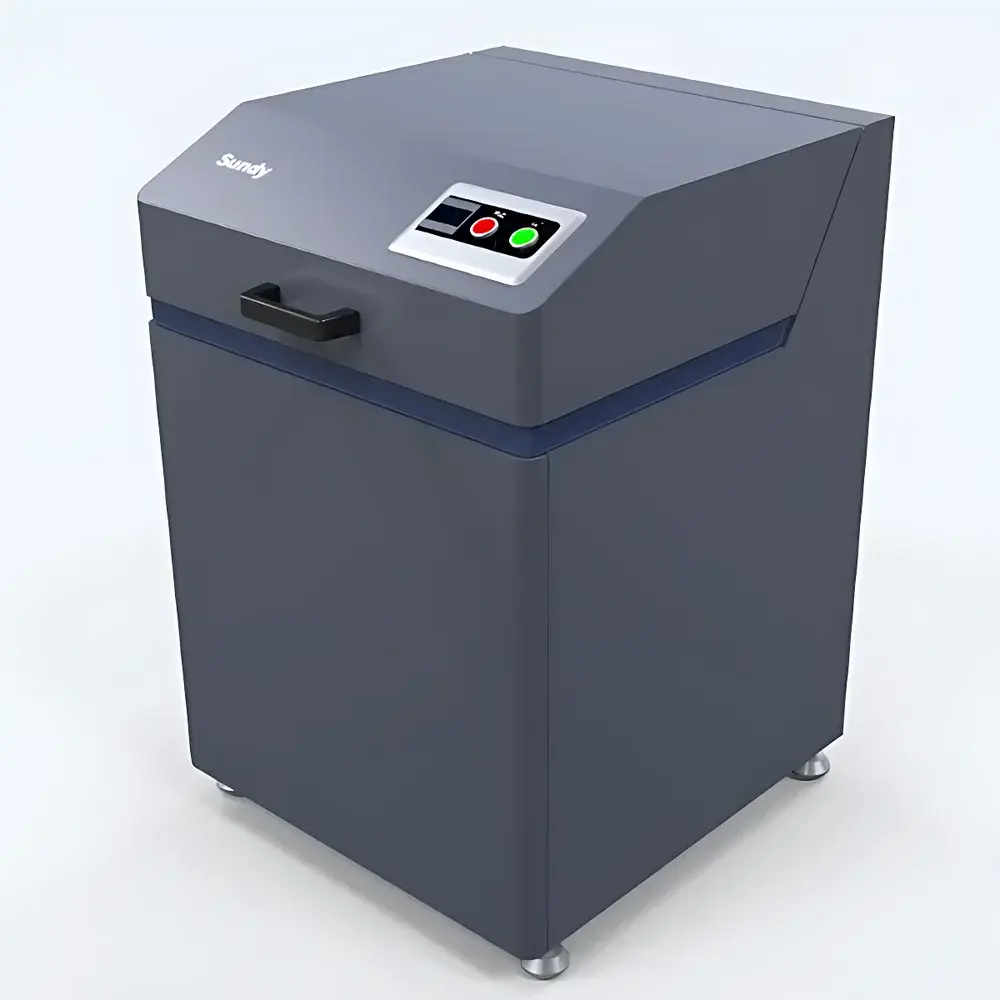
Sundy SDPP Series Laboratory Planetary Pulverizer
| Brand | Sundy |
|---|---|
| Origin | Hunan, China |
| Model | SDPP |
| Instrument Type | Planetary Pulverizer |
| Sample Applicability | Hard and Brittle Materials |
| Feed Size | ≤13 mm |
| Final Particle Size | ≤0.2 mm (adjustable down to 0.01 mm) |
| Batch Capacity | 100 g per grinding bowl |
| Number of Grinding Bowls | 1–3 (model-dependent) |
| Bowl Material | Standard Tungsten Carbide-Coated Alloy Steel (optional full tungsten carbide bowls available) |
| Power Supply | AC 380 V ±10%, 50 Hz ±1 Hz |
| Max Power Consumption | 1.5 kW |
| Noise Level | <72 dB(A) |
| Safety Features | Lid-Interlocked Automatic Power Cut-off, Gas Spring-Assisted Hinged Cover |
| Compliance | GB/T 474–2008 “Methods for Preparation of Coal Samples” |
Overview
The Sundy SDPP Series is a high-efficiency planetary pulverizer engineered for precise, reproducible sample size reduction in analytical laboratories serving power generation, coal quality control, metallurgy, chemical processing, and mineral research. It operates on the principle of planetary ball milling—where grinding bowls rotate eccentrically while simultaneously revolving around a central axis—generating high-energy impact and shear forces that fracture hard, brittle materials into fine, homogeneous powders. Designed specifically to meet the stringent particle-size distribution requirements of standardized coal analysis protocols, the SDPP delivers consistent sub-200 µm output with >95% sieve pass rate under GB/T 474–2008, enabling reliable proximate, ultimate, and calorific value determinations. Its robust mechanical architecture eliminates the need for floor anchoring, making it suitable for integration into ISO/IEC 17025-accredited testing environments where spatial flexibility and operational stability are critical.
Key Features
- Planetary motion mechanism ensures uniform energy transfer across the entire grinding volume, minimizing thermal degradation and contamination risk during short-duration milling cycles.
- Gas-spring-assisted large hinged cover enables rapid, ergonomic access to grinding bowls without manual lifting—reducing operator fatigue and improving workflow continuity.
- Modular bowl configuration supports 1-, 2-, or 3-bowl variants (SDPP1001/1002/1003), allowing parallel processing of multiple samples or sequential batch preparation under identical mechanical conditions.
- Interlocked safety system automatically de-energizes the motor upon lid opening, complying with IEC 61000-6-2 electromagnetic compatibility and IEC 60204-1 machinery safety directives.
- Separate eccentric drive assembly decouples rotational stress from the main motor shaft, extending service life and maintaining angular precision over extended duty cycles.
- Standard alloy steel grinding bowls feature wear-resistant surface treatment; optional full tungsten carbide bowls are available for ultra-high-hardness materials (e.g., silicon carbide, bauxite, ferroalloys).
- Dust extraction port (Φ60 mm) conforms to ISO 9001-compliant laboratory ventilation standards and integrates seamlessly with centralized fume hood or cyclonic dust collection systems.
Sample Compatibility & Compliance
The SDPP series accommodates a broad spectrum of inorganic and organic solids including bituminous and anthracite coal, limestone, quartzite, slag, biomass pellets, lithium electrolyte precursors, and ceramic raw materials. All models are validated against GB/T 474–2008 for coal sample preparation and support traceability in GLP and GMP-regulated workflows through documented parameter settings and maintenance logs. While not certified to ASTM D3174 or ISO 19579, its performance envelope aligns with the particle size and homogeneity criteria specified in those standards for ash and volatile matter determination. Equipment documentation includes calibration certificates for rotational speed verification and mechanical tolerance reports per ISO 2768–1.
Software & Data Management
The SDPP operates as a standalone electromechanical system with no embedded microcontroller or digital interface. All operational parameters—including run time, rotational speed (fixed at optimal 250 rpm for planetary motion), and bowl count—are set manually via front-panel controls. For laboratories requiring audit-ready records, optional external data loggers (e.g., Omega OM-DAQPRO-5300) may be connected to the motor’s auxiliary voltage tap to capture runtime, cycle count, and power-on events. This analog-integration approach ensures long-term firmware obsolescence resistance and simplifies 21 CFR Part 11 compliance when paired with validated LIMS platforms that timestamp and digitally sign operator entries.
Applications
- Coal quality assurance labs performing ASTM D3172-compliant proximate analysis (moisture, ash, volatile matter, fixed carbon).
- Metallurgical R&D facilities preparing homogenized feedstock for XRF fusion bead preparation or ICP-OES digestion.
- Biomass energy research centers generating representative sub-100 µm fractions for higher heating value (HHV) modeling.
- Mineral processing labs conducting liberation analysis via SEM-EDS or automated mineralogy (QEMSCAN®/MLA).
- Electrochemical materials development labs milling cathode/anode precursors where oxygen stoichiometry preservation is critical.
FAQ
What is the maximum allowable feed particle size?
The SDPP accepts feed material up to 13 mm in largest dimension; oversized particles must be pre-crushed using jaw or roll crushers to avoid bowl overload or uneven wear.
Can the SDPP achieve particle sizes below 10 µm?
No—its design target is 20–200 µm (0.02–0.2 mm). Sub-10 µm grinding requires planetary ball mills with extended dwell time, cryogenic cooling, or wet-milling configurations not supported by this dry pulverizer.
Is the equipment suitable for hazardous or explosive samples?
It is not intrinsically safe; operation with combustible dusts (e.g., coal, aluminum powder) requires integration into a Class II Division 1 explosion-proof enclosure and grounding per NFPA 70E.
Does the SDPP include calibration documentation?
Yes—each unit ships with a factory-verified rotational speed certificate, dimensional inspection report, and mechanical clearance validation per ISO 2768–1 medium tolerance class.
What maintenance intervals are recommended?
Lubrication of eccentric bearings every 500 operating hours; visual inspection of bowl sealing gaskets and gas spring integrity before each shift; annual torque verification of drive coupling bolts.



