
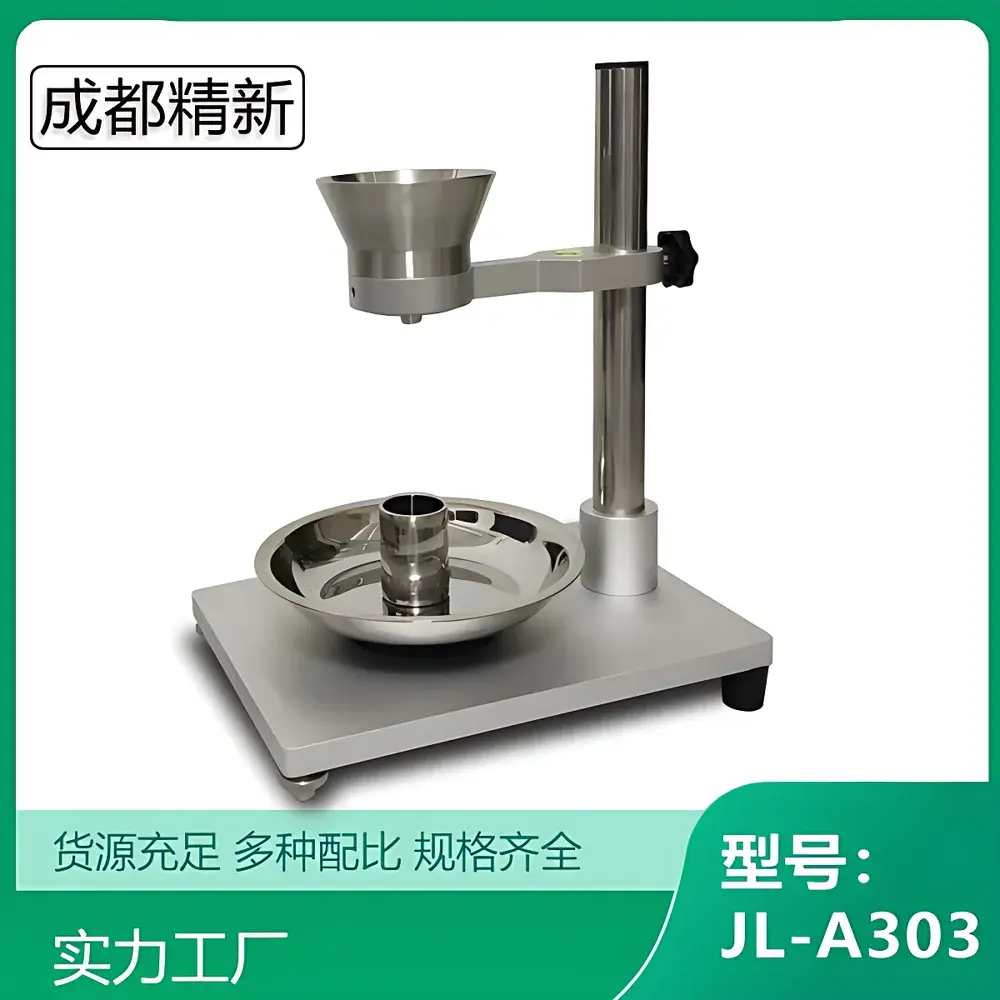
JL-A303 Powder Flowability and Apparent Density Tester
| Brand | Chengdu Jingxin (CDJX) |
|---|---|
| Origin | Sichuan, China |
| Manufacturer | Yes |
| Instrument Type | Apparent Density & Flow Rate Tester |
| Design | Portable Benchtop Unit |
| Measurement Principle | Standard Funnel Method per GB/T 1482–2010 & GB/T 1479.1–2011 |
| Funnel Orifice Diameters | 2.5 mm and 5.0 mm |
| Funnel-to-Container Height | 25 mm ± 2 mm (adjustable) |
| Funnel Cone Angle | 60° |
| Stainless Steel Components | AISI 304 (funnel, scraper, stopper rod, 25 mL cylinder) |
| Cylinder Volume | 25 mL |
| Overall Dimensions | ~230 × 170 × 300 mm |
| Weight | 3.7 kg |
| Timer Resolution | 0.01 s |
| Required External Equipment | Analytical balance (max 1000 g, readability 0.02 g) |
Overview
The JL-A303 Powder Flowability and Apparent Density Tester is a precision-engineered benchtop instrument designed for the standardized determination of two critical bulk powder properties: flow rate (commonly termed “Hall Flow Rate”) and apparent (bulk) density. It operates strictly in accordance with internationally aligned Chinese national standards—GB/T 1482–2010 for flow rate measurement and GB/T 1479.1–2011 for apparent density—both of which are functionally equivalent to ISO 4490:2018 (metal powders – determination of flow rate using the Hall flowmeter) and ASTM B212–22 (standard test method for apparent density of free-flowing metal powders using the Hall flowmeter). The device employs gravity-driven funnel discharge under controlled geometric conditions: a calibrated stainless steel funnel with interchangeable orifices (2.5 mm and 5.0 mm), fixed vertical clearance (25 mm ± 2 mm) between the orifice and receiving cylinder, and a precisely defined cone angle (60°). This configuration ensures high reproducibility across laboratories and supports routine quality control in powder metallurgy, additive manufacturing feedstock qualification, battery cathode/anode material evaluation, and pharmaceutical excipient characterization.
Key Features
- Compliant dual-test platform: Simultaneously supports Hall flow rate (g/s) and apparent density (g/cm³) determinations per GB/T 1482–2010 and GB/T 1479.1–2011—enabling full compliance with ISO/ASTM-aligned protocols without instrument reconfiguration.
- High-stability mechanical architecture: All wetted components—including funnel, scraper blade, stopper rod, and 25 mL volumetric cylinder—are fabricated from AISI 304 stainless steel with electropolished interior surfaces to minimize particle adhesion and ensure rapid, residue-free cleaning between samples.
- Adjustable height fixture: Precision-machined support bracket allows fine-tuning and locking of the funnel-to-cylinder distance at exactly 25 mm ± 2 mm, directly satisfying standard positional tolerance requirements.
- Dual-orifice capability: Interchangeable 2.5 mm and 5.0 mm orifices accommodate both fine and coarse metal powders (e.g., Ti-6Al-4V, Inconel 718, AlSi10Mg, LiCoO₂), extending applicability across particle size distributions from 150 µm.
- Integrated metrology aids: Includes a 25 mm-wide straight-edge stainless steel scraper for consistent meniscus leveling and a 0.01 s resolution digital timer—critical for achieving the repeatability demanded by ISO 4490’s coefficient-of-variation limits (<3% for flow time).
Sample Compatibility & Compliance
The JL-A303 is validated for free-flowing, dry, non-cohesive metallic and ceramic powders capable of passing through a 2.5 mm orifice under gravity. It is routinely deployed in QC labs supporting ISO 9001, IATF 16949, and AS9100-certified supply chains for powder-based components. While not intrinsically GLP/GMP-compliant, its standardized geometry, traceable dimensional tolerances, and documented test procedures allow integration into FDA 21 CFR Part 11–enabled workflows when paired with compliant balance and timer systems and maintained with calibration records. It does not support cohesive, hygroscopic, or electrostatically charged powders without prior conditioning (e.g., drying, anti-static treatment), as such materials fall outside the scope of GB/T 1482 and require alternative methods (e.g., shear cell or dynamic powder analyzers).
Software & Data Management
The JL-A303 is a manual, hardware-only instrument with no embedded software or digital interface. Data acquisition and calculation are performed externally: flow time (s) and mass (g) are recorded manually; apparent density (g/cm³) and flow rate (g/s) are computed using the formulas specified in GB/T 1479.1–2011 and GB/T 1482–2010 respectively. Users are expected to maintain test logs in laboratory notebooks or LIMS-compatible spreadsheets. For audit readiness, we recommend documenting each test with operator ID, date/time, environmental conditions (temperature/humidity), balance calibration status, and raw timing/mass values—practices fully compatible with ISO/IEC 17025 accreditation requirements for testing laboratories.
Applications
- Powder metallurgy: Routine release testing of atomized iron, copper, and stainless steel powders prior to compaction.
- Additive manufacturing: Feedstock screening for laser powder bed fusion (LPBF) and binder jetting processes—correlating flow rate and bulk density with layer uniformity and part density.
- Battery materials: Characterization of cathode (e.g., NMC, LFP) and anode (e.g., graphite, silicon composites) powders for slurry formulation consistency.
- New energy materials: Evaluation of hydrogen storage alloys and solid-state electrolyte powders where packing behavior influences ionic conductivity.
- Academic research: Teaching and methodology development in granular physics, powder rheology, and process–structure–property relationships.
FAQ
What standards does the JL-A303 comply with?
It implements GB/T 1482–2010 (equivalent to ISO 4490) for flow rate and GB/T 1479.1–2011 (equivalent to ASTM B212) for apparent density.
Is calibration certification provided with the instrument?
No factory calibration certificate is included; however, all dimensional features (orifice diameter, cone angle, height clearance) are manufactured to ±0.05 mm tolerance and verified during final assembly. Users must validate geometry periodically using certified gauges.
What external equipment is required to operate the JL-A303?
A Class II analytical balance (capacity ≥1000 g, readability ≤0.02 g) and a stopwatch or digital timer with 0.01 s resolution are mandatory. No computer or software is needed.
Can the JL-A303 be used for non-metallic powders such as polymers or pharmaceuticals?
Yes—if the material is free-flowing and passes through the 2.5 mm orifice without bridging or rat-holing. However, regulatory submissions for pharmaceuticals typically require USP <1174> or EP 2.9.35 methods, which may necessitate additional validation.
How many replicate tests are recommended per sample?
Per both GB/T standards, a minimum of three independent measurements is required; the arithmetic mean is reported, and the relative standard deviation must be ≤3% for flow time to meet acceptance criteria.



