
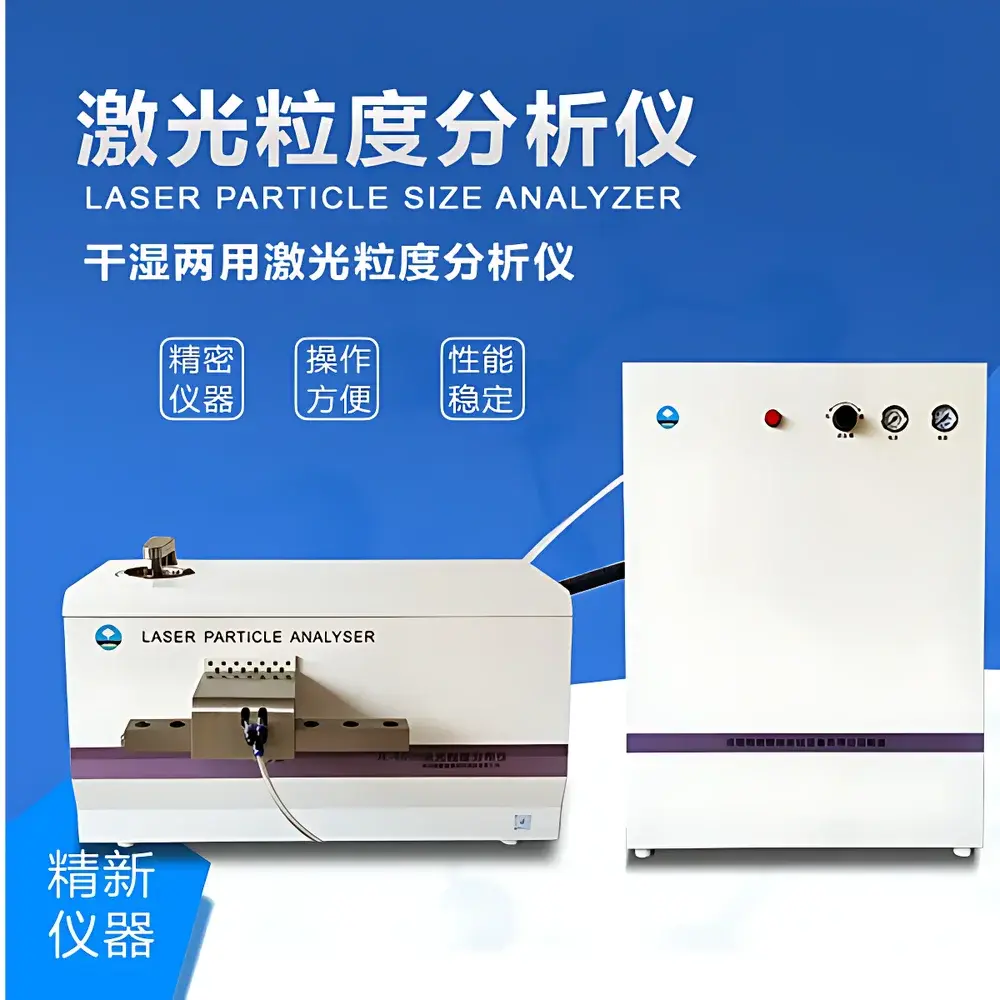
Jingxin JL-6000 Dry/Wet Dual-Mode Laser Particle Size Analyzer
| Brand | Jingxin (Chengdu Jingxin Instrument Co., Ltd.) |
|---|---|
| Origin | Sichuan, China |
| Manufacturer Type | Direct Manufacturer |
| Product Category | Domestic Laboratory Instrument |
| Model | JL-6000 |
| Price Range | USD 17,000–23,000 (FOB Chengdu) |
| Dispersion Method | Dry and Wet Dispersion |
| Instrument Type | Benchtop Laser Diffraction Particle Size Analyzer |
| Measurement Range | 0.01 µm – 3000 µm |
| Repeatability | <3% (D50 of NIST-traceable standard reference materials) |
| Measurement Time | ≤120 s (wet mode) |
Overview
The Jingxin JL-6000 Dry/Wet Dual-Mode Laser Particle Size Analyzer is a high-precision benchtop instrument engineered for comprehensive particle size distribution (PSD) analysis across diverse material classes. It operates on the principle of static laser light scattering, fully compliant with ISO 13320:2020 and GB/T 19077–2016, implementing Mie scattering theory across the entire measurement range without predefined distribution assumptions. This enables model-free, high-fidelity resolution of sub-micron to millimeter-scale particles—critical for R&D validation, QC release testing, and process optimization in regulated environments. The system integrates two independent, software-switchable dispersion modules: a wet dispersion unit featuring ultrasonic cavitation, mechanical stirring, and closed-loop circulation; and a dry dispersion module based on controlled pneumatic jetting with adjustable pressure (0.1–0.8 MPa). No hardware reconfiguration is required—mode selection is executed via intuitive software interface, ensuring rapid method switching while maintaining optical path integrity and calibration stability.
Key Features
- Inverted Fourier optical design minimizes stray light from multiple reflections between sample cell and lens surfaces; large-angle scattered light is fully captured without aperture limitation, enhancing resolution especially below 1 µm.
- Dual-wavelength laser source: primary 650 nm/30 mW semiconductor diode (≥70,000 h lifetime) and auxiliary 405 nm/20 mW violet diode—improving signal-to-noise ratio and detection sensitivity in the sub-100 nm region.
- 128-channel multi-element photodetector array covering forward, side, and backward scattering angles—enabling simultaneous acquisition of full angular intensity profiles with high dynamic range and real-time background compensation per channel.
- Robust optomechanical architecture: elastomer-isolated optical bench with high-rigidity mounting ensures long-term alignment stability under ambient laboratory conditions (5–35 °C, <85% RH).
- Optically optimized sample cell: fused silica windows bonded to stainless steel housing (wet mode, 500 mL capacity) or precision-machined quartz flow cell (dry mode), both certified for refractive index compatibility and minimal birefringence.
- Automated workflow: wet module includes auto-fill, auto-level detection, auto-cleaning, anti-dry-burn ultrasound protection, and integrated peristaltic circulation; dry module features continuous powder feeding, instantaneous aerosolization, and automatic chamber purging between measurements.
Sample Compatibility & Compliance
The JL-6000 accommodates a broad spectrum of industrial and research-grade particulates—including pharmaceutical powders (e.g., micronized APIs), magnetic alloys (NdFeB, ferrites), ceramic precursors (Al₂O₃, ZrO₂), battery cathode materials (LiCoO₂, NMC), pigments, food-grade starches, and emulsified suspensions (e.g., polymer lattices, nanoemulsions). Its dual dispersion capability eliminates cross-contamination risks associated with sample transfer and enables direct comparison of dry vs. wet state behavior—a key requirement for method development per ICH Q5A and USP . The instrument meets electromagnetic compatibility (EMC) Class B requirements (IEC 61326-1), and its sealed metal enclosure provides effective RF shielding. All firmware and software components support audit trail functionality, electronic signatures, and data integrity protocols aligned with FDA 21 CFR Part 11 and EU Annex 11 expectations when deployed in GLP/GMP-compliant laboratories.
Software & Data Management
The proprietary Jingxin Particle Analysis Software (v5.x) supports bilingual UI (English/Chinese) toggle with identical functional depth in both languages. It computes PSD using non-parametric free-distribution algorithms, delivering D3, D10, D25, D50, D75, D84, D90, D97, volume-weighted mean diameter (D[4,3]), surface-area-weighted mean (D[3,2]), specific surface area (SSA), and span (D90–D10)/D50. Output formats include cumulative distribution curves, differential histograms, tabular reports (CSV/PDF export), and customizable templates compliant with internal SOPs or external regulatory submissions. Raw scattering patterns and detector voltage logs are retained with timestamped metadata. Data exchange occurs via USB 2.0 or RS-232; the software is validated for Windows 10 (64-bit), Windows 7 SP1, and Windows Server 2016 environments. Optional network deployment supports centralized database archiving and remote monitoring via secure LAN.
Applications
The JL-6000 serves as a core analytical platform in quality control laboratories for cement, paper, coatings, and agrochemical manufacturers verifying batch-to-batch consistency against ASTM C150, ISO 9276, or company-specific specifications. In pharmaceutical development, it characterizes inhalable dry powder formulations (DPIs) and sterile injectables under wet dispersion, supporting QbD-based control strategy documentation. Academic users apply it to nanoparticle synthesis optimization, colloidal stability assessment, and rheological precursor correlation studies. Materials scientists employ dry-mode analysis to evaluate attrition resistance of granules or sintering behavior of metal powders—where hydration artifacts must be excluded. Its wide dynamic range also supports geological sediment analysis (clay–sand–gravel fractions) and environmental aerosol characterization in compliance with ISO 14644-1 cleanroom monitoring protocols.
FAQ
Does the JL-6000 comply with international metrological standards for particle sizing?
Yes—it adheres to ISO 13320:2020 for laser diffraction methodology and is calibrated using NIST-traceable polystyrene latex standards (PSL) and silica reference materials (e.g., NIST SRM 1963). Certificate of Calibration is provided with each instrument.
Can the same sample be tested sequentially in both dry and wet modes without recalibration?
Yes—the optical path remains invariant across modes; only dispersion modules change. A single factory calibration covers the full 0.01–3000 µm range for both configurations.
Is the software compatible with LIMS integration?
Yes—via configurable ASCII output files and optional OPC UA gateway (add-on module), enabling bidirectional data exchange with major LIMS platforms including LabWare, STARLIMS, and Thermo Fisher SampleManager.
What maintenance is required for long-term operational reliability?
Annual verification of laser power, detector linearity, and dispersion module performance is recommended. Wet module requires periodic replacement of ultrasonic transducer gaskets and pump tubing; dry module needs quarterly inspection of nozzle wear and filter integrity.
Does the instrument support Good Manufacturing Practice (GMP) workflows?
Yes—when configured with user access levels, electronic signatures, and audit trail logging enabled, it satisfies ALCOA+ data integrity principles and supports 21 CFR Part 11 compliance through documented validation packages (IQ/OQ/PQ available upon request).



