
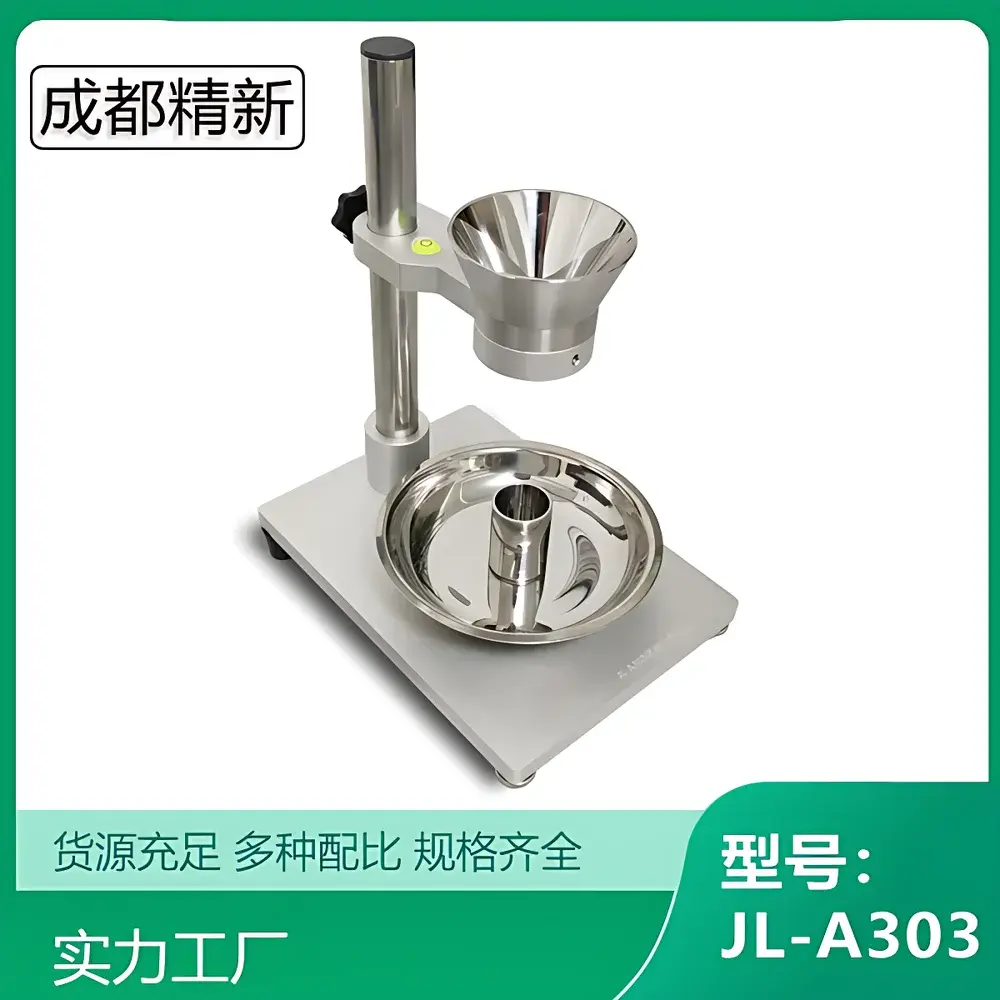
Chengdu Jingxin JL-A303 Powder Bulk Density and Flowability Tester
| Brand | Chengdu Jingxin (CDJX) |
|---|---|
| Origin | Sichuan, China |
| Manufacturer Type | Direct Manufacturer |
| Country of Origin | China |
| Model | JL-A303 |
| Instrument Type | Bulk Density & Flow Tester |
| Design Form Factor | Benchtop (Compact) |
| Sample Type | Free-Flowing Solid Powders |
| Applicable Standards | GB/T 1482–2010, GB/T 1479.1–2011 |
| Funnel Orifice Diameters | 2.5 mm and 5.0 mm |
| Funnel-to-Cylinder Distance | 25 mm ± 2 mm (adjustable) |
| Funnel Cone Angle | 60° |
| Cylinder Volume | 25 mL (stainless steel 304) |
| Scraper Blade | Stainless steel 304, 25 mm width |
| Stopper Rod | Stainless steel 304 |
| Overall Dimensions | ~230 × 170 × 300 mm |
| Net Weight | 3.7 kg |
| Timer Resolution | 0.01 s |
| Required Ancillary Equipment | Analytical balance (max 1 kg, readability 0.02 g) |
Overview
The Chengdu Jingxin JL-A303 Powder Bulk Density and Flowability Tester is a precision-engineered benchtop instrument designed for standardized determination of two critical powder physical properties: bulk density (also referred to as apparent or loose density) and flowability—commonly quantified as Hall Flow Rate. It operates on well-established gravity-driven principles defined in national standards GB/T 1482–2010 (equivalent in methodology to ISO 4490 and ASTM B212) and GB/T 1479.1–2011 (aligned with ISO 3953). The system employs a calibrated stainless steel funnel with interchangeable orifices (2.5 mm and 5.0 mm), positioned at a precisely controlled vertical distance (25 mm ± 2 mm) above a 25 mL volumetric cylinder. Powder flow is initiated manually via a stainless steel stopper rod, and timing is captured using a high-resolution digital timer (0.01 s resolution). All wetted and contact components—including funnel, scraper blade, stopper, and cylinder—are fabricated from AISI 304 stainless steel to ensure corrosion resistance, dimensional stability, and ease of cleaning—essential for maintaining measurement reproducibility across repeated tests.
Key Features
- Compliant dual-test functionality: Simultaneously supports Hall Flow Rate (GB/T 1482–2010) and loose (bulk) density (GB/T 1479.1–2011) measurements on a single platform.
- Interchangeable orifice funnel: Equipped with two standardized outlet diameters (2.5 mm and 5.0 mm) to accommodate powders with varying particle size distributions and flow characteristics.
- Precision height adjustment mechanism: Enables accurate and repeatable positioning of the funnel tip relative to the cylinder rim—critical for eliminating gravitational acceleration variability between tests.
- High-integrity material construction: Entire sample pathway—including funnel interior surface—is polished 304 stainless steel, minimizing adhesion, static buildup, and wear-induced calibration drift.
- Integrated mechanical consistency aids: Includes a rigid stainless steel scraper blade (25 mm width) for consistent removal of excess powder from the cylinder rim, ensuring uniform volume definition per test cycle.
- Compact, self-contained architecture: Designed for laboratory benchtop deployment with minimal footprint (~230 × 170 × 300 mm) and low mass (3.7 kg), facilitating mobility between QC labs, R&D workstations, or production floor environments.
Sample Compatibility & Compliance
The JL-A303 is validated for free-flowing metallic and non-metallic powders capable of passing through a 2.5 mm or 5.0 mm orifice under gravity—typical of atomized metal powders (e.g., Ti-6Al-4V, Inconel 718, SS316L), ceramic precursors, pharmaceutical excipients, and battery cathode materials (e.g., NMC, LFP). It excludes cohesive, hygroscopic, or electrostatically charged powders requiring vibration-assisted flow or fluidization. Method compliance is traceable to GB/T 1482–2010 (identical in procedural logic to ISO 4490:2018 and ASTM B212–16) and GB/T 1479.1–2011 (harmonized with ISO 3953:2013). While the instrument itself does not embed electronic data logging, its mechanical design ensures full compatibility with GLP-compliant documentation practices when paired with calibrated ancillary equipment (e.g., balance certified to ISO/IEC 17025, timer validated per ISO 9001 internal audit protocols).
Software & Data Management
The JL-A303 is a fully manual, electromechanical testing system with no embedded firmware, touchscreen interface, or proprietary software. This architecture eliminates cybersecurity concerns, firmware obsolescence, and vendor lock-in—making it suitable for regulated environments where validation simplicity and long-term operational transparency are prioritized. All measurements are recorded manually into laboratory notebooks or LIMS-compatible spreadsheets. Users are required to supply an external analytical balance (capacity ≥1 kg, readability ≤0.02 g) and a Class A digital timer (resolution ≤0.01 s), both of which must be maintained under documented calibration schedules aligned with ISO/IEC 17025 requirements. Raw data—including individual flow times, cylinder mass readings, and calculated flow rates (g/s) and bulk densities (g/cm³)—are subject to standard statistical treatment (mean, SD, CV%) per GB/T 1482–2010 Section 7.2 and GB/T 1479.1–2011 Section 6.3.
Applications
This instrument serves as a foundational tool in powder metallurgy process development, additive manufacturing feedstock qualification, pharmaceutical solid dosage form formulation, and advanced battery material screening. In metal AM workflows, it provides rapid first-pass assessment of powder spreadability and layer uniformity potential prior to laser or electron beam melting. For cathode producers, it enables batch-to-batch comparison of tap density proxies and flow consistency under ambient conditions—key inputs for die-filling simulation and electrode coating line setup. Quality control laboratories in contract manufacturing organizations (CMOs) use the JL-A303 to verify supplier powder specifications against purchase order tolerances (e.g., Hall Flow Rate: 25–35 s/50 g; Bulk Density: 2.8–3.2 g/cm³). Academic researchers employ it in fundamental studies correlating particle morphology (via SEM), surface energy (via inverse gas chromatography), and macroscopic flow behavior.
FAQ
What standards does the JL-A303 comply with?
It implements test procedures fully aligned with GB/T 1482–2010 (Hall Flow Rate) and GB/T 1479.1–2011 (loose density), which are technically equivalent to ISO 4490:2018, ISO 3953:2013, and ASTM B212–16.
Is the instrument supplied with a balance or timer?
No. A calibrated analytical balance (≥1 kg capacity, 0.02 g readability) and a high-resolution timer (0.01 s resolution) must be provided by the user.
Can the JL-A303 measure tapped density?
No. It is designed exclusively for loose (untapped) bulk density per GB/T 1479.1–2011. Tapped density requires a separate tap density tester compliant with GB/T 5162–2006 / ISO 3953.
What maintenance is required?
Routine cleaning of the funnel interior and cylinder with lint-free wipes and ethanol; periodic visual inspection for scratches or deformation of the orifice edge; annual verification of funnel-to-cylinder distance using calibrated gauge blocks.
Is the 25 mL cylinder certified for volumetric accuracy?
The cylinder is manufactured to dimensional tolerances appropriate for bulk density testing per GB/T 1479.1–2011 but is not supplied with a NIST-traceable volumetric certificate. Users may validate volume independently using water displacement or certified reference standards.



