
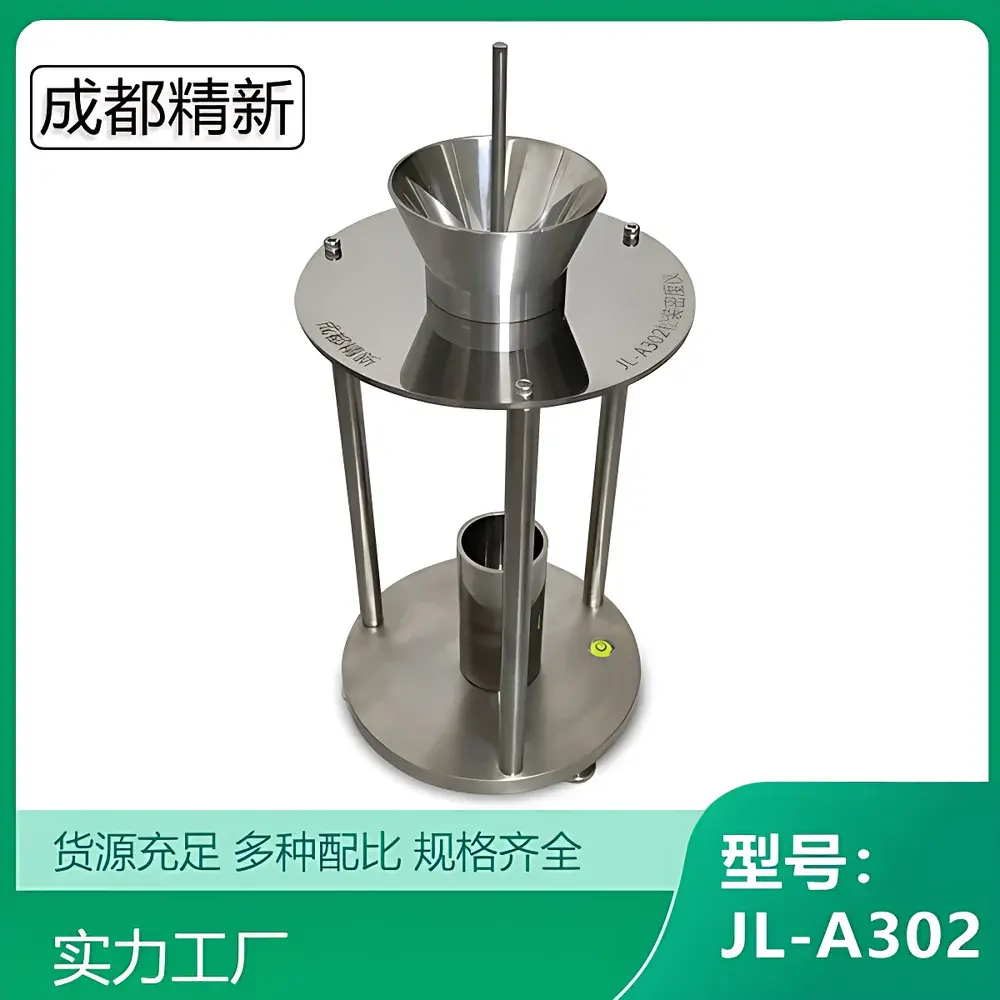
Chengdu Jingxin JL-A302 Universal Bulk Density Tester for Powders and Granules
| Brand | Chengdu Jingxin (CDJX) |
|---|---|
| Origin | Sichuan, China |
| Manufacturer | Yes |
| Type | Bulk Density Tester |
| Design | Portable Benchtop Unit |
| Measurement Principle | Free-Fall Gravimetric Method per GB/T 16913–2008 |
| Funnel Orifice Diameter | 12.7 mm |
| Cylinder Volume | 100 mL |
| Funnel-to-Cylinder Height | 115 mm ± 2 mm |
| Funnel Included Angle | 60° |
| Cylinder Material | ASTM A240 Type 304 Stainless Steel |
| Scraper Blade & Plug Rod | 304 Stainless Steel, 25 mm Width |
| Dimensions | Approx. 160 × 160 × 300 mm |
| Weight | 3.7 kg |
| Required External Balance | Capacity ≥ 1000 g, Readability ≤ 0.02 g |
Overview
The Chengdu Jingxin JL-A302 Universal Bulk Density Tester is a precision-engineered, portable gravimetric instrument designed to determine the bulk (loose) density of free-flowing powders and granular solids in accordance with the standardized natural heap method specified in GB/T 16913–2008 — “Test Methods for Dust Properties.” This methodology relies on controlled gravitational deposition: powder flows freely from a calibrated stainless-steel funnel onto a fixed-volume cylinder under reproducible geometric conditions (115 mm drop height, 12.7 mm orifice, 60° funnel angle). The resulting loosely packed mass per unit volume—expressed in g/cm³ or kg/m³—is defined as bulk density. Unlike tapped or vibrated density measurements, this test reflects the material’s behavior during gravity-fed handling, silo filling, pneumatic conveying start-up, or pharmaceutical capsule fill weight estimation. The device is not intended for cohesive, electrostatically charged, or highly fibrous materials without prior conditioning.
Key Features
- Compliant architecture: Fully aligned with GB/T 16913–2008 requirements for funnel geometry, drop height, cylinder volume, and scraper specification.
- Durable construction: All wetted components—including funnel, cylinder, scraper blade, and plug rod—are fabricated from ASTM A240 Type 304 stainless steel, ensuring corrosion resistance, non-reactivity with most pharmaceutical and chemical powders, and long-term dimensional stability.
- Optimized flow dynamics: Funnel interior surface is electropolished to minimize adhesion and residual powder retention; consistent wall thickness prevents deformation during repeated handling.
- Modular benchtop design: Compact footprint (160 × 160 × 300 mm) and lightweight frame (3.7 kg) support deployment in QC labs, production floors, R&D cleanrooms, and field testing environments.
- Operator-guided repeatability: Fixed mechanical alignment between funnel outlet and cylinder rim eliminates positional variability; standardized scraper stroke ensures planar surface leveling without compression.
Sample Compatibility & Compliance
The JL-A302 is validated for use with dry, non-agglomerating, free-flowing particulates ranging from fine micronized APIs (<10 µm) to coarse granules up to 2 mm diameter. It is routinely applied in quality control workflows compliant with ISO 8420, USP , and ASTM D1895–19 (Standard Test Methods for Apparent Density of Plastic Materials in Powder, Pellet, or Flaked Form). While GB/T 16913–2008 is its primary reference standard, data generated may be cross-referenced with ISO 3953:1993 (Determination of Bulk Density of Metal Powders) when appropriate sample preparation protocols are followed. Note: For GMP-regulated environments (e.g., pharmaceutical manufacturing), users must validate the full measurement process—including balance calibration, environmental humidity control (<40% RH recommended), and operator training—per ICH Q5E and FDA Guidance for Industry on Analytical Procedure Validation.
Software & Data Management
The JL-A302 operates as a manual, hardware-only system requiring no embedded electronics or firmware. Data acquisition is performed externally using a calibrated analytical balance (≥1000 g capacity, ≤0.02 g readability) and recorded manually or via LIMS-integrated spreadsheets. To meet 21 CFR Part 11 compliance for electronic records, laboratories may integrate digital balance output into validated spreadsheet templates or ELN platforms featuring audit trails, user authentication, and version-controlled calculation logic. Chengdu Jingxin provides a traceable calibration certificate for geometric components (funnel orifice, cylinder volume, height gauge) upon request—supporting GLP/GMP documentation requirements.
Applications
- Pharmaceuticals: Pre-formulation screening of excipients (e.g., lactose, microcrystalline cellulose), batch release testing of active ingredients, and correlation with tablet compression behavior.
- Food & Nutraceuticals: Quality assessment of powdered milk, cocoa, spices, and dietary supplements where flowability impacts dosing accuracy and packaging efficiency.
- Battery Materials: Characterization of cathode/anode powders (e.g., NMC, graphite) to inform slurry mixing consistency and electrode coating uniformity.
- Chemicals & Catalysts: Monitoring lot-to-lot consistency of silica gels, zeolites, and supported metal catalysts used in fluidized-bed reactors.
- Academic Research: Teaching fundamental powder mechanics in materials science curricula and supporting research on particle–particle interaction models.
FAQ
What standards does the JL-A302 comply with?
It is engineered specifically to meet GB/T 16913–2008. Its geometry also permits comparative testing aligned with ISO 3953:1993 and ASTM D1895–19 when sample conditioning and procedural controls are applied.
Is a balance included with the instrument?
No. A Class II or III analytical balance (≥1000 g capacity, ≤0.02 g readability) must be sourced separately and maintained under routine calibration per ISO/IEC 17025.
Can the JL-A302 measure tapped density?
No. Tapped density requires mechanical vibration per GB/T 5162–2006 or USP . This unit is strictly for loose (untapped) density determination.
How many replicate measurements are recommended?
Per GB/T 16913–2008, a minimum of three independent determinations should be performed; the arithmetic mean is reported as the bulk density, with relative standard deviation (RSD) documented for process capability assessment.
Does ambient humidity affect results?
Yes. Hygroscopic powders (e.g., sodium chloride, certain APIs) require conditioning at standardized RH (typically 30–40%) and temperature (20–25°C) prior to testing to ensure measurement reproducibility.



