
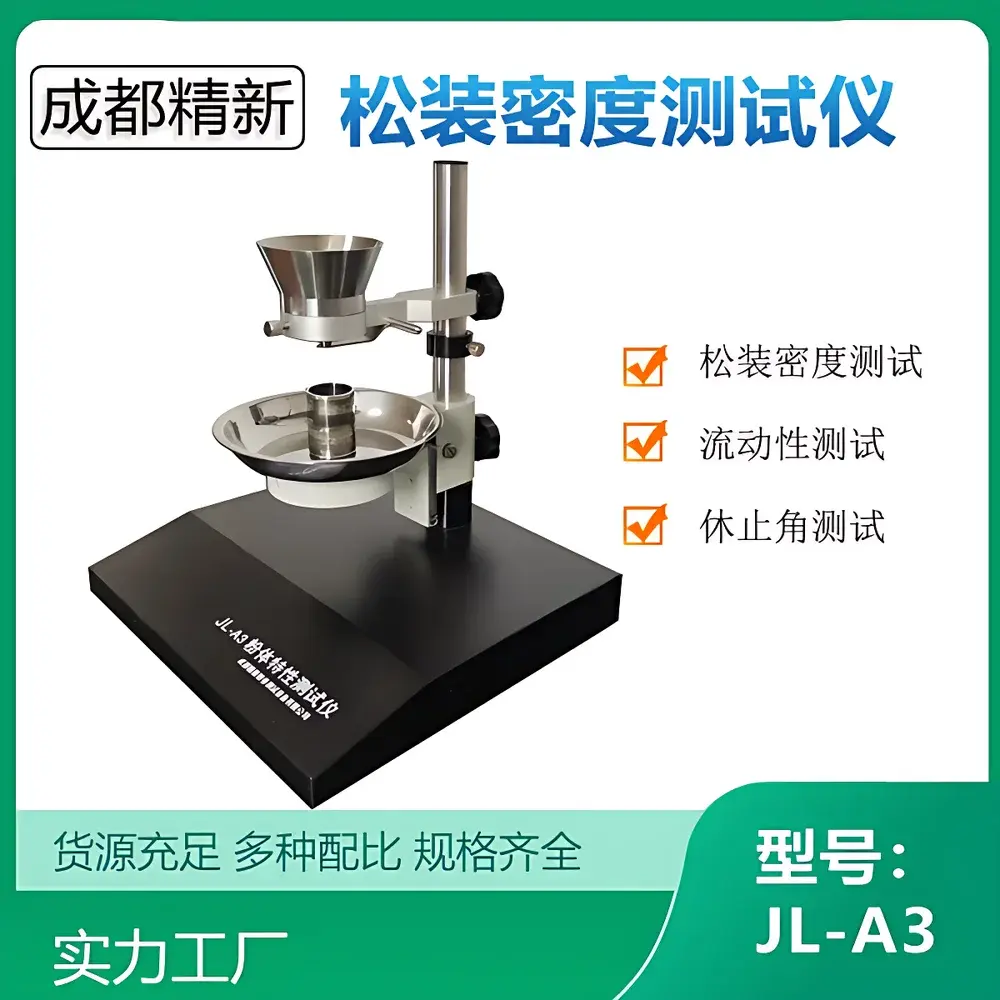
Chengdu Jingxin JL-A3 Powder Characterization Tester – Flowability, Angle of Repose & Apparent Density Analyzer
| Brand | Chengdu Jingxin (CDJX) |
|---|---|
| Origin | Sichuan, China |
| Manufacturer Type | Direct Manufacturer |
| Instrument Type | Angle of Repose Tester, Apparent Density Tester, Powder Flowability Tester |
| Measurable Parameters | Angle of Repose, Flow Time (Haller Flow Rate), Apparent Density |
| Maximum Sample Cup Capacity | 25 mL (standard stainless steel cup) |
| Minimum Sample Mass | 50 g |
| Funnel Orifice Diameter | 5 mm (standard), optional 2.5 mm or custom |
| Funnel Cone Angle | 60° |
| Repose Plate Diameter | 80 mm |
| Stainless Steel Ruler Width | 25 mm |
| Dimensions | 300 × 260 × 260 mm |
| Net Weight | ~5 kg |
| Compliance | GB/T 1482–2010, GB/T 1479.1–2017, GB/T 16913–2008 |
Overview
The Chengdu Jingxin JL-A3 Powder Characterization Tester is an integrated benchtop instrument engineered for standardized measurement of three fundamental powder bulk properties: flow time (per Haller funnel method), angle of repose, and apparent density (loose-packed density). It operates on well-established gravimetric and geometric principles defined in Chinese national standards—GB/T 1482–2010 (metal powder flowability), GB/T 1479.1–2017 (apparent density by funnel method), and GB/T 16913–2008 (angle of repose determination). Unlike single-function testers, the JL-A3 consolidates these measurements into a single mechanical platform with interchangeable fixtures, eliminating inter-instrument calibration drift and ensuring cross-parameter consistency within a unified experimental setup. Its design follows classical powder rheometry conventions: controlled gravity-driven flow through a precision-machined stainless-steel funnel, reproducible powder deposition geometry, and direct linear dimension measurement via calibrated stainless-steel ruler. The system is not intended for dynamic or shear-based flow analysis (e.g., shear cell or rotational rheometry), but rather for routine QC/QA compliance testing where regulatory traceability to national standard protocols is required.
Key Features
- Triple-function mechanical architecture: One instrument supports Haller flow time, angle of repose, and apparent density determinations without hardware reconfiguration beyond fixture selection.
- 304 stainless-steel funnel and sample cups: Precision-machined with uniform wall thickness, electropolished interior surface finish, and calibrated orifice diameters (5 mm standard; 2.5 mm optionally available) to minimize adhesion, wear, and flow disturbance.
- Adjustable vertical positioning system: Micrometer-style height adjustment knob enables precise control over funnel-to-receptacle distance—critical for repeatability in apparent density and repose angle tests per GB/T 1479.1–2017 and GB/T 16913–2008.
- Integrated shutter mechanism: A spring-loaded stainless-steel gate blocks the funnel orifice prior to test initiation, eliminating manual occlusion and reducing operator-induced variability.
- Dedicated Windows-based calculation software: Accepts manually entered raw data (flow time, pile height, mass, volume) and computes final results per standard formulas; supports bilingual (EN/CN) report generation in Word, Excel, and PDF formats with timestamped audit trails.
- Modular fixture compatibility: Standard 25 mL stainless-steel cup (ISO/ASTM-compliant volume), 80 mm diameter repose plate, and 25 mm wide reference ruler—all traceably dimensioned and mechanically aligned to minimize parallax and placement error.
Sample Compatibility & Compliance
The JL-A3 is validated for free-flowing, dry, non-cohesive powders including metal powders (e.g., Ni, Co, Al alloys), battery cathode/anode materials (LiCoO₂, graphite), pharmaceutical excipients (microcrystalline cellulose, lactose), food-grade starches and flours, and ceramic precursors. It is not suitable for hygroscopic, electrostatically charged, fibrous, or highly cohesive powders without prior conditioning (e.g., drying at 105 °C per GB/T 1479.1–2017). All test procedures strictly follow Chinese national standards, which are harmonized with ISO 4490 (metal powder flowability), ISO 3953 (apparent density), and ASTM D6393 (bulk solids flow test methods). While the instrument itself does not carry CE or FDA certification, its operational methodology aligns with GLP-aligned laboratory practice when used with documented SOPs, calibrated balances (±0.01 g), and temperature/humidity-controlled environments (23 ± 2 °C, 50 ± 5 % RH recommended).
Software & Data Management
The bundled PC software provides deterministic calculation only—no curve fitting or statistical extrapolation. Input fields correspond directly to standard-defined variables: mass (g), flow time (s), cup volume (mL), pile height (mm), and plate radius (mm). Each report includes test date/time, operator ID (user-entered), instrument serial number, standard reference clause, and raw input values alongside calculated outputs. Exported files retain embedded metadata and support version-controlled archiving. Audit trail functionality records all data entry modifications with timestamps, satisfying basic 21 CFR Part 11 readiness requirements when deployed on validated Windows systems with user access controls. No cloud connectivity or remote data transmission is implemented—data remains fully local unless explicitly exported by the user.
Applications
This instrument serves as a primary screening tool in powder metallurgy R&D labs evaluating atomized metal feedstocks for additive manufacturing; in battery material production facilities monitoring cathode powder batch consistency prior to slurry mixing; in pharmaceutical solid-dosage development assessing blend uniformity and capsule fill weight variation; and in quality control departments of food ingredient suppliers verifying flow behavior across production lots. It is routinely specified in supplier qualification protocols for ISO 9001-certified manufacturers and referenced in technical data sheets for commercial powder products sold into Chinese and ASEAN markets. Educational institutions utilize it for undergraduate materials science laboratories to demonstrate fundamental powder handling concepts including interparticle friction, void fraction, and gravitational compaction.
FAQ
What standards does the JL-A3 comply with?
It implements GB/T 1482–2010 (equivalent to ISO 4490), GB/T 1479.1–2017 (equivalent to ISO 3953), and GB/T 16913–2008 (aligned with ASTM D6393 Annex A1).
Can the instrument measure tapped density?
No—tapped density requires mechanical vibration per GB/T 5162 or ISO 3953 Part 2; the JL-A3 performs only loose (untapped) density measurements.
Is calibration certificate included?
The system ships with dimensional verification documentation for funnel orifice, cup volume, and ruler scale; users must provide external calibration of analytical balance and timer per ISO/IEC 17025.
What maintenance is required?
Routine cleaning of funnel interior with lint-free cloth and ethanol; periodic inspection of shutter seal integrity and ruler zero-point alignment; no lubrication or firmware updates needed.
Does it support automated data capture from balances or timers?
No—data entry is manual to ensure operator verification; RS-232 or USB balance integration is not supported.



