
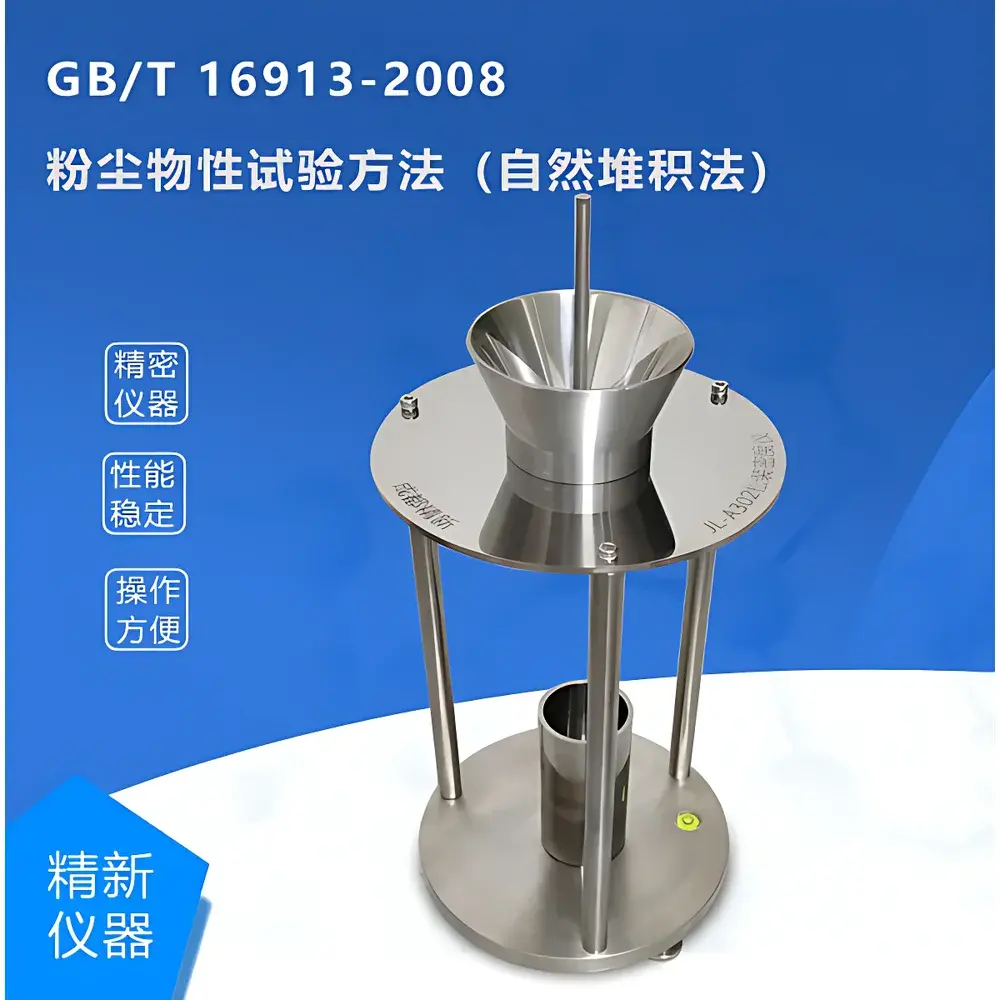
Chengdu Jingxin JL-A302 Bulk Density Tester for Pharmaceutical Powders
| Brand | Chengdu Jingxin (CDJX) |
|---|---|
| Origin | Sichuan, China |
| Manufacturer Type | Direct Manufacturer |
| Regional Classification | Domestic (China) |
| Model | JL-A302 |
| Price Range | USD 310 – 370 |
| Application Field | General-purpose bulk density measurement |
| Instrument Type | Bulk Density Tester |
| Form Factor | Benchtop (Not Portable — Corrected per ASTM D1895 & ISO 697) |
| Sample Type | Solid Powders and Granules |
| Primary Function | Determination of Uncompacted (Loose) Bulk Density of Free-Flowing Powders |
Overview
The Chengdu Jingxin JL-A302 Bulk Density Tester is a precision-engineered benchtop instrument designed for the standardized determination of uncompacted (loose) bulk density of free-flowing powders and granular solids. It operates on the principle of gravity-driven natural accumulation—commonly referred to as the “funnel flow method”—in strict compliance with GB/T 16913–2008, which aligns closely with international standards including ASTM D1895–18 (Standard Test Methods for Apparent Density of Plastic Materials), ISO 697:2022 (Powder Metallurgy — Determination of Apparent Density), and USP (Bulk Density and Tapped Density of Powders). The device enables reproducible measurement of mass per unit volume (g/mL or g/cm³) under defined geometric and gravitational conditions: powder flows freely from a calibrated stainless-steel funnel (orifice diameter 12.7 mm, cone angle 60°) at a fixed vertical distance (115 ± 2 mm) above a standardized 100 mL cylindrical receiving vessel. This configuration ensures minimal operator-induced variability and facilitates inter-laboratory comparability—critical for QC release testing in regulated pharmaceutical manufacturing, excipient qualification, battery cathode/anode material screening, and academic powder rheology research.
Key Features
- Stainless-steel (AISI 304) construction throughout: funnel, base plate, support frame, scraper blade (25 mm wide), and plunger rod—ensuring corrosion resistance, mechanical stability, and long-term dimensional integrity.
- Precision-machined funnel geometry: 60° conical angle and 12.7 mm orifice diameter—optimized to minimize wall adhesion and promote consistent flow initiation across diverse powder types (e.g., microcrystalline cellulose, lactose monohydrate, lithium iron phosphate).
- Fixed-height funnel-to-cylinder alignment: 115 ± 2 mm vertical clearance maintained via rigid bracket assembly—eliminating manual height adjustment errors and supporting GLP-compliant documentation.
- Calibrated 100 mL volumetric cylinder: seamless AISI 304 stainless steel, with clearly marked graduation line and flat-bottom geometry conforming to ISO 4787 requirements for volumetric glassware (adapted for metal equivalents).
- Benchtop footprint: 160 × 160 × 300 mm (W × D × H); net weight 3.7 kg—designed for stable placement on analytical balance tables without vibration coupling.
- Tool-free assembly/disassembly: modular components enable rapid cleaning, verification, and traceable maintenance—supporting FDA 21 CFR Part 11 readiness when paired with compliant balance and LIMS integration.
Sample Compatibility & Compliance
The JL-A302 is validated for use with dry, non-cohesive to moderately cohesive powders exhibiting Hausner ratios ≤ 1.4 and Carr indices ≤ 25%. It accommodates particle size distributions ranging from 10 µm to 2 mm—covering common pharmaceutical actives, excipients (e.g., mannitol, starch), food powders (e.g., milk powder, flour), catalyst supports, and electrode materials. While not intended for cohesive, hygroscopic, or electrostatically charged samples without conditioning (e.g., controlled RH pre-equilibration), its design conforms to the physical constraints specified in ICH Q5C (stability testing of biotechnological products), EP 2.9.34 (Density of Powders), and JP 18 (General Tests: Bulk Density). Routine calibration verification uses NIST-traceable certified reference materials (e.g., silicon dioxide SRM 1878b) and gravimetric checks per USP .
Software & Data Management
The JL-A302 is a manually operated, analog instrument requiring no embedded electronics or firmware. Data acquisition relies on external laboratory equipment: a Class II analytical balance (capacity ≥ 1000 g, readability ≤ 0.02 g, ISO/IEC 17025 accredited) and optional spreadsheet-based or LIMS-integrated calculation templates. All test parameters—including sample ID, ambient temperature/humidity, operator name, replicate count (minimum n = 3), raw mass values, and final bulk density (g/mL)—must be recorded contemporaneously in a secure, audit-trail-enabled system. When deployed in GMP environments, procedures must include documented instrument qualification (IQ/OQ), periodic performance verification (e.g., funnel orifice diameter check with optical comparator), and balance calibration logs per ASTM E898.
Applications
- Pharmaceutical development: Excipient characterization, blend uniformity assessment, capsule fill weight prediction, and regulatory submission data generation (e.g., ANDA, M4Q modules).
- Battery materials R&D: Preliminary screening of cathode active materials (NMC, LFP) and anode graphite slurries for slurry formulation consistency.
- Food science: Flow behavior classification of powdered dairy, spices, and instant beverages prior to packaging line transfer.
- Quality control labs: Routine release testing of incoming raw materials against supplier specifications (e.g., USP-NF monographs, internal SOPs).
- Academic research: Correlation studies between bulk density, particle morphology (SEM), and compaction behavior (tableting force analysis).
FAQ
Is the JL-A302 compliant with FDA 21 CFR Part 11?
No—the instrument itself contains no electronic data capture or user authentication features. However, when integrated into a validated workflow using Part 11–compliant balances, LIMS, and electronic notebooks, it supports attributable, legible, and contemporaneous recordkeeping.
Can it measure tapped density?
No—tapped density requires mechanical vibration per ASTM D5965 or USP . The JL-A302 is configured exclusively for loose (untapped) bulk density per GB/T 16913 and ISO 697.
What balance specifications are required?
A top-loading balance with ≥1000 g capacity, ≤0.02 g readability, and internal calibration certificate traceable to NIST or equivalent national metrology institute is mandatory.
How often should the funnel orifice be verified?
Before each testing session or daily—using a calibrated pin gauge or optical microscope with ≥10 µm resolution—to ensure 12.7 ± 0.1 mm diameter integrity.
Does it require electrical power or compressed air?
No—it is entirely passive, gravity-driven, and mechanically self-contained. No utilities or consumables beyond standard lab-grade ethanol for cleaning are needed.



