
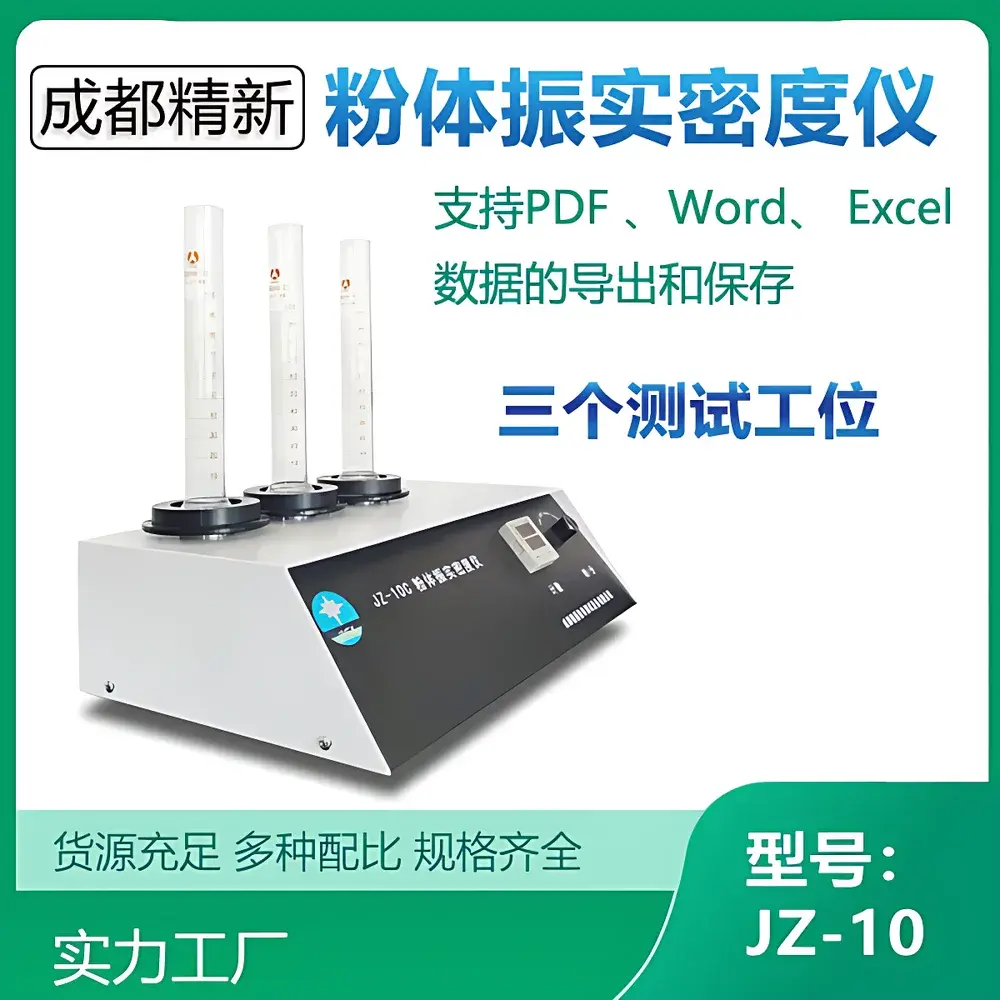
CDJX JZ-10C Series Tap Density Tester with 250 mL Graduated Cylinder (USP & ChP 2020 General Chapter 0993 Compliant)
| Brand | CDJX |
|---|---|
| Origin | Sichuan, China |
| Manufacturer Type | Direct Manufacturer |
| Model | JZ-10C |
| Instrument Type | Tap Density Tester |
| Density Measurement Range | 0–10 g/cm³ |
| Measurement Accuracy | ±1% RSD (Repeatability) |
| Vibration Amplitude | 3.0 ± 0.2 mm |
| Vibration Frequency Options | 100 / 200 / 250 / 300 taps/min |
| Programmable Tap Count | 1–9999 |
| Sample Capacity | ≤500 g (per 250 mL cylinder) |
| Power Supply | AC 220 V, 110 W |
| Dimensions (L×W×H) | 455 × 280 × 125 mm |
| Net Weight | ~15 kg |
| Software Output Formats | PDF, Word, Excel |
| Compliance Standards | GB/T 5162–2021, GB/T 31057.2–2018, ChP 2020 <0993>, USP <616> |
Overview
The CDJX JZ-10C Series Tap Density Tester is a precision-engineered instrument designed for the standardized determination of tap density (also known as tapped density or settled density) and bulk density of free-flowing powders and granular solids. It operates on the principle of controlled mechanical tapping—applying reproducible vertical impacts combined with concurrent horizontal rotation—to simulate gravitational compaction under defined conditions. This dual-motion mechanism ensures uniform powder surface leveling during consolidation, minimizing inter-particle bridging and air entrapment, thereby enhancing measurement fidelity. The system complies fully with pharmacopeial and industrial standards including Chinese Pharmacopoeia (ChP) 2020 General Chapter , United States Pharmacopeia (USP) , GB/T 5162–2021 (Metal Powders), and GB/T 31057.2–2018 (Granular Materials). Its modular three-station configuration supports parallel testing across multiple sample volumes—specifically configured here with three detachable 250 mL calibrated graduated cylinders—enabling high-throughput screening in QC laboratories and R&D environments.
Key Features
- Triple independent test stations for simultaneous tap density assessment of up to three samples, improving laboratory efficiency and statistical robustness.
- Precision-controlled dual-axis motion: vertical tapping at selectable frequencies (100, 200, 250, or 300 taps/min) synchronized with continuous low-speed horizontal rotation (≤5 rpm), ensuring consistent powder bed homogenization.
- Programmable tap count from 1 to 9999 cycles per test sequence, adjustable via integrated microprocessor timer with real-time display and non-volatile memory retention.
- Fixed amplitude of 3.0 ± 0.2 mm, certified per ISO 13320 and aligned with USP mechanical specifications for tap density instrumentation.
- Modular cylinder mounting system: stainless-steel quick-release fixtures allow rapid installation, removal, and cleaning of 250 mL volumetric cylinders—compatible with Class A borosilicate glass or certified polymer alternatives.
- Thermal management architecture featuring rear-panel multi-port ventilation grilles, enabling stable long-duration operation without thermal drift or motor overload.
- Robust mechanical construction using corrosion-resistant stainless steel guides, hardened aluminum alloy frame, and brushless DC motor drive for >50,000-cycle service life.
Sample Compatibility & Compliance
The JZ-10C accommodates a broad spectrum of dry, non-cohesive to moderately cohesive particulate materials—including metal powders (e.g., Ti-6Al-4V, Inconel), pharmaceutical excipients (lactose monohydrate, microcrystalline cellulose), battery cathode/anode materials (LiCoO₂, graphite), food-grade starches, ceramic precursors, and agrochemical granules. All measurements adhere strictly to regulatory validation frameworks: data traceability meets FDA 21 CFR Part 11 requirements when used with validated software configurations; audit trails, electronic signatures, and version-controlled report generation are supported. Instrument qualification documentation (IQ/OQ/PQ protocols) is available upon request for GLP and GMP-compliant facilities.
Software & Data Management
The included CDJX TapDensity Pro software (v3.2+) runs on Windows OS (7/10/11, 64-bit) and provides full control over test parameters, real-time monitoring of tap progression, and automated calculation of both tap density (g/cm³) and bulk density (g/cm³) using ASTM D1464-derived algorithms. Raw input values—including cylinder tare mass, gross mass, and calibrated volume—are logged with timestamp, operator ID, and environmental metadata (optional ambient temperature/humidity integration). Reports conform to ALCOA+ principles: attributable, legible, contemporaneous, original, accurate, complete, consistent, enduring, and available. Export formats include searchable PDF (with digital signature), editable Word (.docx), and analysis-ready Excel (.xlsx) files containing raw data tables, statistical summaries (mean, SD, RSD%), and pass/fail flags against user-defined specification limits.
Applications
This instrument serves critical roles across regulated and industrial sectors: in pharmaceutical development, it supports formulation optimization, flowability assessment (via Carr Index and Hausner Ratio derivation), and stability studies per ICH Q5C; in battery material manufacturing, it informs electrode slurry rheology modeling and calendering process design; in metallurgy and additive manufacturing, it validates powder bed density for laser powder bed fusion (LPBF) simulation inputs; and in quality control labs, it enables routine batch release testing against internal SOPs or pharmacopeial monographs. Academic researchers utilize its programmability for fundamental studies on particle packing dynamics, cohesion-energy relationships, and humidity-dependent densification behavior.
FAQ
What standards does the JZ-10C comply with?
It conforms to ChP 2020 , USP , GB/T 5162–2021, GB/T 31057.2–2018, and ISO 3953:1993.
Can the 250 mL cylinder be replaced with other volumes?
Yes—cylinders ranging from 25 mL to 500 mL may be used, provided they meet ISO 4787 calibration tolerances and are registered in software calibration tables.
Is the instrument suitable for hygroscopic or electrostatic powders?
For such materials, optional environmental enclosures (dry nitrogen purge or relative humidity control chambers) are recommended and compatible with the JZ-10C mechanical interface.
How is measurement repeatability verified?
Each unit undergoes factory verification using NIST-traceable certified reference powders (e.g., tungsten carbide SRM 1976), with RSD ≤ 0.8% demonstrated across ≥10 replicate runs.
Does the software support LIMS integration?
Yes—via configurable CSV/XML export templates and ODBC-compliant database connectors for direct ingestion into major LIMS platforms (e.g., LabWare, Thermo Fisher SampleManager).
Related Products



