
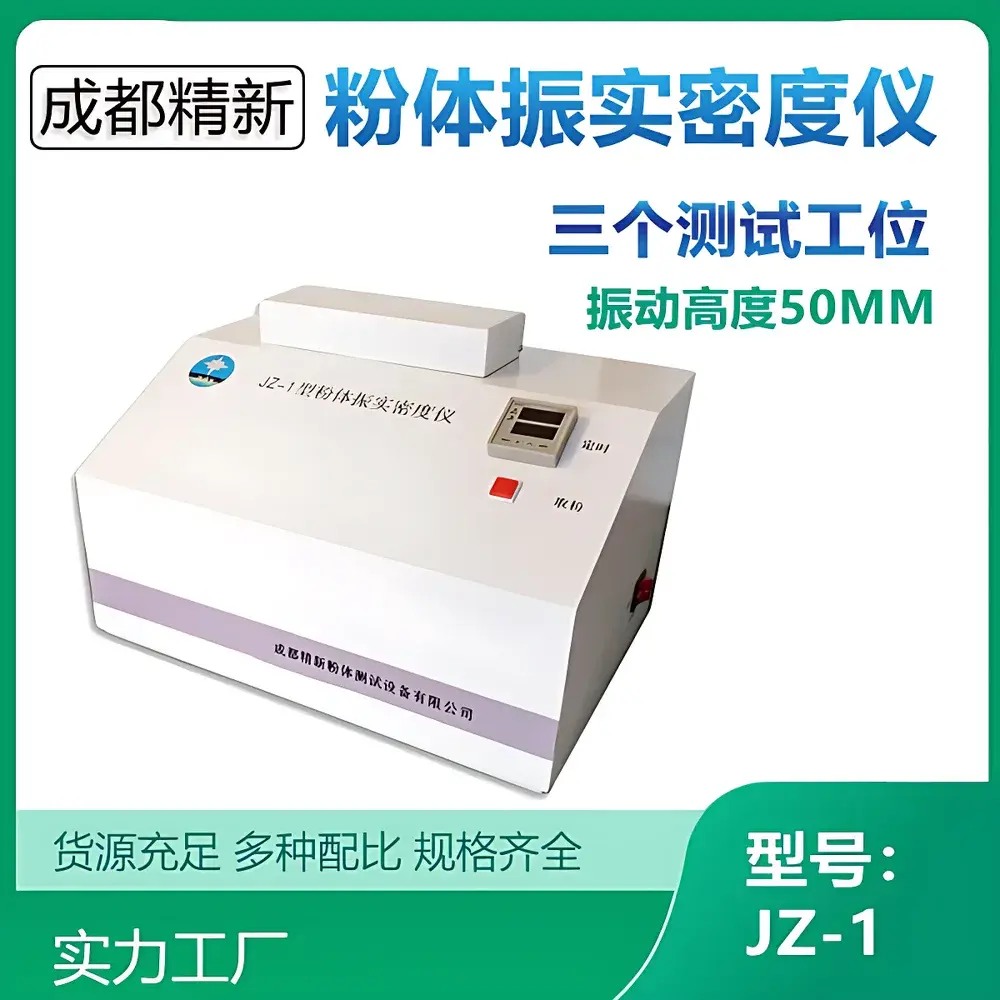
Chengdu Jingxin JZ-1 Tapped Density Tester
| Brand | Chengdu Jingxin (CDJX) |
|---|---|
| Origin | Sichuan, China |
| Manufacturer Type | Direct Manufacturer |
| Country of Origin | China |
| Model | JZ-1 |
| Instrument Type | Tapped Density Analyzer |
| Application | Tapped density measurement of metal powders and battery materials |
| Compliance | GB/T 5162–2021, YS/T 677–2008 |
| Vibration Amplitude | 50 mm ± 0.2 mm |
| Vibration Frequency | 60 taps/min |
| Tap Count Range | 1–9999 (user-configurable) |
| Sample Positions | 3 independent stations |
| Standard Cylinders | 3 × stainless steel cylinders (ID 16.25 mm, height 80 mm, volume 16.6 mL) |
| Measurement Accuracy | ±1.5% |
| Power Supply | AC 220 V ± 22 V, 150 W |
| Dimensions | 400 × 280 × 270 mm |
| Weight | ~13 kg |
| Construction | 304 stainless steel frame and components |
| Software | Included PC-based data acquisition and reporting software (tapped density calculation, report generation, CSV export) |
Overview
The Chengdu Jingxin JZ-1 Tapped Density Tester is an electromechanical instrument engineered for the standardized determination of tapped density (also known as settled density) of free-flowing or cohesionless powdered materials—particularly metallic powders, cathode/anode active materials (e.g., LiMn₂O₄, LiCoO₂, graphite), and other fine particulates used in battery manufacturing, metallurgy, ceramics, and advanced powder processing. It operates on the principle of controlled vertical vibration: a fixed mass of powder is introduced into a calibrated cylindrical tube, which is then subjected to repetitive, uniform mechanical taps under defined amplitude (50 mm ± 0.2 mm) and frequency (60 taps per minute). The process continues until no further volume reduction occurs (i.e., volume stabilization), at which point the final volume is recorded. Tapped density is calculated as the ratio of sample mass (measured separately on an analytical balance) to the stabilized tap volume. This method conforms rigorously to ISO 3953:1993 and its national adoption GB/T 5162–2021, as well as industry-specific standards including YS/T 677–2008 for lithium manganate cathode materials.
Key Features
- Triple-station design enables simultaneous testing of three independent samples—significantly improving throughput for QC laboratories and R&D environments requiring comparative analysis across batches or formulations.
- Precision-engineered 50 mm stroke amplitude—exceeding the typical 3 mm or 10 mm amplitudes found in conventional tapped density testers—ensures effective compaction of low-density, high-aspect-ratio, or electrostatically cohesive powders common in battery electrode slurries and additive manufacturing feedstocks.
- Stainless steel (AISI 304) construction throughout critical structural and contact components—including guide rods, cylinder holders, and base frame—guarantees long-term dimensional stability, corrosion resistance, and compliance with cleanroom-compatible handling protocols.
- Digitally adjustable tap count (1–9999 cycles) allows full method flexibility: users may replicate standard 100/500/1000-tap protocols per GB/T 5162 or define custom sequences for material-specific optimization studies.
- Integrated motor-driven cam mechanism delivers consistent, repeatable impact force without mechanical backlash or drift—ensuring inter-laboratory reproducibility essential for GLP-compliant documentation and supplier qualification workflows.
Sample Compatibility & Compliance
The JZ-1 accommodates powders ranging from dense spherical metal alloys (e.g., Ni, Co, Cu, Al powders) to low-bulk-density functional oxides and carbonaceous materials. Its 16.6 mL stainless steel cylinders (ID 16.25 mm, depth 80 mm) meet dimensional tolerances specified in GB/T 5162–2021 Annex A. The instrument supports both tapped density and apparent (bulk) density measurements when used with appropriate pre-tapping protocols. All operational parameters—including tap count, cycle timing, and cylinder identification—are traceable within the accompanying software environment. While the device itself does not embed real-time audit trails, its output files (CSV, PDF reports) retain timestamps, operator ID fields, and raw volume/mass inputs—enabling alignment with FDA 21 CFR Part 11 requirements when deployed alongside validated laboratory information management systems (LIMS).
Software & Data Management
The included Windows-compatible application provides guided test setup, automated calculation of tapped density (g/cm³), relative density (%), and compressibility index (Carr Index). Data is stored in structured local databases with optional export to CSV for statistical process control (SPC) integration. Reports include instrument ID, calibration date (user-entered), environmental conditions (optional manual entry), sample ID, mass, initial/final volumes, tap count, and pass/fail status against user-defined specification limits. Software logs all session start/end times and operator credentials—supporting basic ALCOA+ principles (Attributable, Legible, Contemporaneous, Original, Accurate) for regulated environments.
Applications
This instrument is routinely deployed in:
- Battery material development labs validating electrode coating consistency and calendering response;
- AM (additive manufacturing) powder suppliers certifying flowability and packing behavior of Ti-6Al-4V or IN718 powders;
- Ceramic and refractory producers assessing green body density predictability;
- Pharmaceutical excipient screening where tapped density correlates with tablet compressibility (per USP <616>);
- Quality control departments performing incoming inspection of metal injection molding (MIM) feedstocks.
FAQ
What standards does the JZ-1 comply with?
It fully implements GB/T 5162–2021 (equivalent to ISO 3953:1993) and YS/T 677–2008 for lithium manganate cathode materials.
Can the instrument be used for non-metallic powders?
Yes—it is validated for ceramic oxides, polymer microspheres, food-grade starches, and pharmaceutical excipients, provided particle size remains within the 1–500 µm range and flow characteristics allow measurable volume reduction.
Is calibration verification supported?
The system includes reference stainless steel cylinders with certified internal dimensions; users perform periodic volumetric verification using traceable gauge blocks or liquid displacement methods per ISO/IEC 17025 guidelines.
Does the software support multi-user access control?
No—the current version uses local user profiles without role-based permissions; however, exported data files contain operator metadata suitable for integration into enterprise LIMS with centralized authentication.
What maintenance is required?
Annual inspection of cam follower wear, motor coupling integrity, and cylinder surface finish is recommended; no lubrication of the tapping mechanism is required due to sealed bearing design.



