
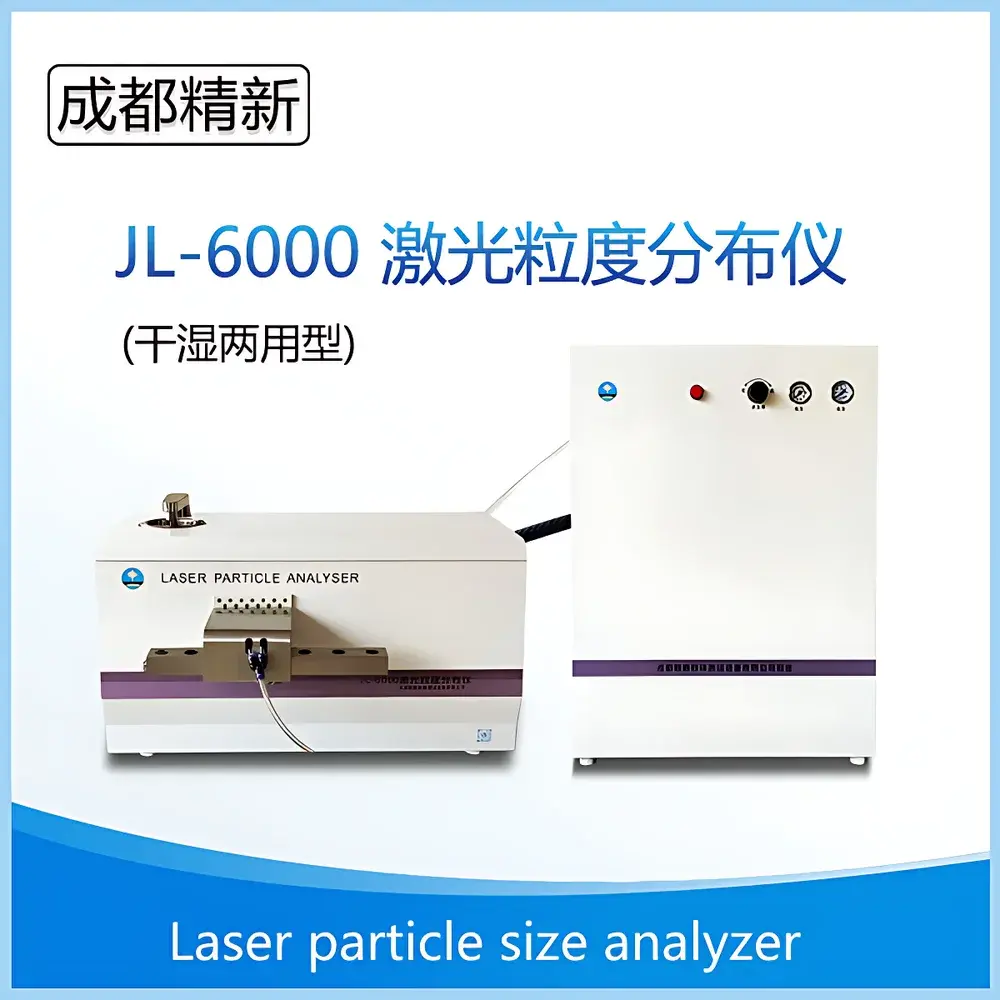
Chengdu Jingxin JL-6000 Dual-Mode Laser Particle Size Analyzer (Dry & Wet Dispersion)
| Brand | Chengdu Jingxin (CDJX) |
|---|---|
| Origin | Sichuan, China |
| Manufacturer Type | Original Equipment Manufacturer (OEM) |
| Product Category | Domestic |
| Model | JL-6000 |
| Price Range | USD 21,000–22,500 (FOB China) |
| Dispersion Method | Dry & Wet |
| Instrument Type | Laboratory Laser Diffraction Particle Size Analyzer |
| Measurement Range | 0.01–3000 µm |
| Repeatability | <1% (wet), <3% (dry) |
| Measurement Time | <2 min (wet), <5 s per run (dry) |
Overview
The Chengdu Jingxin JL-6000 Dual-Mode Laser Particle Size Analyzer is a precision laboratory instrument engineered for high-fidelity particle size distribution (PSD) characterization across diverse material classes. It operates on the principle of static laser light scattering, applying Mie scattering theory across the full measurement range—enabling rigorous, physics-based interpretation of diffraction and scattering patterns generated by particles suspended in liquid or dispersed in air. Unlike empirical calibration-dependent systems, the JL-6000 employs an unconstrained free-distribution inversion algorithm compliant with ISO 13320:2020 and GB/T 19077–2016, ensuring traceable resolution down to 0.01 µm without artificial binning or smoothing artifacts. Its optical architecture integrates a dual-wavelength laser source (650 nm primary, 405 nm auxiliary), enhancing sensitivity in the sub-100 nm regime while maintaining robust signal-to-noise performance up to 3000 µm. The system’s sealed metal enclosure provides electromagnetic interference (EMI) shielding and environmental isolation, supporting stable operation in regulated laboratory environments (5–35 °C, RH <85%).
Key Features
- Inverted Fourier optical design minimizes stray light from multiple reflections between sample cell and lens surfaces; enables unobstructed detection of wide-angle scattering signals beyond conventional lens aperture limits.
- 128-channel multi-element photodetector array captures forward-, side-, and backward-scattered light simultaneously, delivering high angular resolution and enabling accurate reconstruction of complex PSDs.
- Dual-laser excitation (30 mW @ 650 nm + 20 mW @ 405 nm) improves resolution in the nanoscale region without compromising dynamic range or photodiode saturation thresholds.
- Optically stabilized optical bench with elastic suspension mounts ensures long-term alignment integrity under thermal and mechanical perturbation.
- Integrated dry and wet dispersion modules operate independently yet share a common optical path—no hardware reconfiguration required; mode switching is software-controlled via intuitive GUI menu selection.
- Full-seal stainless steel wet dispersion cell (500 mL volume, ASTM A240 304 grade) with auto-fill, auto-leveling, and anti-dry-burn protection; circulation path maintains laminar, bubble-free flow with zero dead volume.
- High-efficiency dry dispersion unit features instantaneous powder aspiration via coaxial jet nozzle, adjustable pressure (0.1–0.8 MPa), and automatic cleaning cycle—eliminating carryover and secondary agglomeration.
Sample Compatibility & Compliance
The JL-6000 accommodates a broad spectrum of particulate materials: non-aqueous suspensions (e.g., ethanol-based pigment dispersions), aqueous emulsions (pharmaceutical nanoemulsions, latexes), cohesive powders (NdFeB, ferrites), hygroscopic or water-soluble APIs, and reactive metal oxides (Al₂O₃, Y₂O₃). Wet-mode testing complies with ISO 13320 Annex B (dispersion protocol validation) and supports method transfer per USP and EP 2.9.31. Dry-mode operation adheres to ISO 13320 Clause 7.3 for pneumatic dispersion verification. All data acquisition meets GLP/GMP documentation requirements: audit trails, user access control, electronic signatures, and raw scatter pattern archiving are supported through optional 21 CFR Part 11-compliant software configuration.
Software & Data Management
The embedded analysis suite (JL-Analyzer v5.x) runs natively on Windows 10/7/XP and supports bilingual UI toggle (English/Chinese) without reboot. It computes D-values (D₃, D₁₀, D₂₅, D₅₀, D₇₅, D₈₄, D₉₀, D₉₇), volume-surface mean diameters (x₅₀, xᵥₛ), specific surface area (SSA), and statistical moments (σg, skewness, kurtosis). Three distribution models—free, Rosin-Rammler, and normal—are exportable as PDF, CSV, or XML. Real-time scatter pattern visualization, batch processing queues, and comparative overlay of up to six datasets are standard. Data transmission occurs via USB 2.0 or RS-232; raw detector voltage arrays and metadata (timestamp, operator ID, dispersion parameters) are stored in HDF5 format for third-party interoperability.
Applications
The JL-6000 serves critical quality control and R&D functions in pharmaceutical solid dosage development (API crystallinity screening, excipient blending homogeneity), advanced ceramics manufacturing (zirconia sintering feedstock optimization), battery materials (anode graphite, cathode NMC particle sizing), catalyst synthesis (Pt/C support uniformity), food science (starch granule integrity, dairy powder flowability), and environmental monitoring (soil sediment fractionation). Its dual-mode capability eliminates cross-contamination risks when analyzing moisture-sensitive or solvent-incompatible samples—making it suitable for labs handling both GMP-regulated drug substances and academic nanomaterial research.
FAQ
What standards does the JL-6000 comply with for particle size measurement?
ISO 13320:2020, GB/T 19077–2016, and ASTM E799–18 (for instrument validation protocols).
Can the instrument be validated for GMP use?
Yes—when configured with 21 CFR Part 11-compliant software, it supports electronic records, audit trails, and role-based access control.
Is the optical cell interchangeable between dry and wet modes?
No—the optical path is shared and fixed; only the dispersion module changes functionally via software selection.
What is the minimum sample mass required for dry-mode analysis?
Typically 2–10 g, depending on powder density and flowability; the system uses volumetric feed control to ensure consistent mass delivery.
Does the wet dispersion system support organic solvents?
Yes—compatible with ethanol, isopropanol, and other low-surface-tension media; all wet-path components are chemically resistant (304 SS, PTFE seals, borosilicate glass).
How is laser alignment maintained during extended operation?
The inverted optical layout and elastomer-mounted optical bench minimize thermal drift; automated center-beam detection runs at startup and every 30 minutes during continuous operation.
Related Products



