
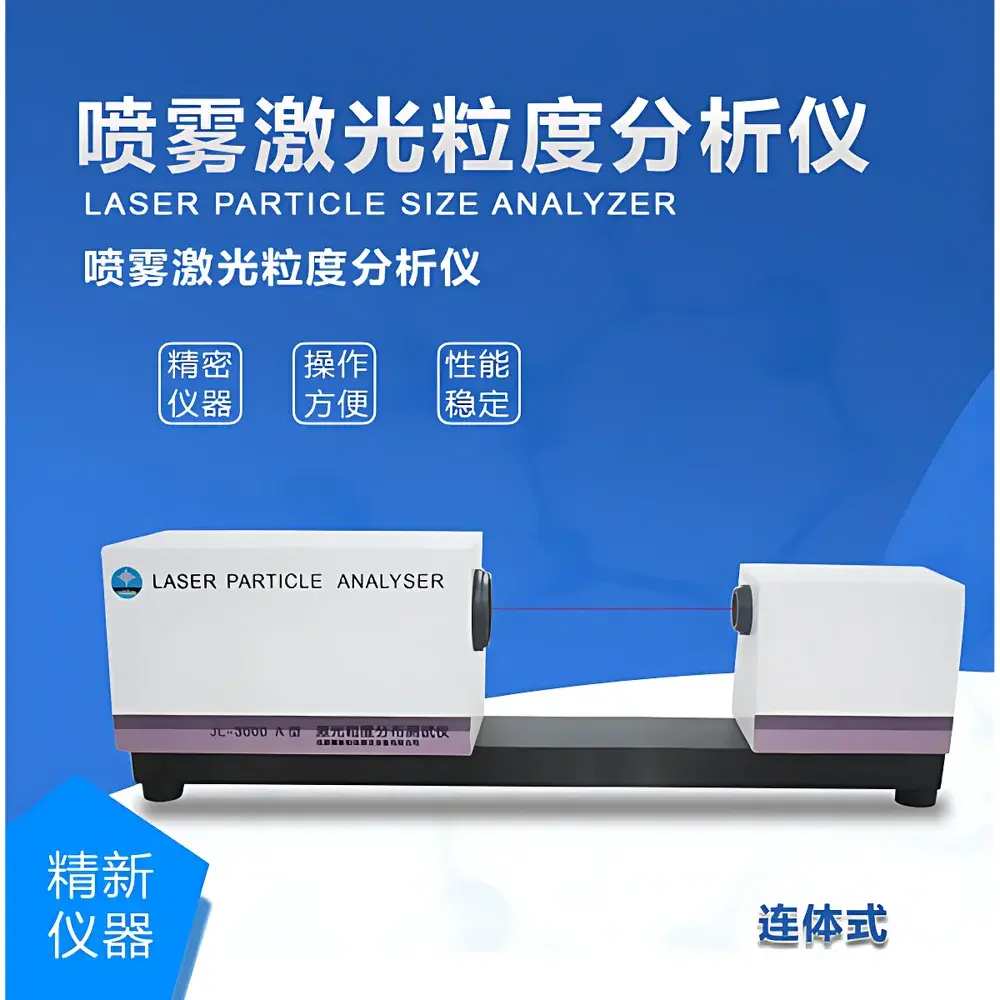
Chengdu Jingxin JL-3000 Integrated Spray Laser Particle Size Analyzer
| Brand | Chengdu Jingxin (CDJX) |
|---|---|
| Origin | Sichuan, China |
| Manufacturer Type | Manufacturer |
| Product Category | Domestic |
| Model | JL-3000 Integrated |
| Price Range | USD 14,000–21,000 |
| Dispersion Method | Wet Dispersion |
| Instrument Type | Laboratory Laser Particle Size Analyzer |
| Measurement Range | 0.01–3000 µm |
| Measurement Time | 10 s per analysis |
| Measurement Principle | Full-range Mie Scattering Theory |
| Optical System | Fourier Transform with Parallel Beam & Large-Diameter Lens |
| Detector | 128-channel Multielement Photodiode Array |
| Laser Source | Imported Semiconductor Laser, 650 nm, 30 mW, >70,000 h Lifetime |
| Repeatability Error | ≤3% (D50 of NIST-traceable Standard Reference Material) |
| Accuracy Error | ≤3% (D50 of NIST-traceable Standard Reference Material) |
| Main Unit–Auxiliary Unit Spacing | 400 mm |
| Dimensions (L×H×W) | 1130 × 340 × 200 mm |
| Weight | ~50 kg |
| Power Supply | AC 220 V ±22 V, 50 Hz ±0.5 Hz |
| Operating Environment | 5–35 °C, RH <85% |
| Data Output | Cumulative Distribution, Frequency Distribution, D10/D50/D90/D97, Mean Diameter, Specific Surface Area |
| Trigger Options | Software Command, TTL Pulse, Mechanical Switch (up to 50 Hz acquisition rate) |
| Interface | RS232 + USB 2.0 (transmission distance up to 100 m) |
| Software Compatibility | Windows XP / 7 / 10 |
| Language Support | English & Chinese UI |
| Reporting | Direct Print, PDF Export, CSV Export |
Overview
The Chengdu Jingxin JL-3000 Integrated Spray Laser Particle Size Analyzer is a purpose-built instrument engineered for high-fidelity, real-time characterization of droplet size distributions in low-volume, transient aerosol streams—including medical nebulizer outputs, humidifier mists, inhalation aerosols, combustion smoke plumes, and industrial atomized sprays. It operates on full-range Mie scattering theory, rigorously solving the electromagnetic scattering equations for spherical particles across the entire measurable size spectrum (0.01–3000 µm), without segmentation or interpolation artifacts. Unlike conventional laser diffraction systems optimized for static suspensions, the JL-3000 employs a fixed 400 mm spacing between its main optical unit and auxiliary sampling module—enabling precise spatial alignment for narrow-beam interrogation of unconfined, freely expanding spray cones. Its parallel-beam Fourier optical architecture, combined with a large-aperture f-theta lens and 128-channel photodetector array, ensures wide angular signal capture (up to ±60° scattering angle), essential for resolving both submicron nuclei and coarse droplets within polydisperse mist clouds.
Key Features
- Fixed 400 mm main–auxiliary unit geometry eliminates optical re-alignment needs and guarantees consistent measurement volume positioning—critical for comparative testing of nozzle variants or process parameter sweeps.
- 128-channel detector with per-channel background light compensation enables fine-grained size binning (logarithmic resolution ≤0.05 φ units), delivering high-resolution frequency distributions without numerical regularization constraints.
- Imported 650 nm, 30 mW semiconductor laser with >70,000 h operational lifetime provides stable, low-noise illumination; laser power is continuously adjustable over full range to optimize signal-to-noise ratio for both low-density smoke and high-concentration oil mists.
- Hermetically sealed chassis with EMI-shielded enclosure ensures electromagnetic compatibility in electrically noisy lab environments (e.g., near HVAC compressors or high-voltage spray generators).
- Dual-trigger capability (TTL pulse, mechanical switch, or software command) supports time-resolved acquisition at up to 50 complete analyses per second—enabling dynamic profiling of pulsating nozzles or transient ignition events.
- RS232 and USB 2.0 interfaces support cable runs up to 100 m, facilitating remote operation in hazardous or confined test cells (e.g., fume hoods, spray booths, or cleanroom gloveboxes).
Sample Compatibility & Compliance
The JL-3000 accommodates open-path sampling of aqueous mists, hydrocarbon-based aerosols, glycol/water mixtures, pharmaceutical propellant-driven sprays, and dilute combustion smoke—without requiring cuvettes, flow cells, or pressurized housings. Its wet dispersion mode is compatible with standard ISO 13320:2020-compliant validation protocols using NIST-traceable polystyrene latex (PSL) standards. While not certified to IEC 61000-4 immunity standards out-of-box, its shielded design meets typical laboratory EMC requirements per CISPR 11 Group 1 Class B. Data integrity complies with ALCOA+ principles: raw scattering patterns and calculated distributions are stored with timestamp, operator ID, instrument serial number, and environmental metadata—supporting GLP audit trails when deployed in regulated R&D settings.
Software & Data Management
Jingxin’s proprietary ParticleSight™ software (v5.x) runs natively on Windows XP through Windows 10 and offers bilingual UI (English/Chinese). It computes particle size distributions via non-negative least-squares inversion of the Mie kernel matrix, applying optional refractive index correction (1.33–1.65 real part; 0–0.1 imaginary part). Output includes D10, D50, D90, D97, span, specific surface area (m²/g), and full cumulative/frequency histograms. All datasets export to CSV, PDF, or XML formats; batch processing allows automated reporting across multi-run experimental series. Audit logging records all user actions, parameter changes, and calibration events—aligning with FDA 21 CFR Part 11 expectations when configured with electronic signatures and role-based access control.
Applications
- Pharmaceutical development: Quantifying droplet size distributions from metered-dose inhalers (MDIs) and soft-mist inhalers (SMIs) per USP & Ph. Eur. aerosol performance guidelines.
- Nozzle engineering: Correlating geometric parameters (orifice diameter, swirl chamber depth) with Dv50 and span metrics to refine atomization efficiency.
- Industrial hygiene: Characterizing respirable fraction (<10 µm) and inhalable mass fraction (<100 µm) in workplace fogging or disinfectant misting operations.
- Combustion research: Measuring soot agglomerate size evolution in laminar diffusion flames or diesel spray plumes under controlled ambient conditions.
- Academic aerosol physics: Validating CFD simulations of droplet breakup, coalescence, and evaporation kinetics using time-resolved size spectra.
FAQ
What refractive index values should be used for water-based mists?
For pure aqueous aerosols at 20 °C, use real part = 1.333, imaginary part = 0.000. For saline or drug-loaded solutions, adjust based on solute concentration using Gladstone–Dale mixing rules.
Can the instrument measure opaque or highly absorbing aerosols?
Yes—Mie theory accommodates complex refractive indices. For carbonaceous smoke or metal oxide mists, input appropriate literature values (e.g., soot: m = 1.75 − 0.75i at 650 nm).
Is calibration required before each test series?
A single daily verification using a NIST SRM 1963 (10.03 µm PSL) is recommended. Full recalibration is performed annually or after optical component replacement.
How is the measurement volume defined in open-path configuration?
The effective sensing volume is a cylindrical region 400 mm from the laser exit, with diameter ≈12 mm and axial length ≈2 mm—determined by beam waist and detector field-of-view overlap.
Does the system support GMP-compliant data archiving?
When deployed with validated network storage and user authentication, raw data files (.jls), analysis logs, and PDF reports satisfy long-term archival requirements per Annex 11 and 21 CFR Part 11.



