
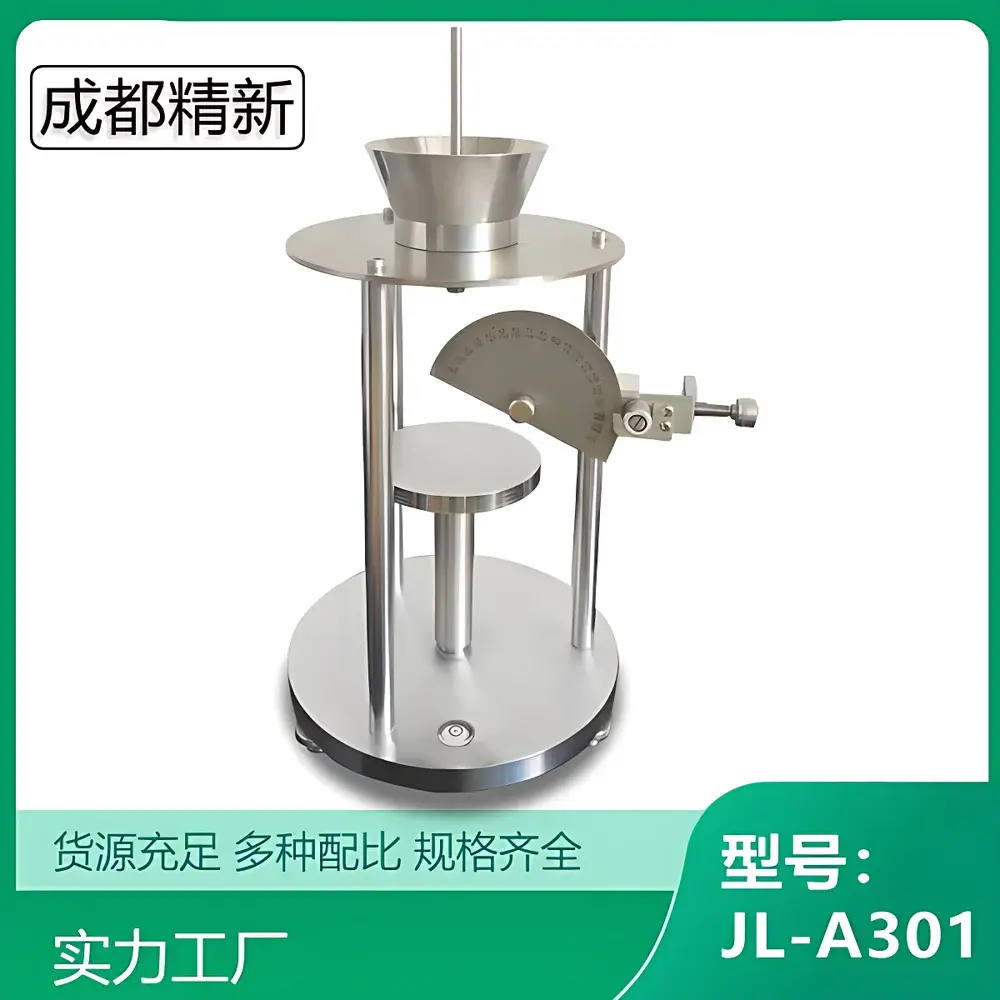
Chengdu Jingxin JLA301 Powder Flowability Tester (Angle of Repose Analyzer)
| Brand | Chengdu Jingxin (CDJX) |
|---|---|
| Origin | Sichuan, China |
| Manufacturer Type | Direct Manufacturer |
| Region Category | Domestic (China-made) |
| Model | JLA301 |
| Price Range | USD 310 – 395 (FOB) |
| Standards Compliance | GB/T 16913–2008, GB/T 31057.3–2018 |
| Funnel Cone Angle | 60° ± 0.5° |
| Funnel Orifice Diameter | 5 mm (optional 10 mm) |
| Receiving Pan Diameter | 80 mm |
| Vertical Distance Between Funnel Tip and Pan Surface | 80 mm ± 2 mm |
| Protractor Scale | 10 cm arc length (±0.5° resolution) |
| Probe Rod Material | Stainless Steel (AISI 304) |
Overview
The Chengdu Jingxin JLA301 Powder Flowability Tester is a precision-engineered instrument designed to determine the angle of repose — a fundamental physical property quantifying the flow behavior of dry, cohesionless or weakly cohesive powders under gravity-driven conditions. Based on the fixed-base funnel method (also known as the “pouring method”), the device operates by allowing a defined mass of powder to flow freely from a standardized conical funnel onto a flat, horizontal stainless-steel receiving plate. The resulting conical pile forms a stable geometry whose apex angle — measured between the sloping surface and the horizontal plane — constitutes the static angle of repose. This parameter reflects interparticle friction, surface energy, particle size distribution, and bulk density effects, and serves as a primary indicator in process design for pneumatic conveying systems, hopper geometry optimization, dust collection equipment layout, and pharmaceutical blend uniformity assessment.
Key Features
- Compliant with internationally referenced national standards: GB/T 16913–2008 (“Test methods for characterization of bulk solids — Angle of repose”) and GB/T 31057.3–2018 (“Powder technology — Part 3: Determination of flowability using angle of repose”)
- Fixed-geometry stainless-steel funnel with precisely machined 60° cone angle (±0.5° tolerance) and interchangeable orifices (5 mm standard; optional 10 mm for coarse granules)
- Calibrated protractor assembly with 10 cm arc scale enabling direct angular readout with ±0.5° repeatability
- Robust aluminum alloy frame with adjustable leveling feet ensuring horizontal alignment per test protocol requirements
- Integrated stainless-steel (AISI 304) probe rod for controlled powder release and gentle agitation during low-flow scenarios
- No electrical components or software dependencies — fully manual, maintenance-free operation ideal for QC labs, R&D environments, and field deployment
Sample Compatibility & Compliance
The JLA301 accommodates free-flowing to marginally cohesive powders ranging from fine pharmaceutical excipients (e.g., microcrystalline cellulose, lactose monohydrate) to industrial minerals (e.g., silica sand, calcium carbonate), metal powders (e.g., atomized stainless steel 316L), and agricultural granules. It is not suitable for highly cohesive, hygroscopic, or electrostatically charged materials without prior conditioning (e.g., drying, anti-static treatment). All mechanical dimensions and procedural steps align with GB/T 16913–2008 Annex A and GB/T 31057.3–2018 Clause 6, ensuring traceable, auditable results compatible with GLP-compliant documentation workflows. While not certified to ISO 4762 or ASTM D6393, its methodology correlates closely with those standards when applied within defined particle size (<1 mm) and moisture content (<1 wt%) boundaries.
Software & Data Management
The JLA301 is a purely mechanical instrument with no embedded electronics, firmware, or digital interface. Data acquisition is performed manually via visual protractor reading and recorded in laboratory notebooks or LIMS-compatible spreadsheets. Users may implement internal SOPs requiring triplicate measurements per sample batch, with arithmetic mean reporting and standard deviation calculation per GB/T 16913–2008 Section 8.2. For regulated environments (e.g., pharmaceutical manufacturing), laboratories commonly integrate the JLA301 into validated test protocols that include operator training records, equipment calibration logs (protractor zero-check and funnel dimension verification), and raw data archiving per FDA 21 CFR Part 11 principles — though the instrument itself imposes no electronic audit trail requirement.
Applications
- Pre-formulation screening of active pharmaceutical ingredients (APIs) and excipients during solid dosage development
- Batch-to-batch consistency monitoring in food ingredient blending (e.g., powdered milk, spices, instant beverages)
- Hopper and silo design validation for cement, fertilizer, and polymer pellet handling systems
- Quality control of additive manufacturing feedstocks (e.g., Ti-6Al-4V, Inconel 718 powders)
- Evaluation of anti-caking agent efficacy in detergent and agrochemical formulations
- Academic research on granular physics, including shear strength modeling and discrete element method (DEM) parameterization
FAQ
What is the recommended sample volume for each test?
A nominal 100 mL volumetric sample is used, delivered via standardized measuring cup. Actual mass varies depending on powder bulk density.
Can the JLA301 be used for wet or damp powders?
No. Moisture content must remain below 1.0 wt% to avoid capillary bridging effects that invalidate repose angle interpretation per GB/T 16913–2008.
Is calibration required before each use?
Yes — users must verify horizontal leveling of the baseplate and confirm protractor zero alignment prior to every test series.
How does funnel orifice size affect the measured angle?
Smaller orifices (5 mm) increase residence time and promote densification, often yielding slightly lower angles for moderately cohesive powders; larger orifices (10 mm) reduce shear history and are preferred for coarse or fragile particles.
Does this instrument meet USP <1174> or EP 2.9.36 requirements?
While not explicitly cited in pharmacopoeial monographs, the JLA301’s methodology satisfies the general principles of “flow through an orifice” described in USP <1174> and supports risk-based justification for powder flow classification in QbD frameworks.



