
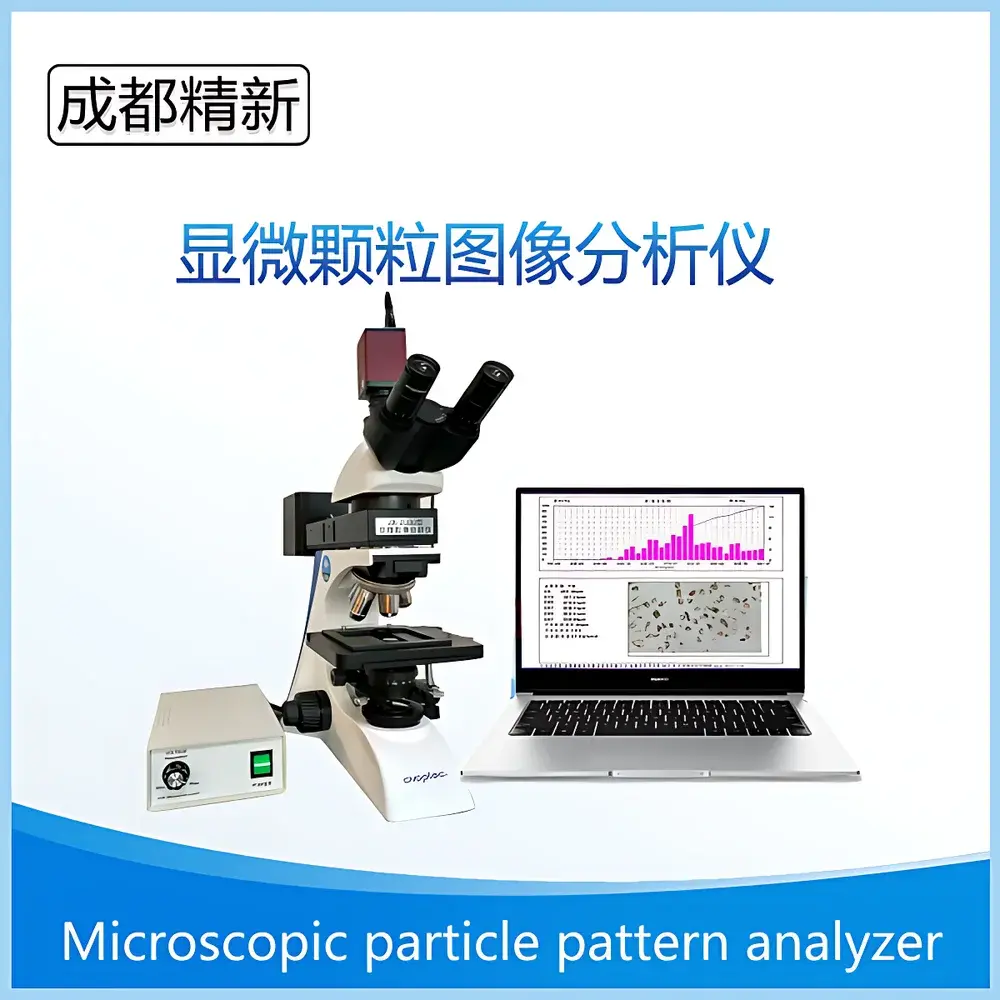
Chengdu Jingxin JX-2000B Static Image-Based Particle Size and Shape Analyzer
| Brand | Chengdu Jingxin (CDJX) |
|---|---|
| Origin | Sichuan, China |
| Manufacturer Type | Direct Manufacturer |
| Regional Category | Domestic (China) |
| Model | JX-2000B |
| Instrument Type | Static |
| Number of Lenses | 8 |
| Measurement Range | 0.5–3000 µm |
| Dispersion Method | Wet Dispersion |
| Image Resolution Precision | 4 MP |
| Measured Parameters | Particle Size Distribution, Aspect Ratio, Morphological Features |
Overview
The Chengdu Jingxin JX-2000B Static Image-Based Particle Size and Shape Analyzer is a precision optical metrology system engineered for quantitative microstructural characterization of particulate materials. It operates on the principle of high-resolution digital microscopy coupled with automated image segmentation and morphometric analysis. Unlike ensemble-averaging techniques such as laser diffraction, this instrument captures individual particle geometry—enabling direct measurement of size distribution, aspect ratio, circularity, convexity, solidity, and surface texture at the single-particle level. Designed for laboratory-based static analysis, the JX-2000B integrates a transmitted/reflected light microscope, a high-sensitivity CCD camera (3–5 megapixels), calibrated stage micrometers, and proprietary Windows-native software to deliver traceable, morphology-aware particle data. Its measurement range spans 0.5 µm to 3000 µm—covering fine powders, abrasive grits, pharmaceutical excipients, and industrial slurries—making it suitable for R&D validation, QC release testing, and method correlation studies.
Key Features
- Modular optical platform supporting both brightfield transmission and reflected-light (metallurgical) observation modes; optional configurations include domestic or imported high-NA objective lenses (4×, 10×, 20×, 40×, 100×) with total optical magnification up to 1600× and digital zoom up to 4000×
- Dual-lens imaging architecture with eight interchangeable lens positions, enabling rapid multi-scale acquisition without manual repositioning or recalibration
- Sub-micron resolution capability (≤0.1 µm effective pixel resolution at highest magnification) supported by 10 µm stage calibration standard and real-time scale overlay
- Wet dispersion module compatible with aqueous and organic media, ensuring stable suspension and minimal agglomeration during imaging
- Comprehensive image preprocessing suite: grayscale conversion, contrast equalization, morphological operations (erosion/dilation), edge enhancement, binary thresholding, hole filling, and manual region-of-interest editing
- Batch processing engine for automated analysis of multiple fields-of-view, statistically increasing particle count per sample (>10,000 particles typical) to improve representativeness and reproducibility
Sample Compatibility & Compliance
The JX-2000B accommodates a broad spectrum of dry powders and liquid suspensions—including abrasives (e.g., silicon carbide, boron carbide), battery cathode materials (e.g., lithium cobalt oxide), functional ceramics (e.g., ceria, mica), pharmaceutical APIs and excipients, food-grade starches, catalyst supports, and glass microspheres. Sample preparation follows standardized wet-mount protocols aligned with ISO 13322-1:2014 (Particle size analysis — Image analysis methods — Part 1: Static image analysis). While not certified for GMP environments out-of-the-box, the system supports audit-ready documentation: all image metadata (timestamp, magnification, calibration ID, operator ID) is embedded in output files, and raw images are stored losslessly in BMP/JPG formats. Optional software modules can be configured to meet GLP-compliant data integrity requirements, including electronic signatures and change logs per FDA 21 CFR Part 11 guidelines.
Software & Data Management
The native Windows 7 (32-bit) analysis software provides full control over acquisition, processing, and reporting workflows via USB 2.0 interface. Calibration units are user-definable (µm, mm, cm, inch), with automatic scaling applied across magnifications using stored lens-specific scale factors. Analytical outputs include number-weighted and area-weighted distributions, D10, D50, D90, D97, mean Feret diameter, projected area, perimeter, circularity (4π·Area/Perimeter²), aspect ratio (major axis/minor axis), and convexity. Reports export to PDF, Excel, or HTML, embedding annotated thumbnails, test parameters, dispersion medium details, and customizable headers. For industry-specific use cases—such as grinding media quality control or mineral fiber classification—custom algorithm templates (e.g., for acicular particle identification or sphericity filtering) can be implemented via scripting interface.
Applications
- Validation and cross-correlation of laser diffraction or dynamic light scattering results through direct morphological verification
- QC inspection of spherical glass beads used in reflective coatings, road marking paints, and biomedical microcarriers
- Characterization of anisotropic particles (e.g., silicon carbide whiskers, mica platelets) where shape-sensitive performance metrics govern functionality
- Monitoring batch-to-batch consistency in battery electrode slurry formulations, especially for conductive carbon black and active material blends
- Regulatory documentation support for pharmaceutical granules and inhalation powders under USP and ICH Q5A guidelines
- Research into fracture mechanics and comminution behavior of brittle minerals (e.g., quartz, barite) in milling process optimization
FAQ
What is the minimum detectable particle size?
The system achieves reliable detection down to 0.5 µm under optimal contrast conditions with 100× oil-immersion objectives and appropriate staining or refractive index matching.
Can the JX-2000B analyze dry powders directly?
No—it is designed for static wet-dispersed samples only. Dry powder analysis requires vacuum-compatible SEM or specialized dry-cell accessories not included in this configuration.
Is the software compliant with 21 CFR Part 11?
The base software does not include electronic signature or audit trail functions; however, validated add-on modules are available upon request for regulated environments.
How many particles are typically analyzed per sample?
Standard protocols acquire ≥50 fields-of-view per sample, yielding statistical populations exceeding 10,000 measurable particles—sufficient for robust percentile estimation per ISO 9276-2.
Does the system support automated focus stacking?
No—focus is manually adjusted per field. Z-stacking and 3D reconstruction require external motorized stages and are not part of the JX-2000B’s core configuration.



