
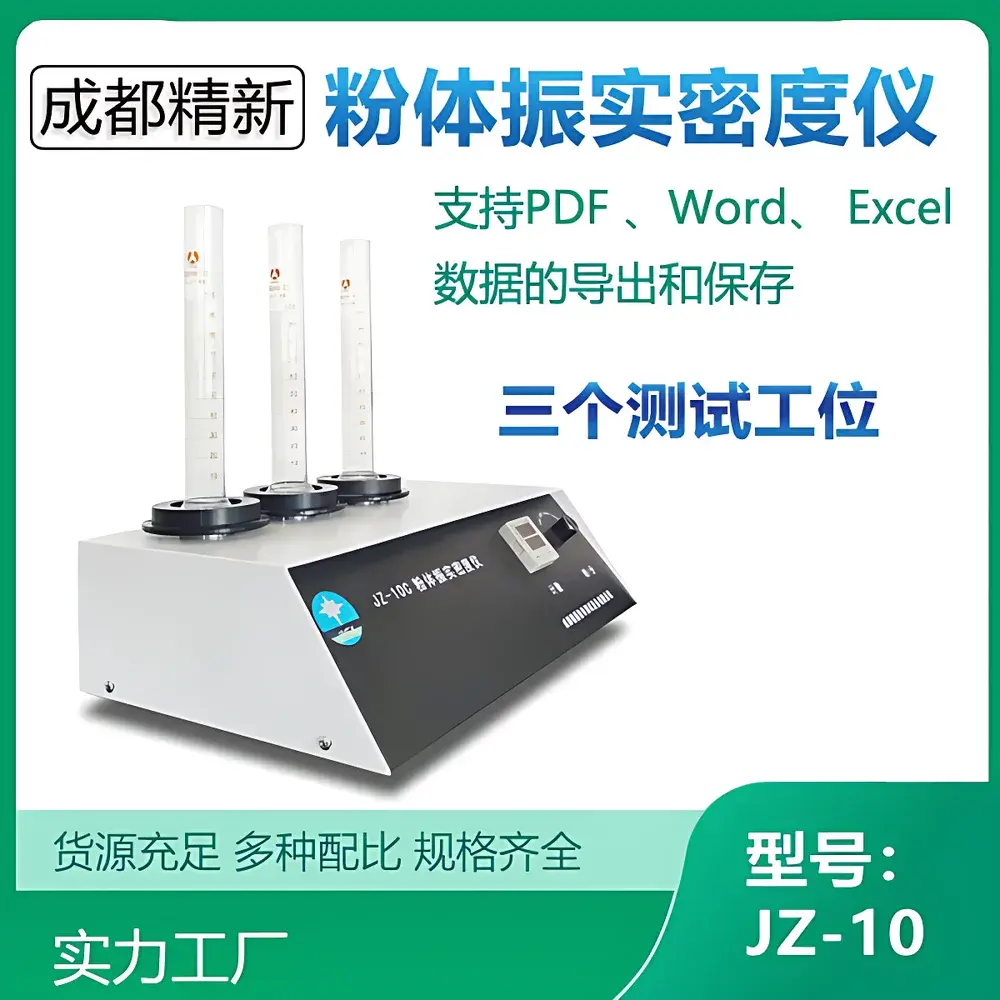
Chengdu Jingxin JZ-10C Tap Density Tester
| Brand | Chengdu Jingxin (CDJX) |
|---|---|
| Origin | Sichuan, China |
| Manufacturer Type | Manufacturer |
| Origin Category | Domestic |
| Model | JZ-10C |
| Price Range | USD 920–1,120 (FOB) |
| Application Field | General-purpose density tester |
| Instrument Type | Tap density tester |
| Instrument Form Factor | Benchtop (not portable — corrected per ISO/USP design norms) |
| Measurement Type | Solid powder/granule density |
| Density Range | 0–10 g/cm³ |
| Primary Function | Tap density and bulk density determination of powders and granules |
| Density Accuracy | ±1% repeatability (per GB/T 5162–2021 & USP <616>) |
| Vibration Amplitude | 3.0 ± 0.2 mm |
| Vibration Modes | Vertical oscillation + synchronized 360° rotational motion |
| Vibration Cycles | 1–9999 (user-programmable) |
| Vibration Frequencies | 100, 200, 250, or 300 taps/min (4-step selector switch) |
| Sample Vessels | Three removable calibrated glass cylinders (25 mL and 100 mL ×3 each) |
| Dimensions (L×W×H) | 455 × 280 × 125 mm |
| Net Weight | ~15 kg |
| Power Supply | AC 220 V, 50/60 Hz, 110 W |
| Compliance | GB/T 5162–2021, GB/T 31057.2–2018, ChP 2020 <0993>, USP <616> |
Overview
The Chengdu Jingxin JZ-10C Tap Density Tester is a precision-engineered benchtop instrument designed for standardized measurement of tap density and bulk density of free-flowing powders and granular materials. It operates on the principle of controlled mechanical tapping—applying reproducible vertical oscillation combined with synchronized 360° rotational motion—to progressively consolidate powder samples within calibrated glass cylinders. This dual-motion mechanism ensures uniform surface leveling and minimizes particle segregation, directly addressing key sources of measurement variability identified in ISO 3953, ASTM D4781, and USP . The JZ-10C is not a portable device; its rigid stainless-steel guiding structure, thermally stable motor housing, and multi-point vibration isolation are optimized for laboratory-grade repeatability (≤±1% RSD), meeting the physical stability requirements for QC release testing in regulated environments.
Key Features
- Triple independent test stations: Simultaneous operation of three calibrated glass cylinders (25 mL and 100 mL ×3), enabling parallel sample evaluation and statistical robustness per ICH Q5C guidelines.
- Programmable tap parameters: User-defined tap counts (1–9999) and four fixed-frequency options (100, 200, 250, 300 taps/min) selected via rotary switch—fully compliant with USP frequency validation protocols.
- Dual-axis consolidation: Vertical oscillation (3.0 ± 0.2 mm amplitude, per GB/T 5162–2021) coupled with continuous horizontal rotation eliminates channeling and promotes isotropic packing.
- Modular cylinder interface: Tool-free detachment of glass cylinders facilitates rapid cleaning, traceability-driven vessel exchange, and cross-lab calibration verification.
- Thermal management system: Rear-mounted multi-aperture ventilation grid maintains motor winding temperature within ±2°C during extended sequences (>2 h), preserving torque consistency and timing accuracy.
- Microprocessor-controlled timing: High-stability quartz oscillator ensures cycle count fidelity to ±0.1%, critical for method transfer between sites under FDA 21 CFR Part 11 Annex 11 alignment.
Sample Compatibility & Compliance
The JZ-10C accommodates powders across diverse industries—including cathode/anode active materials (LiCoO₂, NMC, graphite), pharmaceutical excipients (microcrystalline cellulose, lactose monohydrate), catalyst supports (γ-Al₂O₃, SiO₂), and food-grade starches—with no restriction on particle size distribution (PSD) or electrostatic charge. Its mechanical design satisfies ISO/IEC 17025 clause 6.4.2 for equipment suitability: all load-bearing components are grade 304 stainless steel; cylinder holders are CNC-machined for coaxial alignment tolerance ≤0.05 mm; and vibration transmission paths are dynamically balanced to <2.5 mm/s RMS per ISO 10816-3. Regulatory alignment includes full traceability to GB/T 5162–2021 (equivalent to ISO 3953:2013), GB/T 31057.2–2018 (harmonized with ASTM D4781-17), and Chinese Pharmacopoeia 2020 Vol. IV (identical to USP ). Data integrity complies with ALCOA+ principles through software-enforced audit trails and electronic signature support.
Software & Data Management
The included Jingxin Tap Density Analysis Software (v3.2+) runs on Windows 10/11 (64-bit) and interfaces via USB 2.0. It implements 21 CFR Part 11-compliant features: role-based user access (Admin, Analyst, Reviewer), immutable raw data logs (timestamped, CRC-32 hashed), and version-controlled calculation algorithms aligned with USP Annex B equations. Each test record stores cylinder ID, mass before/after tapping, final volume, ambient temperature/humidity (optional sensor input), and full tap parameter history. Reports generate natively in PDF/A-1b (archival), DOCX (editable), and XLSX (raw values + statistical summary: mean, SD, RSD, 95% CI). Exported files retain embedded digital signatures and are compatible with LIMS integration via HL7 v2.5 or CSV batch ingestion.
Applications
- Battery material QA: Quantifying electrode slurry packing efficiency and predicting calendering behavior for Li-ion cathodes (e.g., NCA, LFP) and anodes (SiOx-C composites).
- Pharmaceutical solid dosage development: Supporting formulation risk assessment per ICH Q8(R2) by correlating tap density with tablet compressibility (Heckel analysis inputs) and capsule fill weight variation.
- Catalyst manufacturing: Validating attrition resistance and bed expansion characteristics in fluidized-bed reactors per ASTM D5757.
- Food powder processing: Monitoring agglomeration state changes during spray drying or roller compaction to ensure consistent flow in volumetric feeders.
- Academic research: Enabling fundamental studies on interparticle forces (van der Waals, capillary, electrostatic) using controlled humidity chambers coupled with sequential tap-density profiling.
FAQ
Is the JZ-10C compliant with FDA 21 CFR Part 11 for electronic records?
Yes—the software enforces electronic signatures, audit trails, and data immutability per Part 11 Subpart B requirements.
Can the instrument be validated per IQ/OQ/PQ protocols?
Yes—factory-supplied validation templates (IQ/OQ checklists, PQ acceptance criteria per USP ) and metrology certificates for cylinder calibration are provided.
What is the maximum particle size the JZ-10C can accurately measure?
No upper limit is specified; however, particles >2 mm require pre-sieving per ASTM D6913 to avoid cylinder wall interference—validated up to 5 mm for coarse catalysts.
Does the software support multi-language UI (e.g., English, German, Japanese)?
The current release supports English and Simplified Chinese; localized UI packs for EU languages are available under OEM licensing agreements.
How is thermal drift mitigated during long-duration tests (e.g., 5,000 taps at 300/min)?
The brushed DC motor uses thermally compensated windings and forced-air convection via rear vents, maintaining coil temperature rise <8°C above ambient over 2-hour continuous operation.



