
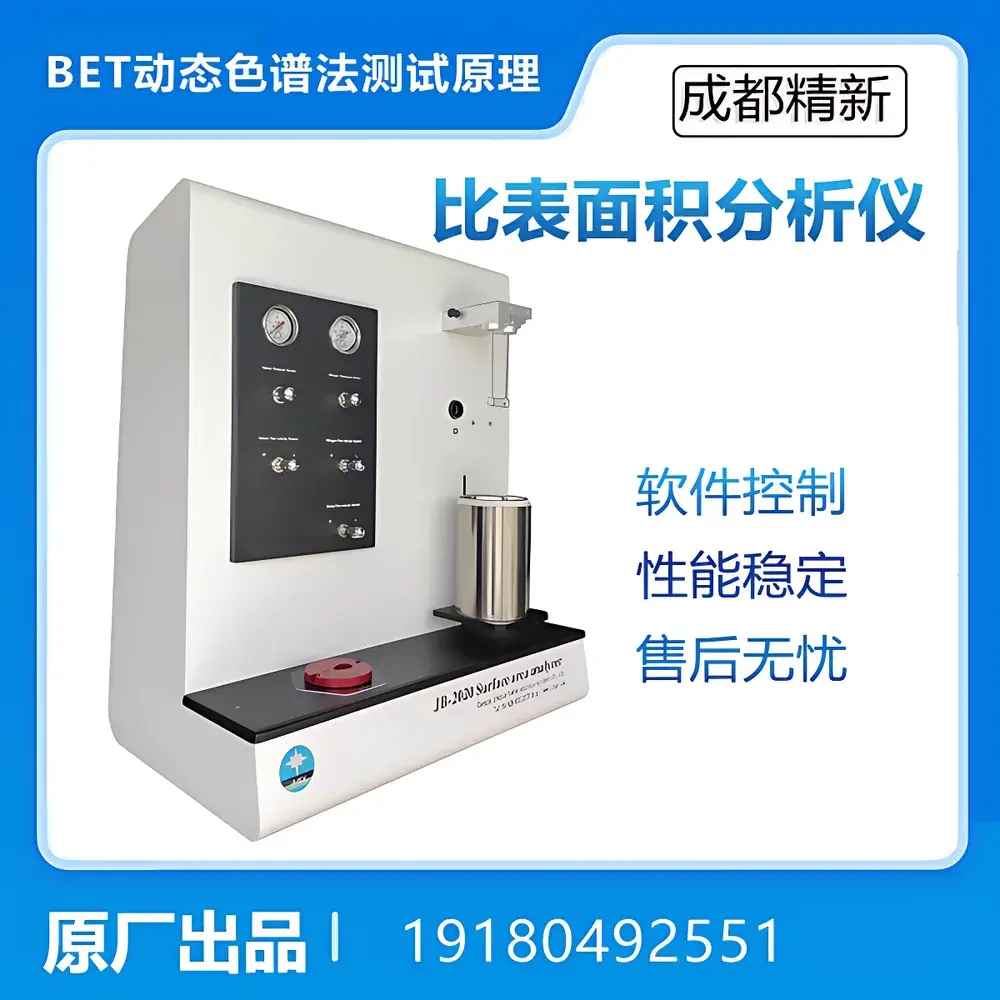
Chengdu Jingxin JB-2020 Automated Specific Surface Area Analyzer (Dynamic Nitrogen Adsorption Method)
| Brand | Chengdu Jingxin (CDJX) |
|---|---|
| Origin | Sichuan, China |
| Manufacturer Type | Direct Manufacturer |
| Product Category | Domestic Instrument |
| Model | JB-2020 |
| Instrument Type | Specific Surface Area Analyzer |
| Principle | Dynamic (Flow-through) Nitrogen Adsorption |
| Number of Analysis Stations | 1 |
| Measurement Range | 0.0005 m²/g to unlimited |
| Pressure Control Range | 1–5 kPa (gauge) |
| Theoretical Basis | Dynamic nitrogen adsorption coupled with cryogenic adsorption thermodynamics and gas chromatographic response calibration |
| Operating Ambient Temperature | 10–36 °C |
| Repeatability Error | ≤ ±3% |
| Accuracy Error | ≤ ±3% |
| Sample Tube Material | High-temperature-resistant borosilicate glass (GG-type, U-shaped) |
| Carrier Gas | Ultra-high-purity helium (≥99.999%) |
| Adsorbate Gas | Ultra-high-purity nitrogen (≥99.999%) |
| Software Compatibility | Windows 7 / Windows 10 (32/64-bit) |
| Dimensions (W×D×H) | 700 × 360 × 710 mm |
| Weight | ~30 kg |
| Power Supply | AC 220 V ±22 V, 50 Hz ±0.5 Hz |
| Environmental Requirements | 5–35 °C ambient temperature |
Overview
The Chengdu Jingxin JB-2020 Automated Specific Surface Area Analyzer is an entry-level, single-station instrument engineered for rapid, reliable determination of specific surface area (SSA) of solid powders and porous materials using the dynamic (flow-through) nitrogen adsorption method. Unlike static volumetric or gravimetric systems, the JB-2020 operates on a continuous-flow principle grounded in cryogenic adsorption thermodynamics: a precisely metered mixture of high-purity helium (carrier) and nitrogen (adsorbate) passes over a cooled sample immersed in liquid nitrogen. Adsorbed nitrogen is subsequently desorbed upon warming, generating a characteristic thermal conductivity detector (TCD) response curve. By comparing the integrated peak area of the desorption signal against that of a known standard gas volume—calibrated using certified reference materials such as GBW(E)130275—the instrument computes SSA per the Brunauer–Emmett–Teller (BET) theory or single-point approximation. This method delivers robust reproducibility for routine quality control while maintaining compliance with GB/T 19587–2017, the Chinese national standard aligned with ISO 9277 and ASTM D3663 for gas adsorption surface area measurement.
Key Features
- Single-station architecture optimized for high-throughput laboratories requiring cost-effective, space-efficient SSA analysis.
- Proprietary high-precision gas dosing module ensures stable, repeatable delivery of helium/nitrogen mixtures across variable flow rates and pressure ranges (1–5 kPa).
- Low-temperature TCD sensor with extended operational lifetime, insensitive to gas composition shifts and resistant to contamination from trace impurities.
- U-shaped GG-grade borosilicate sample tube designed for uniform thermal contact with liquid nitrogen and mechanical resilience during repeated immersion cycles.
- Automated thermal cycling protocol: sample cooling → adsorption → controlled warming → desorption detection → data integration — all executed without manual intervention.
- Integrated calibration workflow supporting traceable validation using NIST-traceable or nationally certified reference materials (e.g., GBW(E)130275).
Sample Compatibility & Compliance
The JB-2020 accommodates a broad spectrum of powdered and granular solids including battery cathode materials (LiCoO₂, LiMn₂O₄, Li₄Ti₅O₁₂), pharmaceutical excipients and APIs, heterogeneous catalysts (e.g., Pt/C, zeolites), ceramic precursors, cementitious phases, and activated carbons. Its dynamic methodology is particularly suited for low-surface-area samples (<1 m²/g), where static techniques often suffer from poor signal-to-noise ratio and long equilibration times. The instrument meets fundamental metrological requirements outlined in GB/T 19587–2017 and supports documentation practices consistent with GLP environments. While not inherently 21 CFR Part 11-compliant out-of-the-box, audit trails, user access logs, and electronic signature readiness can be implemented via supplementary software configuration under validated laboratory procedures.
Software & Data Management
The native Windows-compatible application (tested on Windows 7 and Windows 10) provides full instrument control, real-time signal visualization, automated peak integration, and multi-sample batch processing. Raw TCD response curves are stored in proprietary binary format with embedded metadata (date/time, operator ID, calibration status, environmental conditions). Export options include CSV, PDF, and XML for integration into LIMS or statistical process control platforms. Reporting modules support comparative analysis across batches, trend charting of SSA vs. production lot, and customizable templates compliant with internal QA documentation standards. All measurement records retain full traceability to calibration events and reference material lot numbers.
Applications
- Quality assurance of lithium-ion battery electrode materials during R&D and manufacturing scale-up.
- Routine SSA verification of pharmaceutical powders to ensure consistent dissolution kinetics and blend uniformity.
- Characterization of catalyst support surfaces to correlate activity with accessible active site density.
- Process monitoring of calcination, milling, or spray-drying steps affecting particle agglomeration and porosity.
- Evaluation of adsorbent capacity in environmental remediation media (e.g., activated clays, silica gels).
- Raw material certification for ceramics and refractory producers requiring tight SSA specifications.
FAQ
What standards does the JB-2020 comply with?
The instrument implements measurement protocols fully aligned with GB/T 19587–2017, which references ISO 9277 (2010) and ASTM D3663–03(2020) for dynamic nitrogen adsorption surface area determination.
Can the JB-2020 perform full BET multipoint analysis?
Yes — it supports both single-point estimation and multi-point BET analysis (typically 3–5 relative pressure points) using automated stepwise gas concentration modulation.
Is liquid nitrogen handling required during operation?
Yes — the system relies on standard liquid nitrogen Dewar immersion for cryo-adsorption; no closed-cycle cryocooler is integrated.
How is instrument calibration verified?
Calibration is performed using certified standard materials such as GBW(E)130275 (silica gel standard), with documented certificate of analysis and periodic recalibration intervals defined per lab SOP.
Does the software support network deployment or remote access?
The base software is standalone; however, exported data files (CSV/PDF) are compatible with enterprise-wide data aggregation tools, and remote desktop access may be enabled via institutional IT policy.



