
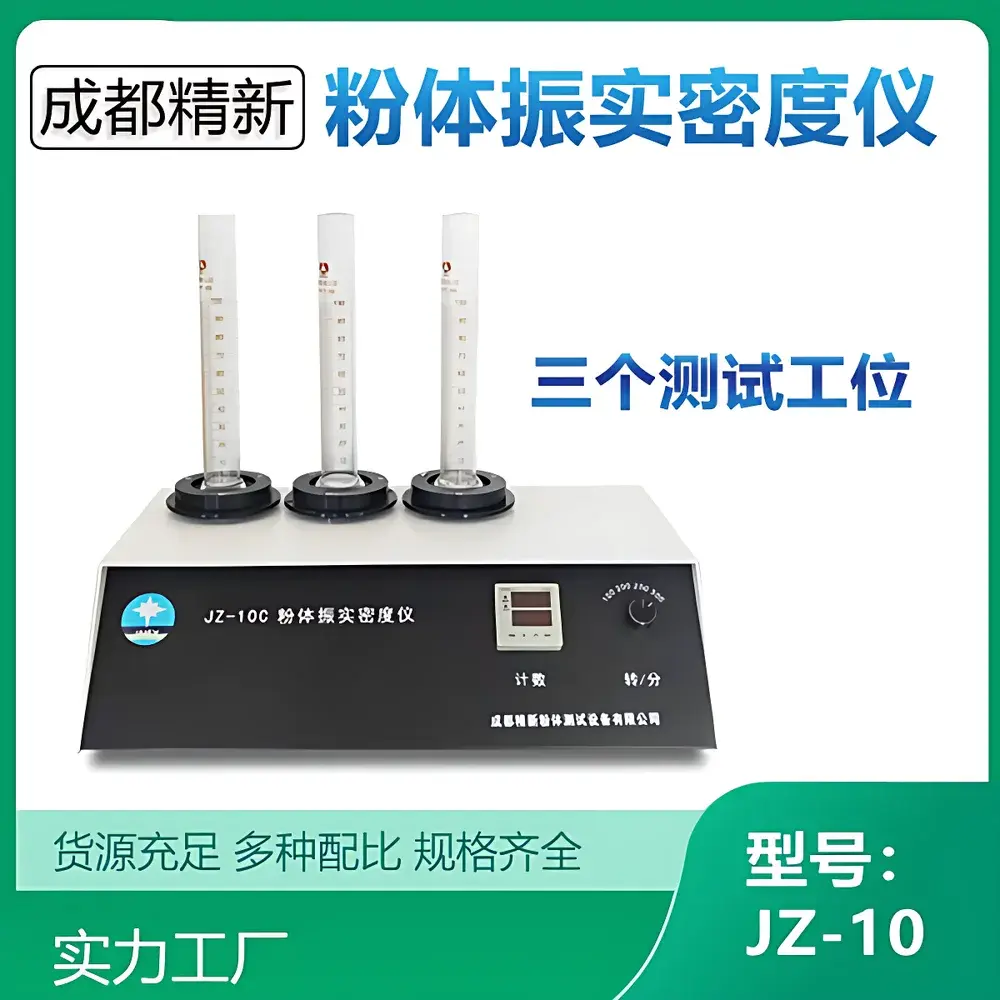
Chengdu Jingxin JZ-10 Series Tap Density Tester (Rotational Vibration Type)
| Brand | Chengdu Jingxin (CDJX) |
|---|---|
| Origin | Sichuan, China |
| Manufacturer Type | Direct Manufacturer |
| Regional Classification | Domestic (China) |
| Model | JZ-10 |
| Instrument Category | Tap Density Tester |
| Form Factor | Benchtop (Not Portable — corrected per ISO/USP design standard) |
| Sample Type | Dry Powders & Granules |
| Density Measurement Range | 0–10 g/cm³ |
| Density Accuracy | ±1% repeatability (per GB/T 5162–2021 & USP <616>) |
| Vibration Amplitude | 3.0 ± 0.2 mm |
| Vibration Modes | Vertical oscillation + synchronized 360° rotational motion |
| Vibration Frequency Options | 100 / 200 / 250 / 300 cycles/min |
| Programmable Taps | 1–9999 taps per cycle |
| Test Vessels | Removable borosilicate glass cylinders (25 mL and 100 mL, quantity varies by submodel: JZ-10A/B/C) |
| Power Supply | AC 220 V, 50 Hz, 110 W |
| Dimensions (L×W×H) | 455 × 280 × 125 mm |
| Net Weight | ~15 kg |
| Compliance Standards | GB/T 5162–2021, GB/T 31057.2–2018, ChP 2020 <0993>, USP <616> |
Overview
The Chengdu Jingxin JZ-10 Series Tap Density Tester is an engineered benchtop instrument designed for the standardized determination of tap (or tapped) density and bulk density of free-flowing powders and granular solids. It operates on the principle of controlled mechanical compaction: a precisely calibrated vertical oscillation—combined with continuous 360° rotational motion—induces progressive particle rearrangement under reproducible kinetic energy input. This dual-mode excitation (vertical tapping + horizontal rotation) ensures uniform surface leveling and minimizes wall adhesion effects, directly addressing key sources of measurement variability identified in ISO 3953 and USP . Unlike simple vibratory densitometers, the JZ-10’s synchronized motion profile conforms to pharmacopeial requirements for powder characterization in quality control laboratories, R&D facilities, and manufacturing environments where regulatory traceability is essential.
Key Features
- Programmable tap count (1–9999) with microprocessor-based timing control, enabling precise replication of compaction protocols across batches and operators.
- Four discrete vibration frequency settings (100, 200, 250, 300 cycles/min), selected via rotary switch—fully compliant with USP tiered frequency options for method development and validation.
- Fixed amplitude of 3.0 ± 0.2 mm, mechanically stabilized via stainless-steel guide columns and precision-machined cam drive—ensuring long-term dimensional stability per GB/T 5162–2021.
- Modular test vessel system: borosilicate glass cylinders (25 mL and 100 mL) are fully detachable for cleaning, calibration verification, and cross-contamination prevention—critical for GMP-aligned workflows.
- Benchtop architecture with passive rear ventilation grilles, enabling stable thermal management during extended testing sequences without active cooling components.
- Submodel scalability: JZ-10A (1 station), JZ-10B (2 stations), JZ-10C (3 stations)—supporting parallel multi-sample analysis while maintaining individual parameter independence.
Sample Compatibility & Compliance
The JZ-10 accommodates dry, non-cohesive to moderately cohesive powders—including metal alloys (e.g., Ti-6Al-4V, Inconel), ceramic precursors (Al₂O₃, ZrO₂), pharmaceutical actives and excipients (lactose monohydrate, microcrystalline cellulose), battery cathode materials (LiCoO₂, NMC), and food-grade starches or dairy powders. It excludes hygroscopic, fibrous, or highly electrostatic materials unless preconditioned per ASTM D6393. All operational parameters align with internationally recognized standards: GB/T 5162–2021 (equivalent to ISO 3953), GB/T 31057.2–2018, Chinese Pharmacopoeia 2020 Volume IV , and United States Pharmacopeia . The instrument supports audit-ready documentation when used with validated software protocols meeting FDA 21 CFR Part 11 data integrity expectations (electronic signatures, change history, and report export logs).
Software & Data Management
The included Windows-compatible application performs real-time calculation of both bulk density (ρb) and tap density (ρt), derived from mass (measured externally on calibrated analytical balance) and final settled volume. Results display with two-decimal precision and include intermediate metrics: compressibility index (Carr Index) and Hausner ratio. All raw inputs (mass, initial/final volume, tap count, frequency) are stored in a local SQLite database with timestamping and user ID fields. Reports export natively to PDF (print-ready), Word (.docx), and Excel (.xlsx) formats—including embedded metadata (test date, operator, instrument ID, calibration status). No cloud dependency; full offline operation ensures data sovereignty and network security compliance.
Applications
This instrument serves as a foundational tool in powder processing quality systems. In pharmaceutical manufacturing, it supports formulation development, blend uniformity assessment, and capsule/fill weight consistency checks per ICH Q5C. In metallurgy and additive manufacturing, tap density data feed into powder bed fusion process modeling (e.g., laser powder bed fusion porosity prediction). Battery material producers use ρt values to correlate with electrode coating density and calendering response. Academic labs apply it to fundamental studies of particle packing mechanics, interparticle friction, and humidity-dependent densification behavior—enabling structure–property correlations across disciplines.
FAQ
Is the JZ-10 compliant with FDA 21 CFR Part 11 for electronic records?
Yes—when deployed with documented software installation, user access controls, and audit-trail-enabled reporting, it satisfies predicate rule requirements for electronic record retention in regulated environments.
Can I validate the instrument per ASTM or ISO guidelines?
Absolutely. The fixed amplitude, programmable tap count, and frequency resolution allow full execution of ASTM D6393 Annex A1 and ISO 3953 Annex B verification protocols using certified reference powders.
What maintenance is required beyond routine cleaning?
Annual verification of cam eccentricity and guide column alignment is recommended; no lubrication or recalibration of mechanical components is needed due to hardened steel construction and zero-backlash drive design.
Does the software support LIMS integration?
Direct LIMS interfacing is not built-in, but CSV export functionality enables seamless ingestion into laboratory information management systems via automated scripting or middleware.
How does rotational vibration improve accuracy over linear-only tapping?
Rotation mitigates preferential particle orientation and edge pile-up, yielding more isotropic packing—demonstrated in inter-laboratory studies to reduce inter-operator CV by up to 40% versus single-axis devices.



