
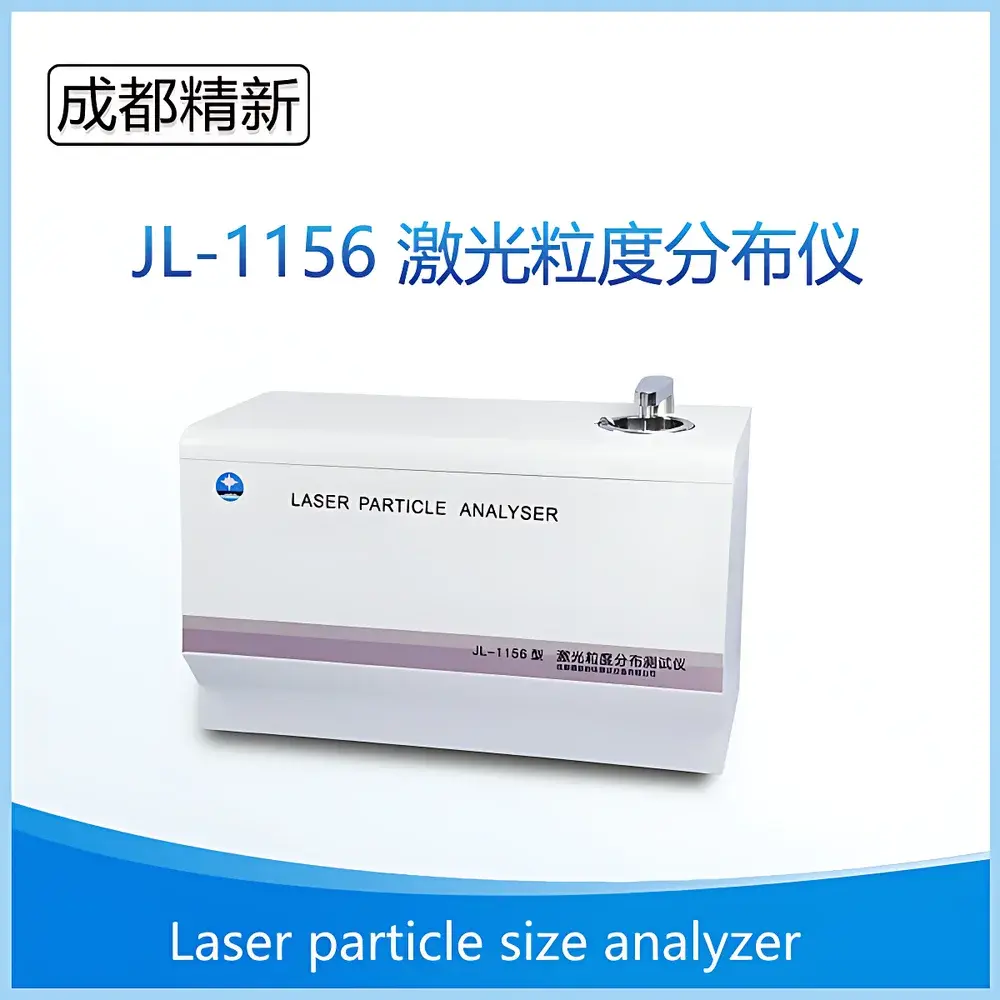
Chengdu Jingxin JL-1156 Wet-Dispersion Laser Particle Size Analyzer
| Brand | Chengdu Jingxin (CDJX) |
|---|---|
| Origin | Sichuan, China |
| Manufacturer Type | Original Equipment Manufacturer (OEM) |
| Instrument Type | Laboratory Laser Diffraction Particle Size Analyzer |
| Measurement Range | 0.1–1000 µm |
| Repeatability | ≤1% (D50 deviation vs. NIST-traceable standard reference materials) |
| Measurement Time | ≤2 minutes per sample |
| Dispersion Method | Wet dispersion with integrated 60 W ultrasonic probe and mechanical stirring |
| Optical System | Inverted Fourier configuration with dual-wavelength laser sources (650 nm / 30 mW primary |
| Detector Array | 98-channel high-resolution photodiode array |
| Sample Cell | 60 mm × 60 mm optical-grade fused silica window |
| Dispersant Volume | 500 mL stainless steel (304) dispersion chamber |
| Compliance | GB/T 19077–2016, ISO 13320:2020, ASTM E799–22 |
Overview
The Chengdu Jingxin JL-1156 is a fully automated, benchtop laser diffraction particle size analyzer engineered for high-precision, routine wet-dispersion analysis of solid powders, suspensions, emulsions, and slurries across industrial QC laboratories and academic research facilities. It operates on the fundamental principles of Mie scattering theory—rigorously applied across the full 0.1–1000 µm dynamic range—and complements this with Fraunhofer approximation where appropriate for coarse particles (>50 µm), ensuring metrological validity under ISO 13320:2020 guidelines. Its inverted Fourier optical architecture minimizes stray light interference from multiple reflections between the sample cell and lens surfaces, while the dual-wavelength laser system (650 nm + 405 nm) enhances resolution in the submicron region—particularly critical for battery cathode materials, pharmaceutical nanosuspensions, and pigment dispersions. All optical components—including the 98-element detector array, beam conditioning optics, and fluidic path—are co-engineered and integrated within a fully sealed, EMI-shielded metal enclosure, delivering long-term optical stability and operational robustness in shared lab environments.
Key Features
- Inverted Fourier optical design with optimized lens geometry and minimized optical path length, reducing signal attenuation and improving angular resolution for fine particles.
- Dual-laser excitation (650 nm main source, 405 nm auxiliary) enables enhanced sensitivity below 1 µm without compromising dynamic range or requiring external alignment.
- 98-channel photodetector array with per-channel dark-current compensation and real-time gain optimization ensures linear response across six orders of magnitude in scattered intensity.
- Integrated wet dispersion module featuring a 500 mL 304 stainless steel dispersion chamber, 60 W programmable ultrasonic transducer with dry-run protection, and variable-speed magnetic stirrer—designed to minimize re-agglomeration and bubble entrapment.
- Fully automated fluid handling: auto-fill, auto-alignment, auto-measurement, auto-rinse, and auto-drain sequences executed via RS232-controlled solenoid valves and peristaltic pump with constant cross-sectional tubing to ensure laminar, reproducible flow profiles.
- Optical sample cell fabricated from optically bonded fused silica (60 mm × 60 mm clear aperture), rated for >10⁶ cycles of thermal and mechanical stress, with zero birefringence and <0.2 nm surface roughness.
Sample Compatibility & Compliance
The JL-1156 supports aqueous and non-aqueous dispersions—including deionized water, ethanol, isopropanol, and low-viscosity organic solvents—compatible with refractive indices ranging from 1.33 (water) to 2.4 (titanium dioxide). It accommodates sample masses from milligrams to grams depending on density, morphology, and optical contrast. The instrument meets traceability requirements of GB/T 19077–2016 (equivalent to ISO 13320:2020) and conforms to ASTM E799–22 for instrument calibration verification using NIST SRM 1963 (10.0 ± 0.2 µm) and SRM 2800 (2.0 ± 0.1 µm). Its software architecture supports audit trails and user access control, aligning with GLP-compliant workflows and preparatory validation for GMP-regulated environments (e.g., USP , FDA 21 CFR Part 11 readiness via optional electronic signature module).
Software & Data Management
The proprietary Jingxin Particle Analysis Suite (v4.2+) runs natively on Windows 10/11 (64-bit) and offers bilingual UI switching (English ↔ Chinese) without reinstalling. It implements unconstrained free-distribution inversion algorithms based on non-negative least squares (NNLS) and Tikhonov regularization, producing D-values (D₃, D₁₀, D₂₅, D₅₀, D₇₅, D₈₄, D₉₀, D₉₇), span, relative width, specific surface area (via volume-surface conversion), and moment-based metrics (d[4,3], d[3,2]). Raw scatter patterns are stored in HDF5 format with metadata tagging (operator ID, timestamp, dispersion parameters, laser power log). Reports export to PDF, CSV, or XML; batch processing supports up to 99 samples with customizable pass/fail thresholds against SOP-defined specification limits. Data integrity is enforced through SHA-256 checksums and optional encrypted database storage.
Applications
The JL-1156 serves as a primary characterization tool in sectors requiring strict control over particulate morphology: lithium-ion battery cathode/anode slurries (LiCoO₂, NMC, graphite); functional pigments and effect pigments in automotive coatings; precipitated calcium carbonate (PCC) and ground calcium carbonate (GCC) in papermaking; catalyst supports (γ-Al₂O₃, zeolites); ceramic raw materials (kaolin, talc, feldspar); pharmaceutical excipients and micronized APIs; food-grade starches and dairy powders; and marine sediment profiling in environmental geology. Its rapid two-minute cycle time and minimal operator intervention make it suitable for high-throughput QA/QC labs performing ≥50 tests/day under ISO/IEC 17025-accredited protocols.
FAQ
Does the JL-1156 support dry powder dispersion?
No—it is designed exclusively for wet dispersion analysis. Dry powder measurement requires separate pneumatic dispersion modules not included in this model.
Can the software generate GMP-compliant reports with electronic signatures?
The base software provides full audit trail functionality; 21 CFR Part 11 compliance requires optional validation package and third-party digital certificate integration.
What maintenance intervals are recommended for the optical system?
Laser alignment verification every 6 months; detector background calibration before each daily session; sample cell cleaning after every 10 tests using lint-free wipes and spectroscopic-grade ethanol.
Is the 405 nm auxiliary laser necessary for all applications?
It is essential for resolving multimodal distributions below 0.5 µm (e.g., nano-TiO₂, quantum dots); for coarse particles (>10 µm), the 650 nm source alone suffices.
How is repeatability validated per ISO 13320?
Repeatability is assessed using three consecutive measurements of certified reference material (CRM); coefficient of variation (CV) of D₅₀ must remain ≤1%, verified annually by accredited metrology lab.



