
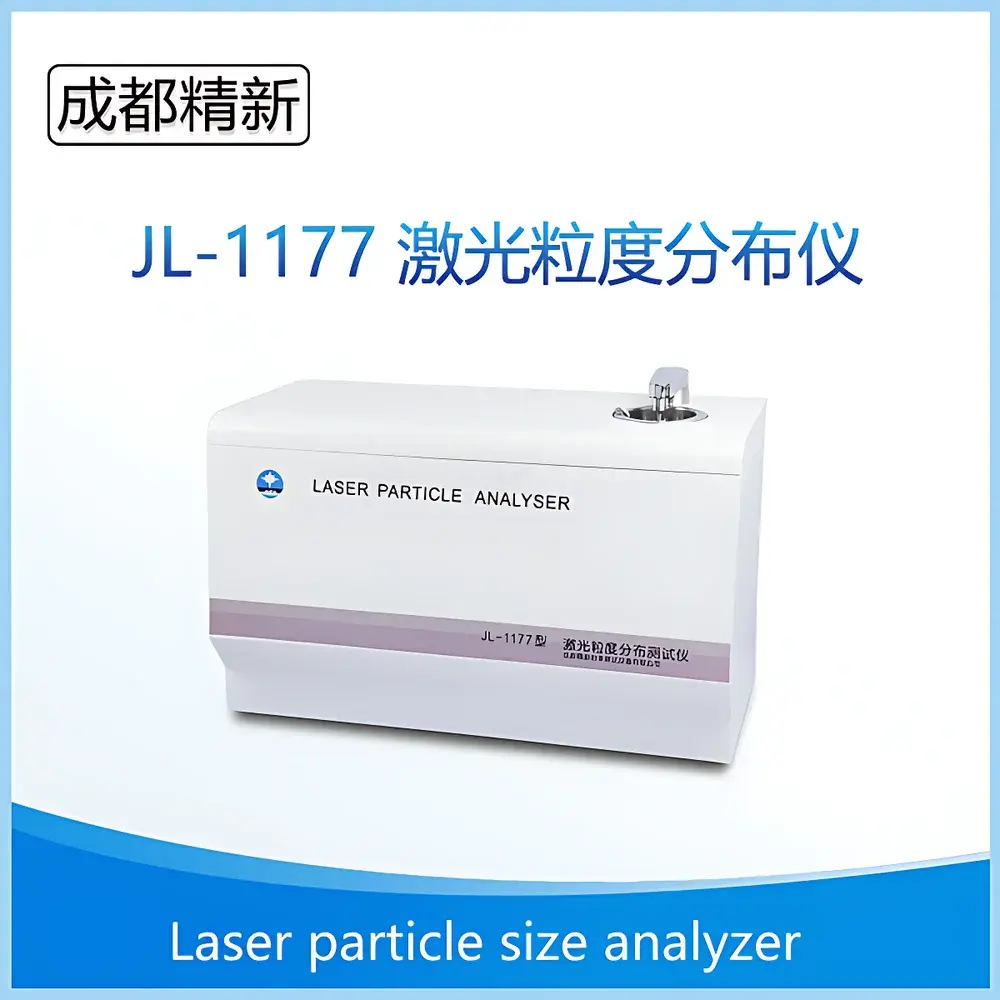
Chengdu Jingxin JL-1177 Wet Dispersion Laser Particle Size Analyzer
| Brand | Chengdu Jingxin (CDJX) |
|---|---|
| Origin | Sichuan, China |
| Manufacturer Type | Direct Manufacturer |
| Regional Category | Domestic (China) |
| Model | JL-1177 |
| Price Range | USD 11,200–14,000 (FOB) |
| Dispersion Method | Wet Dispersion |
| Instrument Type | Laboratory Laser Diffraction Particle Size Analyzer |
| Measurement Range | 0.01 µm – 3000 µm |
| Repeatability | <1% (D50 of NIST-traceable standard reference material) |
| Measurement Time | <120 seconds |
Overview
The Chengdu Jingxin JL-1177 is a fully automated, laboratory-grade wet dispersion laser diffraction particle size analyzer engineered for high-resolution, traceable, and reproducible analysis of solid powders, suspensions, emulsions, and slurries. It operates on the fundamental principles of Mie scattering theory and Fraunhofer diffraction—validated per ISO 13320:2016 and GB/T 19077–2016—and integrates dual-wavelength optical detection (650 nm primary + 405 nm auxiliary) to enhance sensitivity across the full dynamic range—from sub-100 nm colloidal particles to coarse granules up to 3 mm. The inverted Fourier optical design minimizes stray light interference from cell-to-lens reflections, while the 128-channel multi-element detector array captures forward, side, and backward scattered light simultaneously, enabling true angular coverage from ~0.02° to ~140°. This architecture ensures accurate deconvolution of complex, multimodal distributions without reliance on empirical calibration curves.
Key Features
- Optical System: Inverted Fourier configuration with sealed metal housing; eliminates optical drift via elastic suspension of rigid optical bench; high-transmission quartz sample cell (60 mm × 60 mm) bonded with optical-grade adhesive for long-term dimensional stability.
- Dual-Laser Source: Imported 30 mW, 650 nm semiconductor laser (rated lifetime >70,000 h) paired with a 20 mW, 405 nm auxiliary diode to improve resolution in the sub-micron region (especially <0.5 µm).
- Detector Array: 128 independent photodetector channels with per-channel background compensation and high-speed analog signal amplification; real-time optical center self-alignment during each measurement cycle.
- Integrated Wet Dispersion Module: 500 mL stainless steel (AISI 304) dispersion tank with integrated 60 W ultrasonic transducer featuring dry-run protection—automatic power cutoff if liquid level falls below threshold.
- Fluid Handling: Peristaltic pump circulation system with uniform cross-section tubing; zero negative-pressure zones or centrifugal segregation; rapid bubble removal via mechanical stirring motor and optimized flow path geometry.
- Automation Suite: Fully programmable sequence including auto-water intake (level-sensing solenoid valve), optical alignment, measurement, post-run cleaning, and drain—all executed without manual intervention.
Sample Compatibility & Compliance
The JL-1177 supports aqueous and organic dispersions (e.g., deionized water, ethanol, isopropanol) and accommodates sample masses ranging from milligrams to several grams per run. Its wet dispersion system is compatible with fragile nanoparticles, shear-sensitive biopolymers, and abrasive industrial powders—including metal oxides, ceramic precursors, pharmaceutical actives, catalysts, and mineral fillers. The instrument meets structural and operational requirements for GLP-compliant laboratories: audit-trail-capable software logging (user ID, timestamp, parameter set, raw data checksum), configurable pass/fail criteria for reference material verification, and support for routine performance qualification (PQ) using NIST SRM 1963 (10.0 µm) and SRM 2800 (1.5 µm). While not certified to FDA 21 CFR Part 11 out-of-the-box, its data export architecture (CSV, PDF, XML) enables integration into validated LIMS environments under client-defined SOPs.
Software & Data Management
The embedded Windows-compatible analysis software (XP/7/10 native) provides bilingual UI toggle (English/Chinese) and offers three standardized reporting modes: cumulative distribution (volume-, number-, or surface-weighted), Rosin-Rammler (RR), and normal probability plots. Output includes D3, D10, D25, D50, D75, D84, D90, D97, volume mean diameter (D[4,3]), area mean diameter (D[3,2]), and specific surface area (SSA) derived from Mie-based volume-surface conversion. Raw scattering patterns are stored in proprietary binary format with metadata headers (instrument ID, operator, date/time, medium RI, particle RI input). Export options include PDF reports with embedded graphics, CSV tables for statistical post-processing, and direct RS232/USB streaming to external SCADA or MES platforms.
Applications
The JL-1177 serves as a primary characterization tool in R&D and QC laboratories across diverse sectors: electronic materials (conductive pastes, battery cathode slurries), advanced ceramics (zirconia, alumina feedstocks), pharmaceuticals (milled APIs, nanoemulsion carriers), agrochemicals (wettable powders, suspension concentrates), construction materials (cement clinker, fly ash), and specialty chemicals (pigments, catalyst supports, carbon black dispersions). Its wide dynamic range and robust wet dispersion make it especially suitable for quality control of polydisperse systems such as marine sediments, ground limestone, titanium dioxide pigments, and functionalized graphene suspensions—where accurate quantification of both fines (100 µm) directly impacts formulation performance and regulatory compliance.
FAQ
What standards does the JL-1177 comply with?
It adheres to ISO 13320:2016 and GB/T 19077–2016 for laser diffraction methodology, and its performance validation aligns with ISO 22412 for instrument repeatability and accuracy assessment.
Can the system be used with non-aqueous media?
Yes—compatible with low-viscosity organic solvents including ethanol, isopropanol, and acetone, provided refractive index values are entered into the software for Mie theory correction.
Is the ultrasonic disperser adjustable in frequency or power?
The 60 W transducer operates at a fixed resonant frequency optimized for broad-spectrum deagglomeration; power output is digitally regulated and monitored in real time, with automatic thermal cutoff.
How is optical alignment maintained over time?
The inverted optical path and elastically mounted lens assembly minimize thermal and mechanical drift; each measurement cycle includes an internal reference beam check and automatic centering algorithm.
Does the software support user-defined report templates?
Yes—customizable report layouts, logo insertion, and field-specific metadata fields (e.g., batch ID, lot number, analyst signature) can be configured and saved as reusable templates.
What maintenance is required for long-term stability?
Annual verification using NIST-traceable standards is recommended; routine cleaning of the quartz cell and stainless-steel dispersion tank with mild detergent and deionized water is sufficient—no optical realignment tools are required.



