
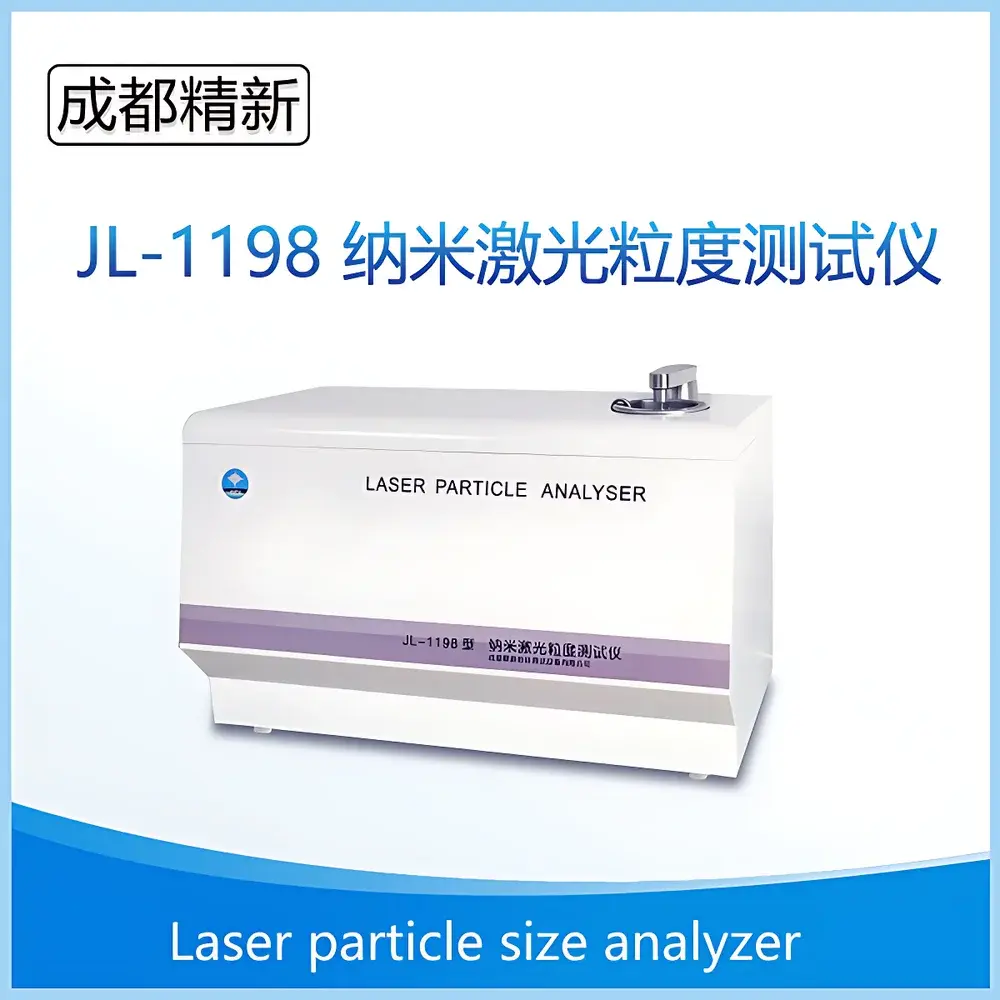
JL-1198 Nanoparticle Laser Particle Size Analyzer by Chengdu Jingxin
| Brand | Chengdu Jingxin (CDJX) |
|---|---|
| Origin | Sichuan, China |
| Manufacturer Type | Direct Manufacturer |
| Instrument Type | Laboratory Dynamic Light Scattering (DLS) Analyzer |
| Measurement Range | 1 nm – 10,000 nm |
| Repeatability | ≤1% (D50 of NIST-traceable standard reference material) |
| Measurement Time | 2–5 minutes per sample |
| Dispersion Method | Wet Dispersion |
| Laser Source | Dual solid-state lasers — 30 mW @ 405 nm |
| Detection Geometry | Transmission mode (90°), Reflection mode (160°) |
| Correlator Channels | 4000 |
| Delay Time Range | 50 ns – 100 ms |
| Temperature Control Range | 0.5 °C – 99.5 °C (resolution: 0.002 °C, no thermal gradient) |
| Sample Volume | 2.5 mL (static cell), 500 mL (circulating cell) |
| Ultrasonic Dispersion | 60 W integrated probe |
| Detector | High-gain, low-noise photomultiplier tube (PMT) |
| Gain Settings | 10-step automatic selection |
| Concentration Range | Transmission mode — ppm to 1% w/v |
| Software Compatibility | Windows XP/7/10, bilingual (English/Chinese) UI |
| Data Output | Volume-based & number-based distributions, D10/D50/D90, specific surface area, cumulative & differential histograms (108 size classes) |
Overview
The JL-1198 Nanoparticle Laser Particle Size Analyzer by Chengdu Jingxin is a laboratory-grade dynamic light scattering (DLS) and photon correlation spectroscopy (PCS) instrument engineered for precise, rapid, and reproducible characterization of colloidal nanoparticles and macromolecular dispersions. It operates on the physical principle that Brownian motion velocity of particles suspended in liquid is inversely proportional to their hydrodynamic diameter—enabling non-invasive determination of size distribution from temporal fluctuations in scattered laser intensity. The system employs dual optical configurations: 90° transmission geometry for dilute systems (ppm–1% w/v) and 160° backscattering geometry for highly concentrated or opaque suspensions (up to 40% v/v), eliminating the need for serial dilution and preserving native dispersion stability. Fully sealed metal enclosure ensures electromagnetic interference (EMI) shielding and long-term optical alignment stability—critical for high-sensitivity autocorrelation measurements.
Key Features
- Integrated dual-mode optical path: Independent transmission (90°) and reflection (160°) detection channels with one-touch switching—optimized for broad concentration adaptability without hardware reconfiguration.
- Automated parameter optimization: Real-time algorithm selects optimal correlator channel count (up to 4000), delay time window (50 ns–100 ms), and PMT gain (10-step auto-ranging) based on signal-to-noise ratio and scattering intensity—ensuring maximal resolution across monodisperse and polydisperse samples.
- Dual sample handling: 2.5 mL thin-path static cell for precious or limited-volume samples (e.g., synthesized quantum dots, bioconjugates); 500 mL recirculating chamber with 60 W ultrasonic disperser for high-throughput QC testing in R&D or production environments.
- In situ temperature monitoring: High-resolution (0.002 °C) Peltier-controlled thermal sensor embedded within the sample cell enables real-time temperature tracking with zero thermal gradient—essential for thermally sensitive proteins, polymers, and liposomes.
- Concentration-aware analysis: Simultaneous DLS sizing and qualitative mass concentration estimation via normalized scattering intensity—supporting rapid batch consistency screening without calibration standards.
- Comprehensive data modeling: Built-in algorithms support both cumulant (for narrow distributions) and CONTIN (for broad/multimodal distributions) analysis, with validation against ISO 13321 and GB/T 29022–2012 protocols.
Sample Compatibility & Compliance
The JL-1198 accommodates aqueous and organic media—including deionized water, distilled water, ethanol, and common surfactant-stabilized formulations—without optical window fouling or cell degradation. Its static and circulating flow paths are chemically inert (quartz cuvette, stainless-steel wetted parts), compatible with pH 2–12 and low-viscosity solvents (<20 cP). The instrument meets structural and metrological requirements outlined in ISO 13321:2020 (DLS particle sizing), GB/T 29022–2012 (Chinese national standard for nanoparticle size analysis), and ASTM E2490–18 (standard guide for DLS measurement). While not FDA 21 CFR Part 11–certified out-of-the-box, audit trails, user access logs, and electronic signature support can be enabled via optional software configuration for GLP/GMP-aligned laboratories.
Software & Data Management
Jingxin’s proprietary ParticleSizePro software (v5.x) runs natively on Windows platforms and provides bilingual interface toggling (English/Chinese) without reinstalling. Data acquisition, correlation processing, and distribution fitting occur in real time with full traceability: every test record stores raw intensity autocorrelation functions, instrument parameters (laser power, temperature, gain, delay settings), and metadata (operator ID, timestamp, sample ID). Export formats include CSV, PDF, and TXT; graphical outputs include volume-weighted, number-weighted, and log-normalized histograms across 108 discrete size bins. Cumulative metrics (D10, D50, D90, D97), specific surface area (via spherical assumption), and polydispersity index (PdI) are calculated per ISO-defined conventions. Batch reporting supports automated pass/fail flagging against user-defined specification limits.
Applications
The JL-1198 serves as a core analytical tool in nanomaterial development and quality control workflows across academia and industry. It is routinely deployed for: characterization of silica and titania sols in ceramic precursor synthesis; stability assessment of oil-in-water and water-in-oil emulsions in coatings and cosmetics; sizing verification of polymer nanoparticles used in drug delivery carriers; aggregation kinetics monitoring of monoclonal antibodies under thermal or pH stress; and routine lot-release testing of carbon black, quantum dots, and metal oxide pigments. Its ability to resolve sub-10 nm species while maintaining accuracy up to 10 µm makes it uniquely suited for hybrid systems—such as protein-coated liposomes or polymer-stabilized metallic colloids—where primary particle size and aggregate formation must be decoupled.
FAQ
What is the minimum detectable particle size, and how is it validated?
The lower limit of 1 nm is verified using certified gold nanoparticle reference materials (NIST SRM 1930 series) and polystyrene latex standards traceable to ISO 13321 Annex A. Detection sensitivity depends on scattering contrast, solvent refractive index, and instrument alignment stability.
Can the JL-1198 measure molecular weight?
Yes—via static light scattering (SLS) mode, the system estimates approximate molar mass of soluble macromolecules (e.g., proteins, synthetic polymers) using Zimm or Debye plot extrapolation, provided concentration and dn/dc values are known.
Is the software compliant with 21 CFR Part 11?
Base software includes electronic signature capability, audit trail logging, and role-based access control. Full Part 11 compliance requires documented validation protocol execution and IT infrastructure alignment—available through Jingxin’s professional services engagement.
How does the reflection mode improve measurement of concentrated samples?
Backscattered light at 160° minimizes multiple scattering artifacts in turbid media by reducing the effective photon path length through the sample—enhancing signal fidelity and enabling robust sizing without dilution-induced aggregation artifacts.
What maintenance is required for long-term optical performance?
Annual recalibration of laser power, temperature sensor, and correlator timing is recommended. Quartz cells require cleaning with appropriate solvents after each use; PMT gain stability is monitored automatically during startup diagnostics.
Related Products



