
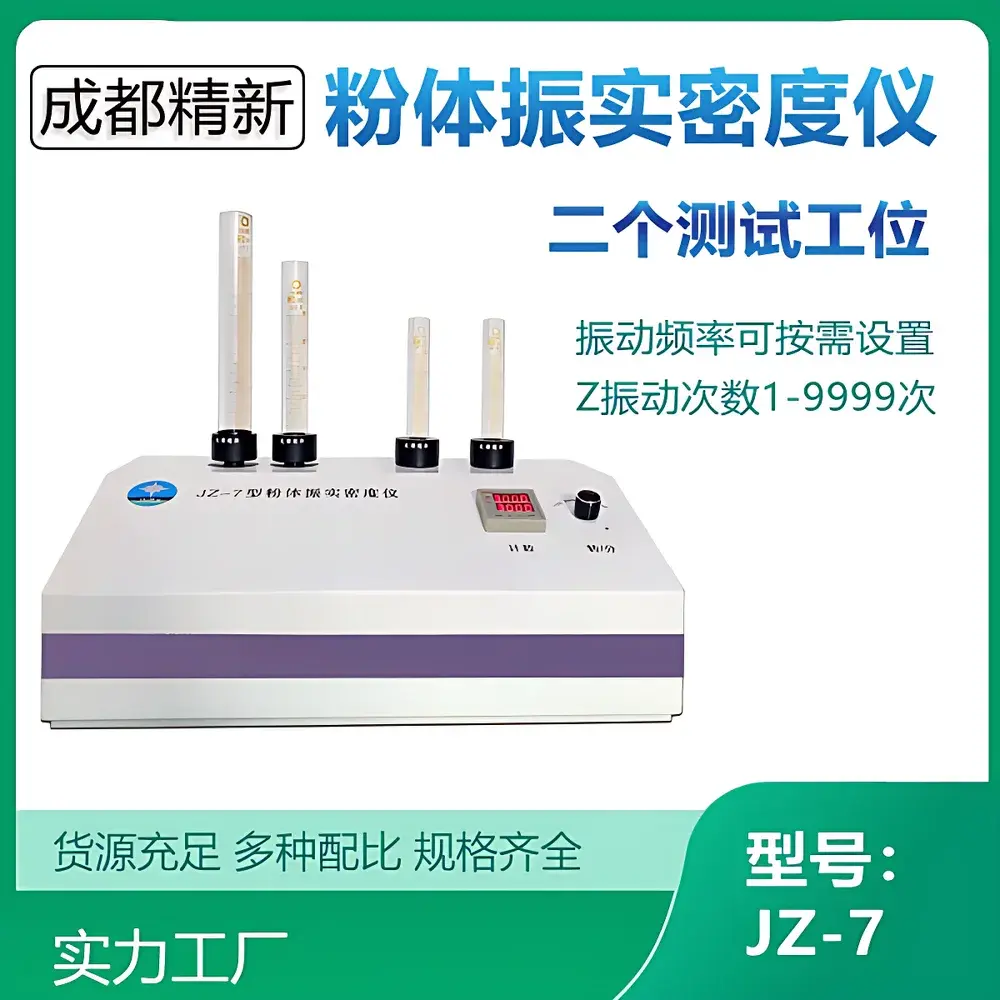
Chengdu Jingxin JZ-7 Tap Density Tester
| Brand | Chengdu Jingxin (CDJX) |
|---|---|
| Origin | Sichuan, China |
| Manufacturer Type | Direct Manufacturer |
| Origin Category | Domestic |
| Model | JZ-7 |
| Price Range | USD 920–1,120 (FOB) |
| Application Field | General-purpose density testing |
| Instrument Type | Bulk Density Tester |
| Form Factor | Benchtop Laboratory Instrument |
| Sample Type | Solid Powders |
| Measurement Scope | Tap Density & Bulk Density |
| Repeatability | ≤ ±1% |
| Vibration Amplitude | 3.0 mm ± 0.2 mm |
| Accuracy Error | ≤ ±1% |
| Number of Stations | 2 Active + 2 Waiting Positions |
| Sample Mass Capacity | ≤ 500.00 g |
| Vibration Frequency Options | 100, 200, 250, or 300 taps/min (adjustable via rotary selector) |
| Tap Count Range | 1–9999 (user-programmable) |
| Standard Compliance | GB/T 5162–2021 |
| Dimensions (W×D×H) | 450 × 280 × 180 mm |
| Net Weight | ~13 kg |
| Power Supply | AC 220 V, 50/60 Hz, 110 W |
| Included Cylinders | 25 mL, 50 mL, and 100 mL (ISO/USP-compliant borosilicate glass) |
| Data Output | PDF, Word, Excel export via proprietary software with audit trail logging |
Overview
The Chengdu Jingxin JZ-7 Tap Density Tester is an electromechanically actuated, dual-station benchtop instrument engineered for the standardized determination of tap density (also known as tapped density) and bulk density (also referred to as apparent density or loose density) of free-flowing and cohesive powders. It operates on the principle of controlled mechanical tapping—repetitive vertical displacement combined with synchronized horizontal rotation—to induce progressive particle rearrangement and volume reduction under defined mechanical energy input. This method aligns with the fundamental physical definition of tap density: the mass of powder divided by its final settled volume after a prescribed number of taps at a fixed amplitude and frequency. The JZ-7 implements this principle in strict accordance with GB/T 5162–2021, which mirrors ISO 3953:1993 and ASTM D4781–22 for powder packing behavior characterization. Its design emphasizes mechanical stability, metrological traceability, and operational repeatability—critical attributes for quality control laboratories operating under GLP, GMP, or ISO/IEC 17025 frameworks.
Key Features
- Dual active measurement stations with two additional waiting positions—enabling sequential testing without manual intervention, thereby improving throughput and minimizing operator-induced variability.
- Precision-controlled vibration system featuring a brushless DC motor and stainless-steel linear guide assembly, delivering consistent 3.0 mm ± 0.2 mm stroke amplitude across all frequency settings (100, 200, 250, or 300 taps per minute).
- Integrated horizontal rotation during vertical tapping ensures uniform surface leveling and eliminates channeling or bridging artifacts—enhancing volumetric reproducibility and reducing inter-operator dependence.
- Microprocessor-based timer with programmable tap count (1–9999), allowing full compliance with pharmacopeial methods (e.g., USP <616>, EP 2.9.34) requiring specific tap numbers (e.g., 125, 500, or 1250 taps).
- Borosilicate glass graduated cylinders supplied as standard (25 mL, 50 mL, 100 mL), calibrated per ISO 4787 and traceable to NIM (National Institute of Metrology, China); optional custom volumes (250 mL, 500 mL) available upon request.
- Robust structural architecture with reinforced aluminum alloy frame and anti-vibration rubber feet—ensuring long-term dimensional stability and resistance to resonance interference in shared laboratory environments.
Sample Compatibility & Compliance
The JZ-7 accommodates a broad spectrum of dry, granular, and powdered materials—including pharmaceutical actives and excipients, metal and ceramic powders, battery cathode/anode materials (e.g., LiCoO₂, graphite), food-grade starches and dairy powders, catalysts, pigments, and abrasive grits—with maximum sample mass of 500.00 g per cylinder. All test procedures are fully compatible with regulatory documentation requirements: the instrument’s firmware supports timestamped, user-identifiable data logging, and its software generates reports compliant with FDA 21 CFR Part 11 (electronic signatures, audit trail, and data integrity controls). Validation documentation—including IQ/OQ templates and calibration certificates for included cylinders—is provided to support laboratory accreditation under ISO/IEC 17025 and pharmaceutical quality systems (ICH Q5, Q7).
Software & Data Management
The proprietary Jingxin Density Analysis Software (v3.2+) runs on Windows OS and provides real-time monitoring of tap cycles, automatic calculation of both tap density (ρt) and bulk density (ρb), and statistical evaluation of repeatability (RSD ≤ 1.0%). All raw and processed data—including cylinder ID, sample ID, operator name, date/time stamp, tap parameters, mass, and final volume—are stored in an encrypted local database with immutable audit trails. Reports can be exported in three formats: PDF (with embedded digital signature and watermark), Microsoft Word (.docx), and Excel (.xlsx) with formula-locked cells to prevent post-hoc editing. Exported files retain full metadata and comply with ALCOA+ principles (Attributable, Legible, Contemporaneous, Original, Accurate, Complete, Consistent, Enduring, Available).
Applications
The JZ-7 serves as a primary tool for powder flowability assessment, formulation development, and batch release testing across multiple regulated and industrial sectors. In pharmaceutical manufacturing, it supports excipient qualification, blend uniformity studies, and capsule/fill weight optimization. In advanced materials R&D, it enables comparative analysis of particle morphology effects (e.g., spherical vs. angular powders) on packing efficiency—directly informing cold/hot isostatic pressing (CIP/HIP) process parameters. Battery material producers use it to correlate tap density with electrode coating density and porosity targets. Additionally, it supports ASTM D1464 (plastic powder density), ISO 787–11 (pigments), and GB/T 19077 (particle size distribution correlation studies) where volumetric density serves as a secondary orthogonal metric.
FAQ
What standards does the JZ-7 comply with?
It conforms to GB/T 5162–2021, ISO 3953:1993, ASTM D4781–22, USP <616>, and EP 2.9.34 for tap and bulk density determination.
Can the instrument validate under 21 CFR Part 11?
Yes—the software includes electronic signature capability, automated audit trail generation, and role-based access control, meeting core requirements for regulated environments.
Is calibration service available internationally?
Factory-certified calibration is provided pre-shipment; third-party accredited calibration services (e.g., UKAS, DAkkS, A2LA) can be arranged through authorized distributors.
Are cylinder calibrations traceable to national standards?
All supplied cylinders include individual calibration certificates traceable to NIM (China) or NIST (upon request), with uncertainty budgets stated per ISO/IEC 17025.
Does the system support LIMS integration?
Data export in CSV and Excel formats enables seamless ingestion into most LIMS platforms; API-based integration is available under enterprise licensing agreements.
Related Products



