
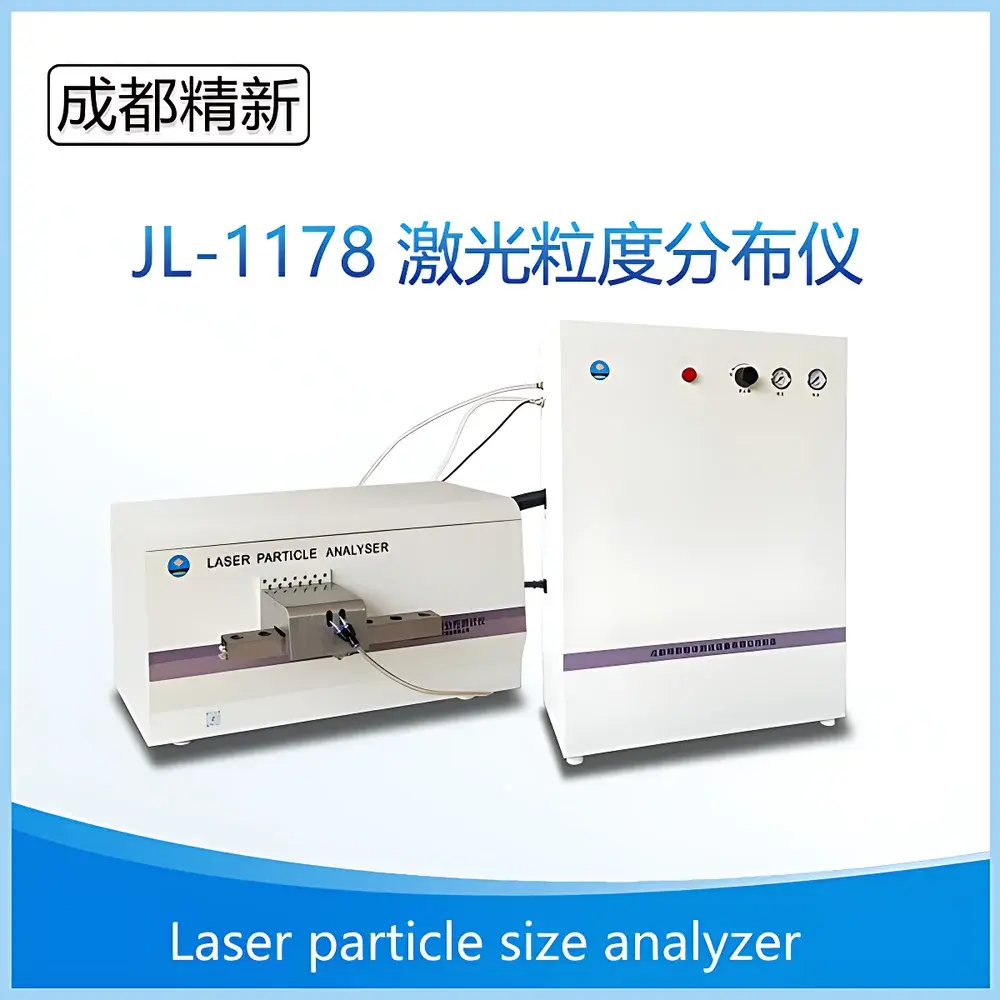
Chengdu Jingxin JL-1178 Dry-Dispersion Laser Particle Size Analyzer
| Brand | Chengdu Jingxin (CDJX) |
|---|---|
| Origin | Sichuan, China |
| Manufacturer Type | Direct Manufacturer |
| Region of Origin | Domestic (China) |
| Model | JL-1178 |
| Dispersion Method | Dry Dispersion |
| Instrument Type | Laboratory Laser Particle Size Analyzer |
| Measurement Range | 0.01–3000 µm |
| Repeatability | <1% (RSD for D50) |
| Measurement Time | ≤10 s per sample |
| Test Principle | Mie Scattering & Fraunhofer Diffraction |
| Detector Array | 128-channel multi-element photodetector |
| Light Source | Dual-wavelength semiconductor laser (650 nm / 30 mW primary |
| Optical Design | Inverted Fourier optical system with auto-aligned f-theta lens |
| Air Pressure Range | 0.1–0.8 MPa (adjustable) |
| Sample Mass | 2–10 g per test |
| Operating Environment | 5–35 °C, AC 220 V ±10%, 50 Hz |
| Compliance | GB/T 19077–2016, ISO 13320:2020 |
Overview
The Chengdu Jingxin JL-1178 Dry-Dispersion Laser Particle Size Analyzer is an industrial-grade laboratory instrument engineered for high-fidelity particle size distribution (PSD) analysis of non-aqueous, moisture-sensitive, or chemically reactive powders. It operates on the fundamental physical principles of Mie scattering theory—applied rigorously across the full sub-micron to coarse particle range—and complements this with Fraunhofer diffraction modeling where appropriate for larger particles (>50 µm). Unlike wet-dispersion systems, the JL-1178 eliminates solvent-induced agglomeration, particle dissolution, or surface hydration artifacts—critical for accurate characterization of magnetic materials (e.g., NdFeB, ferrites), battery cathode precursors (e.g., lithium carbonate), pharmaceutical APIs, cement clinker, ceramic raw materials, and explosive or pyrophoric powders. Its inverted Fourier optical architecture ensures minimal stray light, zero spherical or coma aberration, and unobstructed capture of forward-, side-, and backward-scattered light up to 165°, enabling resolution of subtle multimodal distributions and robust quantification of fine fractions down to 10 nm.
Key Features
- Integrated dry dispersion module featuring a coaxial nozzle-inlet design that minimizes transport lag and eliminates gravitational segregation during feeding—ensuring homogeneous aerosol generation and representative sampling.
- Dual-wavelength laser system: Primary 650 nm/30 mW diode laser for broad-range sensitivity; secondary 405 nm/20 mW violet diode enhances signal-to-noise ratio in the sub-100 nm region, improving detection confidence for nanoscale fines.
- 128-channel annular photodetector array with per-channel background compensation and high-speed analog signal amplification—delivering dynamic response times <10 ms and enabling real-time scatter intensity mapping.
- Self-contained auxiliary unit housing oil-free silent air compressor, dust extraction pump, HEPA-filtered exhaust purification, and sealed waste collection reservoir—meeting ISO 14644 Class 8 cleanroom-compatible operation without external utilities.
- Full-metal, EMI-shielded enclosure with vibration-damped optical bench and passive thermal stabilization—designed for long-term stability under variable lab conditions without recalibration.
- Automated workflow sequence: sample loading → pressure-controlled dispersion → measurement → chamber purge → waste transfer → optical path cleaning—all executed via synchronized PLC and PC control.
Sample Compatibility & Compliance
The JL-1178 is validated for use with free-flowing, cohesive, and electrostatically charged dry powders across diverse industrial sectors—including but not limited to battery materials (LiCoO₂, graphite anodes), catalysts, metallurgical powders (cobalt, tungsten carbide), construction binders (cement, fly ash), and regulated pharmaceutical excipients. It conforms to GB/T 19077–2016 (equivalent to ISO 13320:2020) for instrument calibration, validation, and reporting requirements. While not inherently 21 CFR Part 11 compliant, its data acquisition software supports audit-trail-enabling configurations when deployed on validated Windows platforms within GLP/GMP environments. Traceability is ensured through NIST-traceable PSL and SiO₂ reference standards (e.g., NIST SRM 1963, 2800 series), with repeatability verified per ISO 13320 Annex C using certified D50 uncertainty budgets.
Software & Data Management
The embedded analysis suite runs natively on Windows XP/7/10 and offers bilingual UI toggling (English/Chinese) without reinstallation. Raw scatter patterns are stored in proprietary binary format with metadata tagging (operator ID, timestamp, pressure setting, sample ID). Quantitative outputs include volume-based cumulative distributions, Rosin-Rammler (RR), normal, and log-normal fits. Standard report metrics encompass D3, D10, D25, D50, D75, D90, D97, volume-mean diameter (D[4,3]), and surface-area-mean diameter (D[3,2]). Export options include CSV (for LIMS integration), PDF (with embedded spectral plots), and image formats (PNG/TIFF). Communication protocols support both USB 2.0 and RS-232 interfaces, enabling direct linkage to enterprise MES or ELN systems.
Applications
This analyzer serves as a primary QC tool in R&D laboratories and production facilities where dry-state particle integrity is non-negotiable. Typical use cases include: optimization of jet-milled pharmaceutical blends prior to tableting; monitoring sintering behavior of rare-earth magnet powders; validating attrition resistance of fluidized-bed-synthesized catalysts; assessing dispersion efficiency of pigment masterbatches; and certifying fineness of refractory-grade alumina for investment casting slurries. Its 10-second measurement cycle and <1% D50 repeatability support high-throughput screening in DOE-driven formulation studies, while the dual-laser configuration provides metrological confidence for regulatory submissions involving nano-enabled products.
FAQ
What types of powders are unsuitable for testing on the JL-1178?
Highly fibrous, sticky, or hygroscopic materials that cannot be reliably dispersed into stable aerosols using compressed air—such as certain biopolymers or unmodified starches—may require pre-treatment or alternative methods.
Can the instrument be calibrated using international reference standards?
Yes—certified polystyrene latex (PSL) and silica standards traceable to NIST or BAM are fully supported; calibration verification follows ISO 13320 procedures with documented uncertainty budgets.
Is remote diagnostics or firmware update capability available?
Firmware updates are performed locally via USB drive; remote desktop-assisted troubleshooting is supported upon customer authorization and network configuration.
Does the system meet explosion-proof requirements for hazardous area deployment?
The standard configuration is rated for general laboratory use (IEC 61000-4 EMC compliance); ATEX or UL-classified variants require custom engineering and are available under OEM agreement.
How is data integrity maintained during extended operational campaigns?
All measurement sessions generate immutable .log files containing raw detector voltages, environmental logs (temperature, pressure), and operator annotations—enabling retrospective forensic analysis and full ALCOA+ compliance when paired with controlled access policies.



