
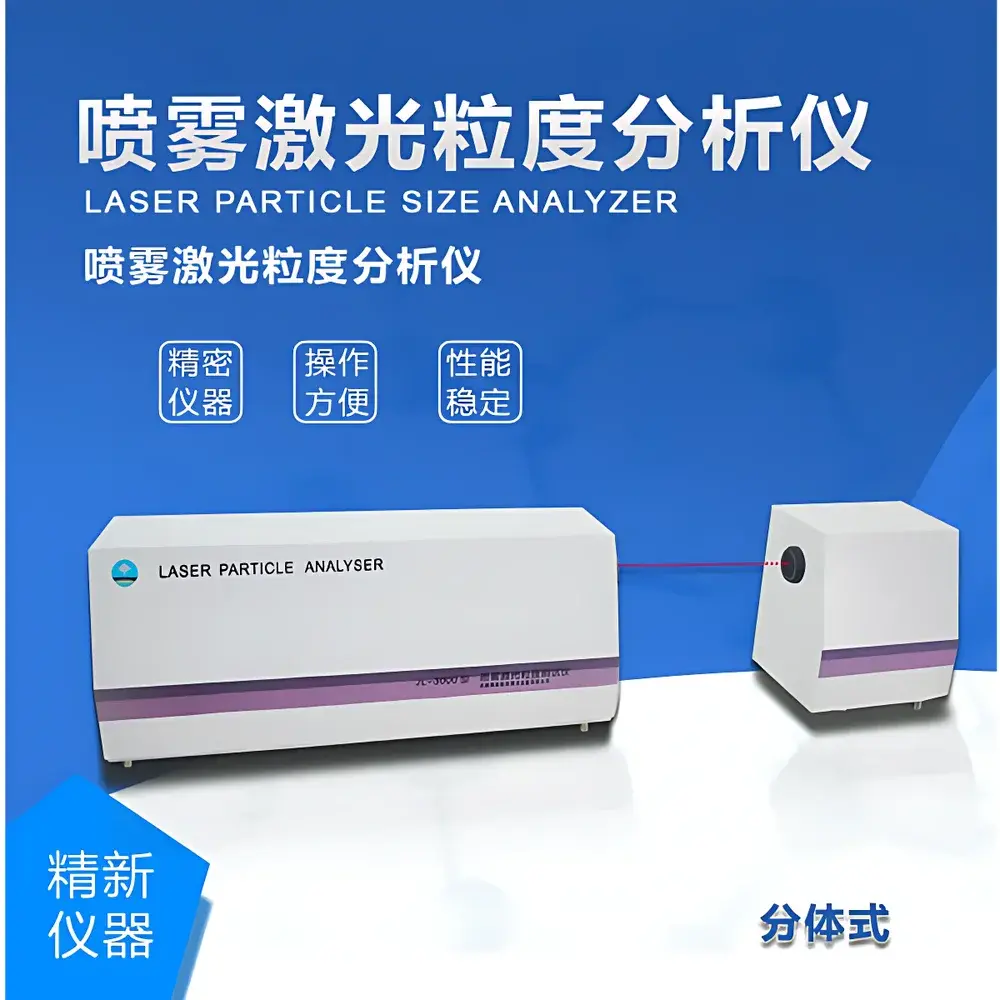
JL-3000 Split-Design Spray Laser Particle Size Analyzer
| Brand | Chengdu Jingxin (CDJX) |
|---|---|
| Origin | Sichuan, China |
| Manufacturer Type | Direct Manufacturer |
| Origin Category | Domestic |
| Model | JL-3000 Split-Design |
| Pricing Range | USD 14,000–21,000 (FOB) |
| Dispersion Method | Wet Dispersion |
| Instrument Type | Laboratory Laser Diffraction Particle Size Analyzer |
| Measurement Range | 0.01–3000 µm |
| Measurement Time | ≤10 s per analysis |
| Measurement Principle | Full-Range Mie Scattering Theory |
| Detector Channels | 128 |
| Repeatability Error | ≤1% (D50 deviation against GB standard reference materials) |
| Accuracy Error | ≤1% (D50 deviation against GB standard reference materials) |
| Optical System | Fourier Transform Lens, 80 mm aperture |
| Laser Source | Imported semiconductor laser, 650 nm, 30 mW, >70,000 h lifetime |
| Alignment System | Built-in CCD auto-centering camera |
| Host-Footprint Distance | Adjustable from 1 m to 10 m |
| Data Interface | RS232 & USB, transmission distance up to 100 m |
| Software Compatibility | Windows XP / 7 / 10 |
| Operating Environment | 5–35 °C, RH <85%, AC 220 V ±10%, 50 Hz ±0.5 Hz |
Overview
The JL-3000 Split-Design Spray Laser Particle Size Analyzer is a purpose-engineered instrument for high-fidelity, real-time characterization of atomized droplets in industrial and research spray applications. It operates on the physical foundation of full-range Mie scattering theory—rigorously applied across the entire 0.01–3000 µm dynamic range—to compute volume-based particle size distributions (PSDs) from angular intensity profiles of scattered laser light. Unlike conventional benchtop diffraction analyzers constrained by fixed optical geometry, the JL-3000 adopts a physically decoupled host–satellite architecture: the laser source, Fourier lens assembly, and 128-channel photodiode array reside in the main optical unit, while the spray interaction zone is positioned remotely within a dedicated auxiliary chamber or test fixture—enabling flexible integration into spray rigs, wind tunnels, combustion test benches, or pharmaceutical nebulizer validation setups. This design eliminates optical path obstruction, minimizes turbulence-induced measurement artifacts, and supports non-intrusive in-situ monitoring at working distances from 100 mm to 3000 mm. The system’s sealed stainless-steel enclosure meets IP54 environmental protection standards, providing dust resistance, moisture ingress protection, and robust electromagnetic interference (EMI) shielding—critical for stable operation in electromagnetically noisy industrial laboratories or engine test cells.
Key Features
- Split-design architecture with scalable host–auxiliary spacing (1–10 m), enabling seamless integration into custom spray test platforms and large-scale hardware-in-the-loop environments.
- High-stability optical train featuring a precision-machined, rigid-mount Fourier lens (80 mm clear aperture) and collimated 650 nm semiconductor laser (30 mW, >70,000 h MTBF), ensuring long-term beam alignment without recalibration.
- 128-element logarithmically spaced silicon photodetector array with per-channel background-light compensation and real-time gain optimization—delivering high-resolution angular scattering data across wide dynamic ranges.
- Integrated CCD-based automatic beam centering system, allowing rapid in-field optical alignment verification and drift correction under computer control.
- Programmable triggering via TTL logic or mechanical switch inputs, supporting high-speed synchronized acquisition at up to 50 complete PSDs per second—essential for transient spray dynamics analysis (e.g., nozzle start-up, pulsatile delivery, or combustion cycle-resolved measurements).
- Variable laser power control across full output range to optimize signal-to-noise ratio for both submicron aerosols and coarse mist droplets—preserving resolution and accuracy without manual hardware reconfiguration.
- Dual data interface (RS232 + USB) with 100 m cable support, facilitating remote instrument control and data streaming in distributed test facilities.
Sample Compatibility & Compliance
The JL-3000 is validated for aqueous, organic, and oil-based sprays—including pesticide emulsions, pharmaceutical inhalation formulations, diesel fuel atomization, fire suppression water mists, and aviation turbine fuel sprays. Its wet dispersion configuration ensures compatibility with liquid-phase delivery systems and avoids electrostatic aggregation artifacts common in dry-powder aerosol sampling. The analyzer complies with Chinese national metrological verification regulations JJG 1001–2018 and GB/T 19077–2016 for laser diffraction particle sizing. While not certified to ISO 13320:2020 or ASTM E799–22 out-of-the-box, its Mie-based inversion algorithm, traceable calibration using NIST-traceable PSL and silica standards, and documented repeatability (≤1% D50 RSD) align with GLP-aligned laboratory practices. Raw scattering data export (ASCII/CSV) and audit-ready test logs support internal validation protocols required under FDA 21 CFR Part 11 for regulated product development.
Software & Data Management
The proprietary Jingxin Particle Analysis Suite (v5.x) provides dual-language UI (English/Chinese), real-time PSD visualization, and comprehensive statistical reporting—including D10, D50, D90, D97, span, specific surface area (SSA), and frequency/differential/integrated distribution curves. All analyses generate timestamped metadata (instrument ID, operator, environmental conditions, trigger mode, laser power setting) stored in encrypted local databases. Export options include PDF reports, CSV datasets, and image exports (PNG/TIFF) compatible with MATLAB, Python (pandas), and JMP for advanced statistical modeling. Batch processing, user-defined pass/fail criteria, and automated report generation streamline QC workflows. The software supports Windows XP through Windows 10 (64-bit), with no cloud dependency or subscription licensing—ensuring full data sovereignty and long-term archival integrity.
Applications
- Aerosol science research: Quantifying droplet size evolution in evaporating sprays, coalescence-dominated regimes, and turbulent mixing zones.
- Pharmaceutical device development: Validating metered-dose inhaler (MDI) and soft-mist inhaler (SMI) performance per USP & Ph. Eur. guidelines.
- Combustion engineering: Optimizing fuel injector nozzle geometry, injection pressure, and air–fuel mixing efficiency in gas turbines and internal combustion engines.
- Agricultural technology: Characterizing pesticide spray drift potential, canopy penetration efficacy, and adjuvant-enhanced deposition uniformity.
- Fire safety R&D: Assessing water mist cooling efficiency, heat absorption capacity, and droplet evaporation kinetics in suppression systems.
- Academic fluid mechanics: Supporting CFD model validation with experimentally derived boundary conditions for Lagrangian droplet tracking simulations.
FAQ
What is the minimum detectable droplet size, and how is submicron resolution achieved?
The instrument achieves 0.01 µm lower detection limit through optimized laser coherence, low-noise detector electronics, and high-angular-resolution scattering capture—enabled by the 128-channel detector and wide-angle Fourier optics.
Can the system measure moving or vibrating spray sources?
Yes—TTL-triggered acquisition at 50 Hz allows phase-locked sampling relative to external events (e.g., camshaft position, solenoid actuation), enabling time-resolved analysis of cyclic spray behavior.
Is calibration traceable to international standards?
Calibration uses GB-certified polystyrene latex (PSL) and silica reference materials; users may perform secondary traceability via NIST SRM 1963 or ISO 13320-recommended standards.
Does the software support automated pass/fail decision logic for QC release?
Yes—customizable acceptance criteria can be defined per parameter (e.g., Dv50 ±0.5 µm, Span ≤1.8), with automatic flagging and report annotation upon deviation.
What maintenance is required for long-term operational stability?
No routine optical alignment is needed due to monolithic optical mounting; recommended annual verification using reference standards and environmental sensor calibration (temperature/humidity).



