
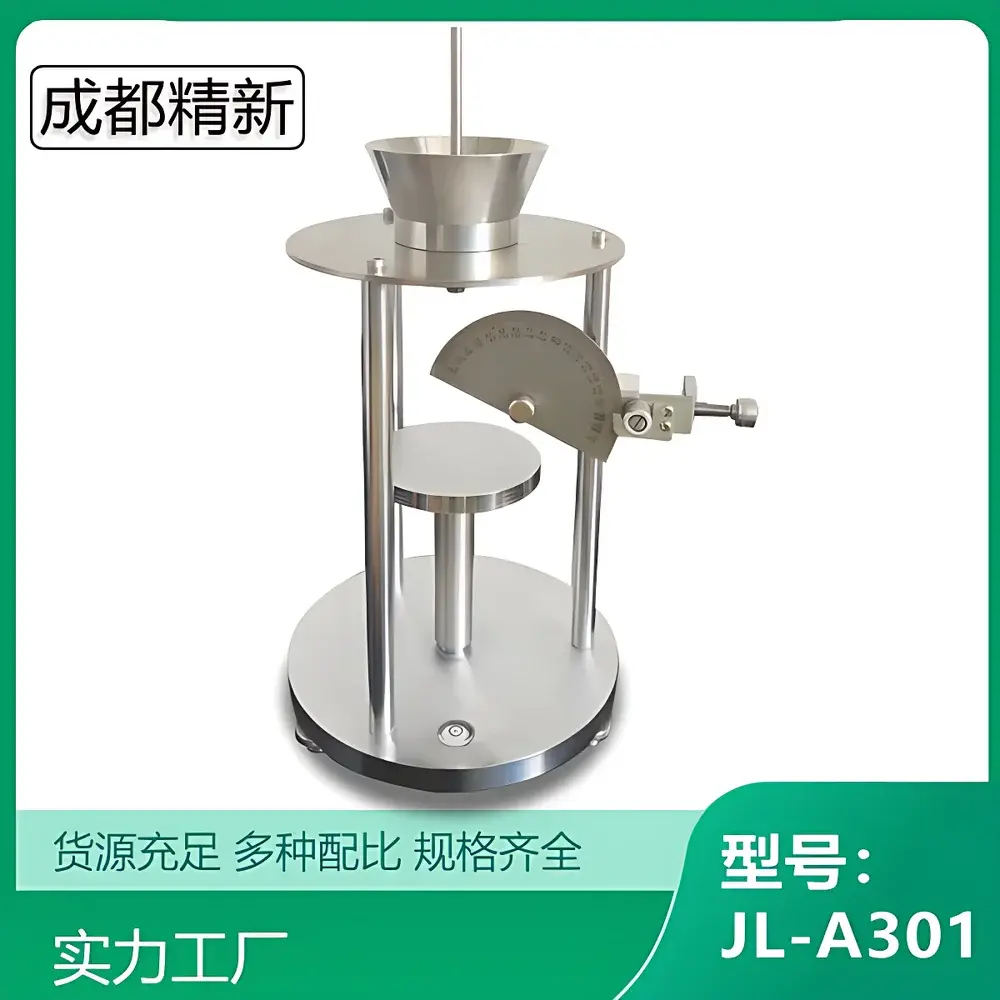
JL-A301 Jiangxin Funnel Flow Method Angle of Repose Tester
| Brand | Chengdu Jiangxin (CDJX) |
|---|---|
| Origin | Sichuan, China |
| Manufacturer Type | Direct Manufacturer |
| Origin Category | Domestic |
| Model | A301 |
| Price Range | USD 310 – 395 |
| Standard Compliance | GB/T 16913–2008, GB/T 31057.3–2018 |
| Funnel Cone Angle | 60° ± 0.5° |
| Funnel Orifice Diameter | 5 mm (optional 10 mm) |
| Receiving Pan Diameter | 80 mm |
| Vertical Distance Between Funnel Tip and Pan Surface | 80 mm ± 2 mm |
| Protractor Scale Range | 7.5–10 cm |
| Probe Rod Material | Stainless Steel |
Overview
The JL-A301 Jiangxin Funnel Flow Method Angle of Repose Tester is a precision-engineered instrument designed for the standardized determination of the angle of repose (also known as the angle of rest or static angle of heap) of dry, free-flowing powders and granular materials. It operates on the principle of controlled gravity-fed deposition: powder is released from a fixed-height, standardized funnel onto a horizontal, rigid receiving surface, forming a conical pile. The angle formed between the cone’s sloping surface and the horizontal plane—measured directly using an integrated protractor—is defined as the angle of repose. This parameter serves as a fundamental indicator of bulk powder flow behavior under static conditions and is widely accepted in pharmaceutical, chemical, food, mineral processing, and additive manufacturing industries for preliminary flowability assessment. Unlike dynamic flow indices (e.g., flow rate through orifices), the angle of repose reflects cohesive and frictional interactions between particles under low-stress, quasi-static accumulation—making it especially relevant for hopper design, silo discharge analysis, and dust control system engineering.
Key Features
- Compliant with two key Chinese national standards: GB/T 16913–2008 “Determination of angle of repose for powders” and GB/T 31057.3–2018 “Powder technology — Part 3: Methods for characterization of flowability — Funnel flow method”.
- Precision-machined stainless steel funnel with rigorously controlled geometry: 60° ± 0.5° internal cone angle and interchangeable orifice diameters (standard 5 mm; optional 10 mm) to accommodate varying particle size distributions.
- Stable, level-adjustable base platform with calibrated spirit level ensures consistent horizontal reference for reproducible measurements.
- Integrated vertical protractor (7.5–10 cm scale) with fine-resolution vernier alignment for direct angular reading without auxiliary instrumentation.
- Durable construction using corrosion-resistant stainless steel components—including the probe rod and funnel—ensuring long-term dimensional stability and resistance to abrasive wear.
- Modular assembly design enables rapid setup, cleaning, and verification; no electronic components or calibration certificates required for routine operation.
Sample Compatibility & Compliance
The JL-A301 is intended for use with non-cohesive to moderately cohesive, dry, free-flowing powders and granules with median particle sizes ranging from ~50 µm to 2 mm. It is not suitable for hygroscopic, electrostatically charged, or highly cohesive materials unless preconditioned per GB/T 16913–2008 Annex A (e.g., via controlled humidity conditioning or anti-static treatment). All test procedures strictly follow the geometric and procedural constraints defined in the referenced standards—including sample volume (100 mL pre-conditioned powder), funnel-to-pan vertical distance (80 mm ± 2 mm), and measurement repetition (n = 3 minimum). While not certified to ISO 4762 or ASTM D6393, its mechanical configuration and operational protocol are functionally equivalent to internationally recognized funnel-based repose angle methods used in GLP-compliant laboratories for internal quality control and material screening.
Software & Data Management
The JL-A301 is a fully manual, analog instrument requiring no software, firmware, or digital interface. All measurements are recorded manually in laboratory notebooks or LIMS-compatible spreadsheets. To support audit readiness, users are advised to document: date/time, operator ID, material batch number, ambient temperature/humidity (per GB/T 16913–2008 Clause 5.2), raw angular readings (three replicates), arithmetic mean, and any deviations from standard procedure (e.g., gentle tapping of the funnel). For laboratories operating under FDA 21 CFR Part 11 or ISO/IEC 17025 requirements, handwritten records must be signed, dated, and retained for a minimum of five years. No electronic data capture or automated reporting functionality is provided or implied.
Applications
- Preliminary flowability screening during formulation development in pharmaceutical solid dosage manufacturing.
- Batch-to-batch consistency monitoring of excipients (e.g., microcrystalline cellulose, lactose monohydrate) and active pharmaceutical ingredients (APIs).
- Hopper and feeder design validation for pneumatic conveying systems and gravity-fed packaging lines.
- Dust explosion hazard assessment—low-angle materials (>45°) often correlate with higher dust cloud formation potential.
- Quality control testing of catalysts, metal powders (e.g., Ti-6Al-4V for AM), fertilizers, and food-grade starches.
- Educational use in materials science and chemical engineering laboratories for teaching powder rheology fundamentals.
FAQ
What standards does the JL-A301 comply with?
It is explicitly designed and validated for compliance with GB/T 16913–2008 and GB/T 31057.3–2018.
Can the instrument be used for wet or humidified powders?
No—GB/T 16913–2008 specifies testing must be performed on air-dried samples at ambient relative humidity ≤ 65%. Conditioning protocols must be documented separately.
Is calibration required before each use?
No formal calibration is mandated; however, daily verification of funnel orifice diameter, vertical height, and protractor zero position is recommended per standard Annex B.
What is the typical repeatability of measurements?
Under controlled conditions and trained operators, inter-replicate deviation is typically ≤ ±1.5° for free-flowing materials (d50 < 100 µm); wider scatter may indicate poor sample homogeneity or operator inconsistency.
Does the device support ISO or ASTM equivalents?
While not formally certified to ISO 4762 or ASTM D6393, its physical configuration and test methodology align closely with those standards’ funnel-based repose angle definitions.



