
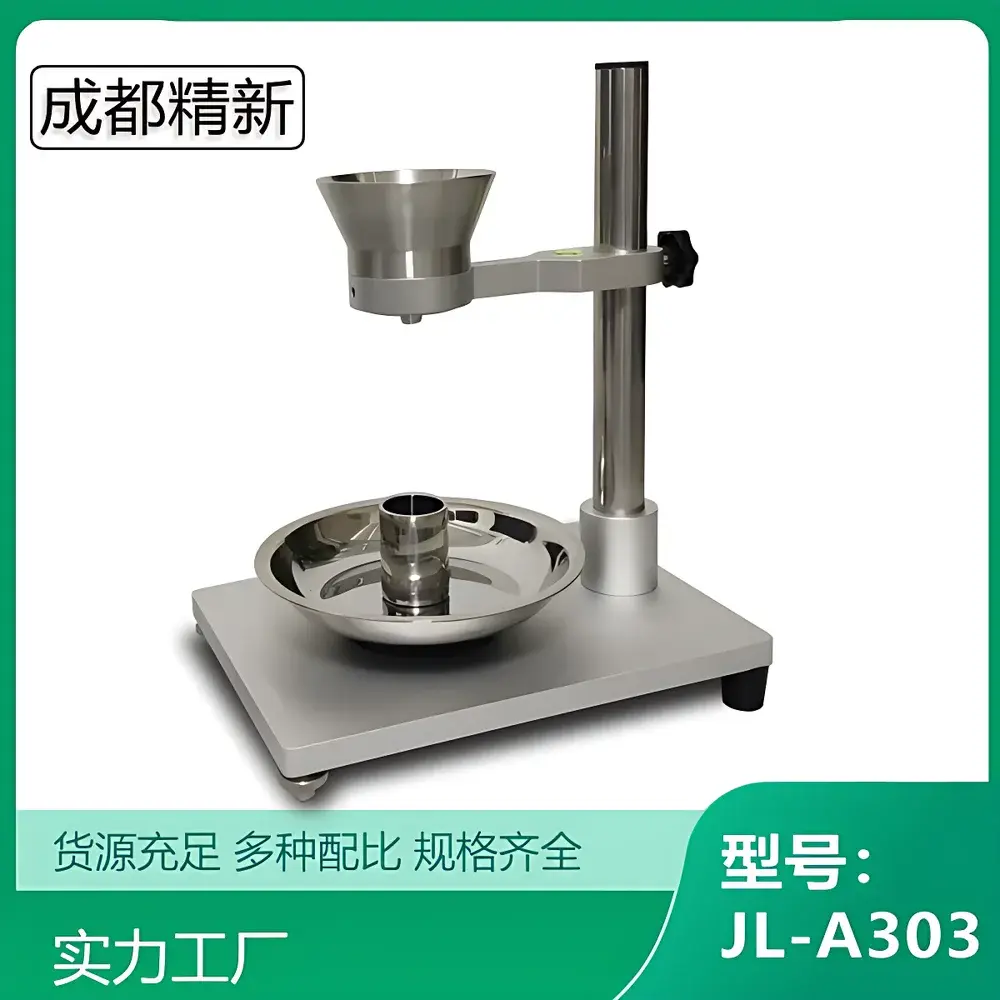
Chengdu Jingxin JL-A303 Hall Flowmeter & Apparent Density Tester
| Brand | Chengdu Jingxin (CDJX) |
|---|---|
| Origin | Sichuan, China |
| Manufacturer Type | Direct Manufacturer |
| Regional Classification | Domestic (China) |
| Model | JL-A303 |
| Instrument Type | Bulk Density & Flow Rate Tester |
| Form Factor | Benchtop (Portable Design) |
| Sample Type | Free-Flowing Solid Powders |
| Primary Applications | Metal Powders, Additive Manufacturing Feedstocks, Battery Cathode/Anode Materials, Ceramic Precursors, and Advanced Powder Metallurgy |
| Standards Compliance | GB/T 1482–2010 (Hall Flow Test), GB/T 1479.1–2011 (Apparent Density by Funnel Method) |
| Funnel Orifice Diameters | 2.5 mm and 5.0 mm |
| Funnel-to-Cylinder Distance | 25 mm ± 2 mm (adjustable) |
| Funnel Included Angle | 60° |
| Cylinder Volume | 25 mL (stainless steel 304) |
| Scraper Blade | Stainless steel, 25 mm width |
| Stopper Rod | Stainless steel 304 |
| Dimensions | Approx. 230 × 170 × 300 mm |
| Weight | 3.7 kg |
| Timing Resolution | 0.01 s (external stopwatch required) |
| Recommended Balance | 1 kg capacity, 0.02 g readability (user-supplied) |
Overview
The Chengdu Jingxin JL-A303 Hall Flowmeter & Apparent Density Tester is a precision benchtop instrument engineered for the standardized determination of two critical powder physical properties: flow rate (as defined by the Hall flow test) and apparent (bulk) density. It operates on the principle of gravity-driven powder discharge through calibrated orifices—specifically conforming to the geometry and procedural constraints outlined in GB/T 1482–2010 and GB/T 1479.1–2011. These national standards align closely with internationally recognized methodologies including ASTM B213 (Standard Test Methods for Flow Rate of Metal Powders Using the Hall Flowmeter) and ISO 4490:2018 (Metallic powders — Determination of flow rate using the Hall flowmeter). The device is not intended for cohesive, agglomerated, or moisture-sensitive powders; rather, it is optimized for free-flowing, dry, spherical or near-spherical metallic and ceramic powders commonly used in powder metallurgy, thermal spray feedstock qualification, and additive manufacturing process development.
Key Features
- Modular stainless-steel 304 construction throughout—funnel, stopper rod, scraper blade, and 25 mL measuring cylinder—ensuring corrosion resistance, dimensional stability, and long-term repeatability.
- Dual-orifice funnel system with precisely machined 2.5 mm and 5.0 mm discharge apertures, enabling method selection based on particle size distribution and industry specification requirements.
- Adjustable vertical alignment mechanism allowing precise 25 mm ± 2 mm spacing between funnel outlet and cylinder rim—critical for maintaining laminar, non-turbulent powder fall and minimizing wall adhesion effects.
- 60° conical funnel geometry manufactured to strict tolerance, minimizing internal friction and ensuring consistent flow initiation across repeated trials.
- Integrated base plate and support column with locking thumbscrews for rapid setup, leveling, and height reproducibility—essential for GLP-compliant laboratory workflows.
- Compact footprint (230 × 170 × 300 mm) and lightweight design (3.7 kg) facilitate transport between QC labs, production floors, and R&D facilities without sacrificing mechanical rigidity.
Sample Compatibility & Compliance
The JL-A303 is validated for use with metal powders—including stainless steels (e.g., 316L, 17-4PH), titanium alloys (Ti-6Al-4V), nickel-based superalloys (Inconel 625, 718), aluminum alloys (AlSi10Mg), and tungsten carbide composites—that exhibit free-flow behavior per ASTM B213 criteria (i.e., flow time ≤ 60 s for 50 g through a 2.5 mm orifice). It is unsuitable for nanoscale particles, hygroscopic materials, or powders requiring fluidization assistance. All operational procedures comply with GB/T 1482–2010 and GB/T 1479.1–2011, which are harmonized with ISO/IEC 17025 requirements for test method validation. While the instrument itself does not embed electronic data logging, its manual protocol supports full traceability when paired with calibrated external timers and analytical balances meeting ISO/IEC 17025 metrological requirements.
Software & Data Management
The JL-A303 is a fully manual, hardware-only system with no embedded firmware or digital interface. Data acquisition relies on user-operated external devices: a stopwatch with 0.01 s resolution and an analytical balance (1 kg capacity, 0.02 g readability) supplied by the end user. This architecture ensures compliance with environments where electromagnetic interference must be minimized (e.g., near sintering furnaces or EMI-sensitive metrology zones). Laboratories implementing 21 CFR Part 11 or EU Annex 11 requirements may integrate the JL-A303 into validated paper-based or LIMS-linked workflows by documenting operator identity, environmental conditions (temperature/humidity), calibration status of ancillary equipment, and raw timing/mass values in auditable logbooks or electronic lab notebooks (ELN). No proprietary software is required or provided.
Applications
- Quality control of metal powders prior to laser powder bed fusion (LPBF) and binder jetting processes—verifying batch-to-batch consistency in flowability and packing behavior.
- Raw material release testing in battery manufacturing, particularly for cathode (e.g., NMC, LFP) and anode (e.g., graphite, silicon composite) powders where uniform electrode coating depends on predictable volumetric feed rates.
- Research-grade characterization in university and national laboratories studying particle shape effects (sphericity, aspect ratio) on bulk handling performance.
- Regulatory submission support for medical device manufacturers using metal AM, where GB/T 1482–2010 data may be referenced alongside ASTM F3049 in biocompatibility dossiers.
- Supplier qualification audits in aerospace and energy sectors, where adherence to ISO 4490-compliant flow metrics is contractually mandated.
FAQ
What standards does the JL-A303 comply with?
It conforms to GB/T 1482–2010 (equivalent to ASTM B213 and ISO 4490) for Hall flow measurement and GB/T 1479.1–2011 (equivalent to ISO 3953) for apparent density determination.
Is the instrument suitable for non-metallic powders?
Yes—provided they are free-flowing, dry, and meet the geometric criteria (e.g., spherical ceramics, polymer powders used in selective laser sintering), but validation against the cited standards is the user’s responsibility.
Does the system include a built-in timer or balance?
No. A high-resolution stopwatch (0.01 s) and analytical balance (1 kg / 0.02 g) must be supplied separately by the user.
Can the funnel height be adjusted beyond 25 mm?
The mechanical design permits fine adjustment within ±2 mm of the nominal 25 mm distance to accommodate minor leveling corrections—but deviation beyond this range invalidates compliance with GB/T 1482–2010 and ASTM B213.
How many replicate measurements are recommended?
Minimum three independent trials per sample for both flow time and mass measurement; arithmetic mean reported as final result, with standard deviation documented for uncertainty assessment per ISO/IEC 17025 guidelines.



