
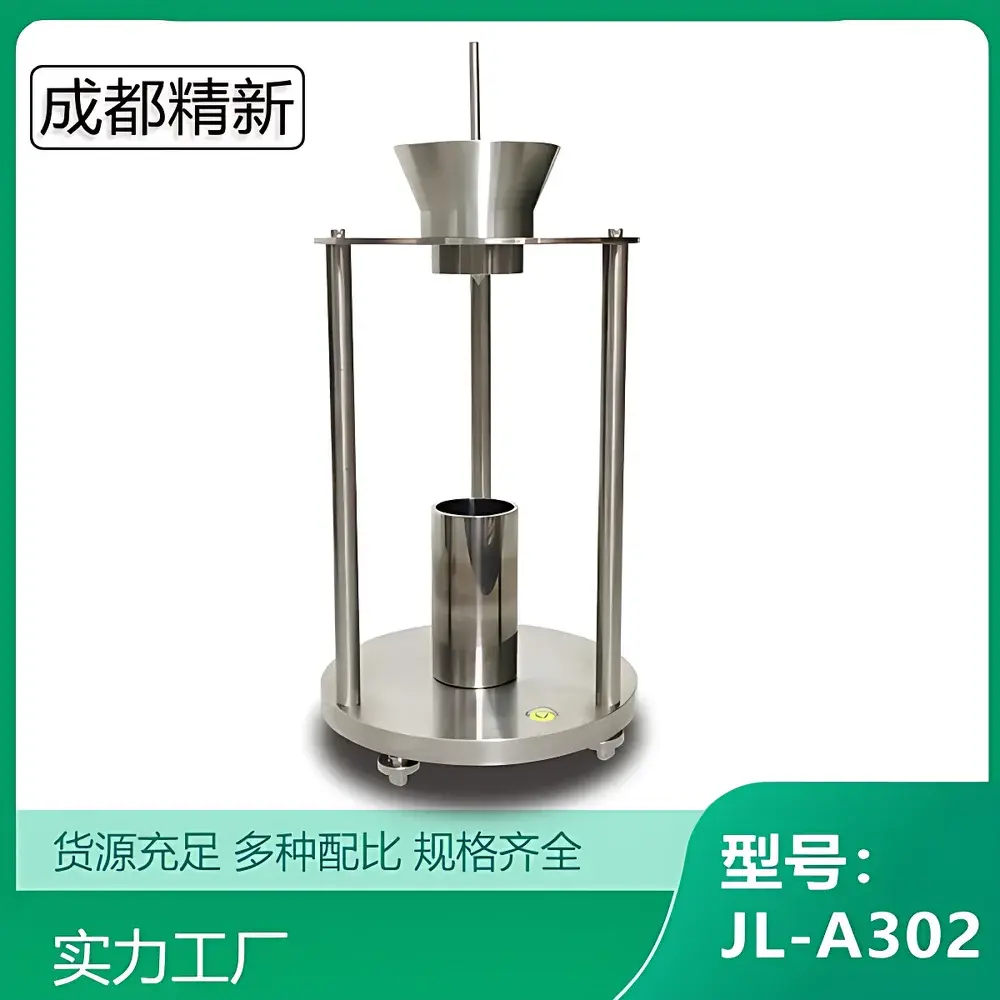
Jingxin JL-A302 Bulk Density Tester for Powders and Granules
| Brand | Jingxin (Chengdu) |
|---|---|
| Origin | Sichuan, China |
| Manufacturer Type | Direct Manufacturer |
| Regional Category | Domestic (China) |
| Model | A302-2 |
| Instrument Type | Bulk Density Tester |
| Instrument Class | Portable |
| Sample Form | Solid Powders & Granules |
| Application Scope | General-purpose bulk density measurement of free-flowing powders |
| Standard Compliance | GB/T 16913–2008 (Natural Pile Method) |
| Funnel Orifice Diameter | 12.7 mm |
| Cylinder Volume | 100 mL |
| Funnel-to-Cylinder Height | 115 mm ± 2 mm |
| Funnel Cone Angle | 60° |
| Cylinder Material | Stainless Steel 304 |
| Scraper Blade | Stainless Steel, 25 mm wide |
| Plug Rod | Stainless Steel 304 |
| Overall Dimensions | ≈ 160 × 160 × 300 mm |
| Weight | 3.7 kg |
| Required External Balance | Capacity ≥ 1000 g, Readability ≤ 0.02 g |
Overview
The Jingxin JL-A302 Bulk Density Tester is a precision-engineered, portable instrument designed for the standardized determination of bulk (loose) density of free-flowing powders and granular materials. It operates on the principle of natural pile formation under gravity, as defined in GB/T 16913–2008 — China’s national standard for dust property testing using the natural stacking method. This gravimetric technique relies on controlled, unobstructed powder flow from a calibrated stainless steel funnel into a fixed-volume cylinder, enabling reproducible quantification of mass per unit volume in the loosely packed state. Unlike tapped or vibrated density measurements, the JL-A302 captures the material’s inherent packing behavior under minimal mechanical disturbance — a critical parameter for powder handling, storage, transportation, and process design in regulated manufacturing environments.
Key Features
- Stainless steel 304 construction throughout — including funnel, cylinder, scraper blade, and plug rod — ensuring corrosion resistance, dimensional stability, and long-term repeatability.
- Precision-machined funnel with 12.7 mm orifice diameter and 60° cone angle, optimized to minimize wall adhesion and promote uniform powder discharge.
- Fixed vertical drop height of 115 mm ± 2 mm between funnel outlet and cylinder rim, maintaining strict compliance with GB/T 16913–2008 geometric requirements.
- 100 mL volumetric stainless steel cylinder with smooth interior finish and calibrated capacity traceable to national metrological standards.
- Integrated, ergonomic stainless steel scraper (25 mm width) for consistent, level powder surface removal without compaction.
- Modular, space-efficient benchtop design (160 × 160 × 300 mm; 3.7 kg), facilitating deployment in QC labs, production floors, R&D facilities, and field testing environments.
Sample Compatibility & Compliance
The JL-A302 is validated for use with dry, non-cohesive to moderately cohesive powders and granules exhibiting free-flow characteristics — including pharmaceutical excipients, food-grade starches and sugars, battery cathode/anode materials (e.g., LiCoO₂, graphite), catalysts, metal powders, ceramics, and agricultural chemicals. It is not intended for hygroscopic, electrostatically charged, or highly cohesive materials requiring forced flow or fluidization. The instrument fully satisfies the physical configuration and procedural specifications outlined in GB/T 16913–2008. While primarily aligned with Chinese national standards, its operational parameters are compatible with parallel international methods such as ASTM D1895–18 (Method A, “Bulk Density by Graduated Cylinder”) and ISO 697–1985 (Cement — Determination of Bulk Density). For GMP/GLP-regulated workflows, users may integrate the JL-A302 into documented SOPs with audit-trail-capable balance systems meeting FDA 21 CFR Part 11 requirements.
Software & Data Management
The JL-A302 is a manual, hardware-only instrument with no embedded electronics or firmware. All data acquisition and calculation are performed externally using a calibrated analytical balance (user-supplied, ≥1000 g capacity, ≤0.02 g readability) and standard laboratory documentation practices. Results are calculated as ρb = m / V, where m is net powder mass (g) and V is cylinder volume (100 mL). To support quality system compliance, laboratories commonly pair the JL-A302 with LIMS-integrated balances or spreadsheet-based templates that enforce calculation validation, operator identification, date/time stamping, and revision-controlled reporting — all essential for ISO/IEC 17025 accreditation and internal audit readiness.
Applications
This instrument delivers critical input for multiple industrial and scientific domains: In pharmaceutical manufacturing, it supports formulation development, blend uniformity assessment, and capsule/fill weight prediction. In food processing, it informs silo design, auger feed rate calibration, and packaging volume estimation. Battery material producers rely on bulk density data to optimize electrode slurry rheology, calendering pressure, and cell energy density modeling. Catalyst and ceramic manufacturers use it to correlate particle morphology with reactor bed void fraction and pressure drop profiles. Academic and government testing laboratories apply the JL-A302 in materials science research, inter-laboratory round-robin studies, and reference material certification protocols.
FAQ
What standards does the JL-A302 comply with?
It is engineered and verified per GB/T 16913–2008 (Natural Pile Method), and its geometry and procedure align with ASTM D1895–18 (Method A) and ISO 697–1985.
Is a balance included with the instrument?
No. A high-precision balance (≥1000 g capacity, ≤0.02 g readability) must be provided separately by the user.
Can the JL-A302 measure tapped density?
No. It is configured exclusively for loose (untapped) bulk density. Tapped density requires a separate tap density tester per GB/T 5162 or ASTM D4781.
What maintenance is required?
Routine cleaning with non-abrasive solvents and lint-free cloths; periodic inspection of funnel orifice and cylinder interior for scratches or residue buildup.
How many replicate tests are recommended per sample?
GB/T 16913–2008 specifies a minimum of three independent determinations; the arithmetic mean is reported as the final bulk density value.



