
Jingxin JZ-10 Series Tap Density Tester (Bulk Density Analyzer)
| Brand | Chengdu Jingxin (CDJX) |
|---|---|
| Origin | Sichuan, China |
| Manufacturer Type | Direct Manufacturer |
| Country of Origin | China |
| Model | JZ-10 Series |
| Instrument Type | Tap Density Tester |
| Density Measurement Range | 0–10 g/cm³ |
| Sample Form | Powders & Granules |
| Vibration Amplitude | 3.0 ± 0.2 mm |
| Vibration Frequency Options | 100 / 200 / 250 / 300 taps/min |
| Tap Count Range | 1–9999 adjustable |
| Repeatability | ≤ ±1% |
| Operating Voltage | AC 220 V |
| Power Consumption | 110 W |
| Dimensions (L×W×H) | 455 × 280 × 125 mm |
| Weight | ~15 kg |
| Test Capacity | ≤500 g per cylinder |
| Cylinder Compatibility | Removable borosilicate glass cylinders (25 mL and 100 mL) |
| Software Output Formats | Word, PDF, Excel |
| Compliance Standards | GB/T 5162–2021, GB/T 31057.2–2018, ChP 2020 <0993> |
Overview
The Jingxin JZ-10 Series Tap Density Tester is an engineered solution for standardized measurement of tap density (also known as tapped density) and bulk density of free-flowing powders and granular solids. Based on the principle of controlled mechanical compaction—where a precisely defined volume of powder is subjected to reproducible vertical tapping combined with rotational motion—the instrument quantifies volumetric reduction under standardized mechanical energy input. This method aligns with fundamental powder characterization protocols used in pharmaceutical development, battery material qualification, metallurgical powder processing, and quality control laboratories. Unlike static density methods, tap density reflects the packing behavior of particulates under low-energy consolidation, directly informing downstream processes such as die filling, tablet compression, and pneumatic conveying efficiency. The JZ-10 Series implements a dual-motion mechanism: simultaneous vertical oscillation and horizontal rotation ensures uniform surface leveling and minimizes particle segregation during tapping—critical for achieving high inter-laboratory reproducibility.
Key Features
- Programmable tap count (1–9999 cycles) via microprocessor-based timer, enabling full compliance with pharmacopeial and industrial test protocols requiring specific consolidation endpoints.
- Four-step selectable vibration frequency (100, 200, 250, or 300 taps/min), adjusted via rotary switch—no software configuration required for routine operation.
- Dual-axis motion architecture: vertical tapping (3.0 ± 0.2 mm amplitude, per GB/T 5162–2021) synchronized with continuous rotation to maintain planar powder surface geometry and reduce channeling artifacts.
- Modular cylinder mounting system: borosilicate glass cylinders (25 mL and 100 mL) are fully detachable for cleaning, calibration verification, and cross-lab traceability—supporting GLP-aligned sample handling practices.
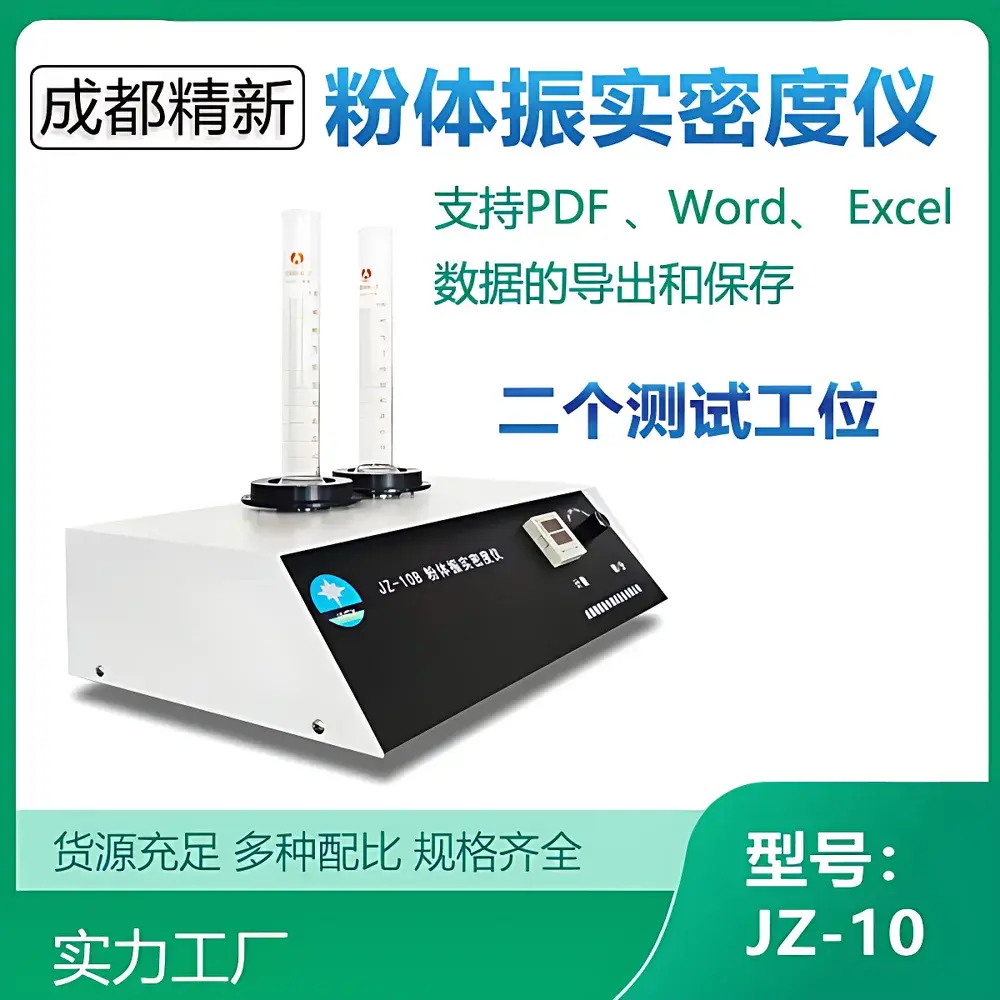
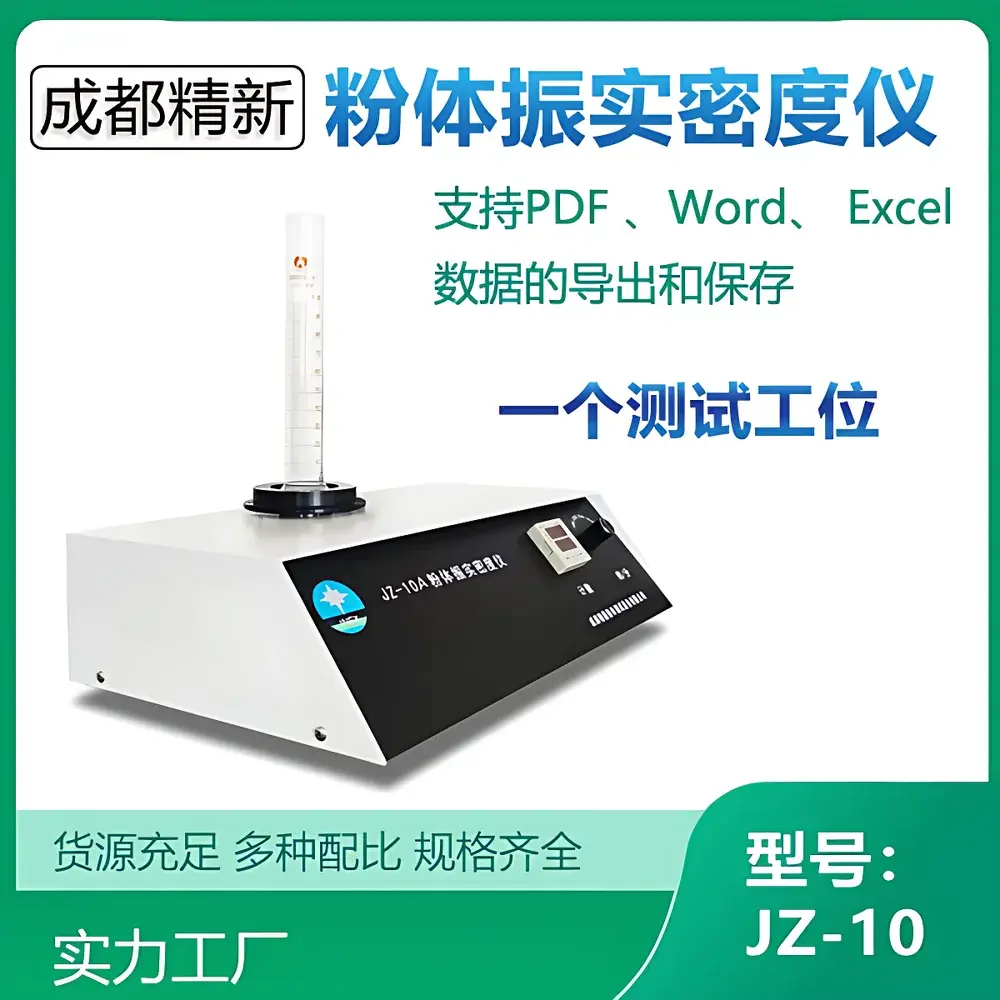
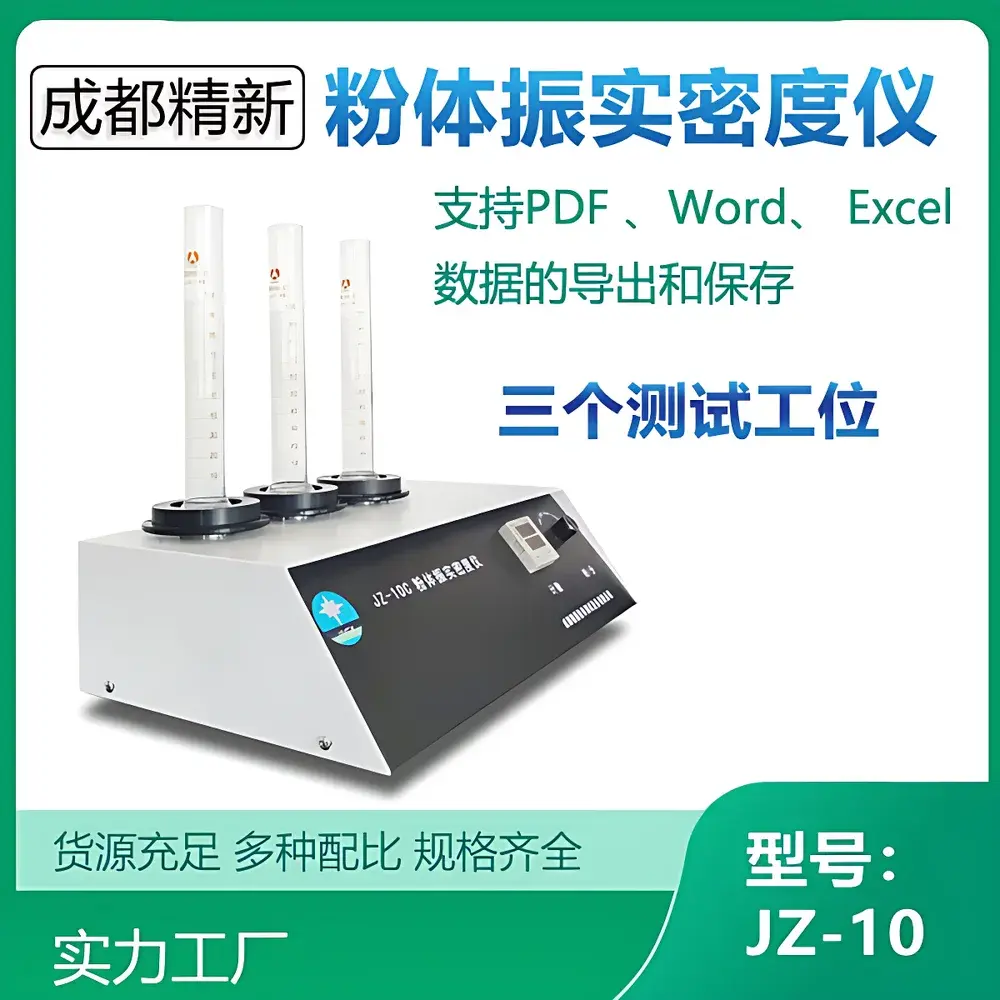
- Three configuration variants (JZ-10A: 1 station; JZ-10B: 2 stations; JZ-10C: 3 stations) allow parallel testing of multiple samples or comparative studies under identical mechanical conditions.
- Thermally optimized chassis design with rear-mounted ventilation apertures ensures stable motor performance during extended test sequences (e.g., 3000+ taps).
Sample Compatibility & Compliance
The JZ-10 Series accommodates a broad spectrum of dry, non-cohesive to moderately cohesive powders—including metal powders (e.g., stainless steel, aluminum, nickel alloys), ceramic precursors, active pharmaceutical ingredients (APIs), excipients, food-grade starches, lithium cobalt oxide (LCO), lithium iron phosphate (LFP), and polymer granules. It meets the mechanical and procedural requirements of ISO 3953:1993 (Determination of tap density of metallic powders), ASTM D4781–22 (Standard Test Method for Determination of Tap Density of Catalysts and Catalyst Carriers), and USP (Bulk and Tapped Density). Its alignment with Chinese Pharmacopoeia 2020 Edition Chapter and GB/T 31057.2–2018 further supports regulatory submissions in APAC markets. All hardware components—including stainless steel guide rails, corrosion-resistant drive shafts, and precision-machined cylinder holders—are designed for long-term dimensional stability under repeated mechanical loading.
Software & Data Management
The included dedicated Windows-compatible software performs automated calculation of both bulk density (ρb) and tap density (ρt) using user-input mass and calibrated cylinder volume data. It enforces mandatory entry fields for tap count, frequency, and cylinder ID—ensuring audit-ready metadata capture. Each test session generates a timestamped record with operator ID, environmental notes (optional), and raw input values. Reports are exportable in three formats: editable Word (.docx), print-optimized PDF (.pdf), and analysis-ready Excel (.xlsx) with embedded formulas for Carr Index and Hausner Ratio derivation. No cloud dependency or license activation is required; software installation is portable across lab workstations. While the system does not implement FDA 21 CFR Part 11 electronic signature controls, its deterministic calculation engine and immutable report generation support internal GMP/GLP documentation workflows when paired with institutional SOPs.
Applications
This instrument serves critical roles in R&D and QC environments where powder flowability, compressibility, and packing efficiency must be quantified objectively. In pharmaceutical manufacturing, it supports formulation screening of direct compression blends and excipient selection. Battery material producers use tap density data to correlate electrode coating uniformity with cathode/anode powder morphology. Metal additive manufacturing facilities rely on consistent tap density values to predict green part density and sintering shrinkage. Academic researchers apply the JZ-10 Series in studies of particle size distribution effects on consolidation behavior, humidity-induced caking mechanisms, and surface modification efficacy. Its compact footprint and low power draw make it suitable for shared instrumentation cores and mobile QC labs.
FAQ
What standards does the JZ-10 Series comply with?
It conforms to GB/T 5162–2021, GB/T 31057.2–2018, ChP 2020 , ISO 3953:1993, and ASTM D4781–22.
Can the instrument measure both bulk and tap density in one workflow?
Yes—bulk density is measured before tapping; tap density is calculated after the selected number of taps, using identical mass and final settled volume.
Is calibration of the glass cylinders required?
Yes—users must verify cylinder volume traceability using certified reference standards per ISO/IEC 17025 guidelines prior to GMP-relevant testing.
Does the software support multi-user access control?
No—the software operates in single-user mode without role-based permissions or audit trail logging.
What maintenance is recommended for long-term accuracy?
Biannual inspection of motor coupling alignment, periodic cleaning of cylinder contact surfaces, and annual verification of tap amplitude using calibrated displacement sensors.



