
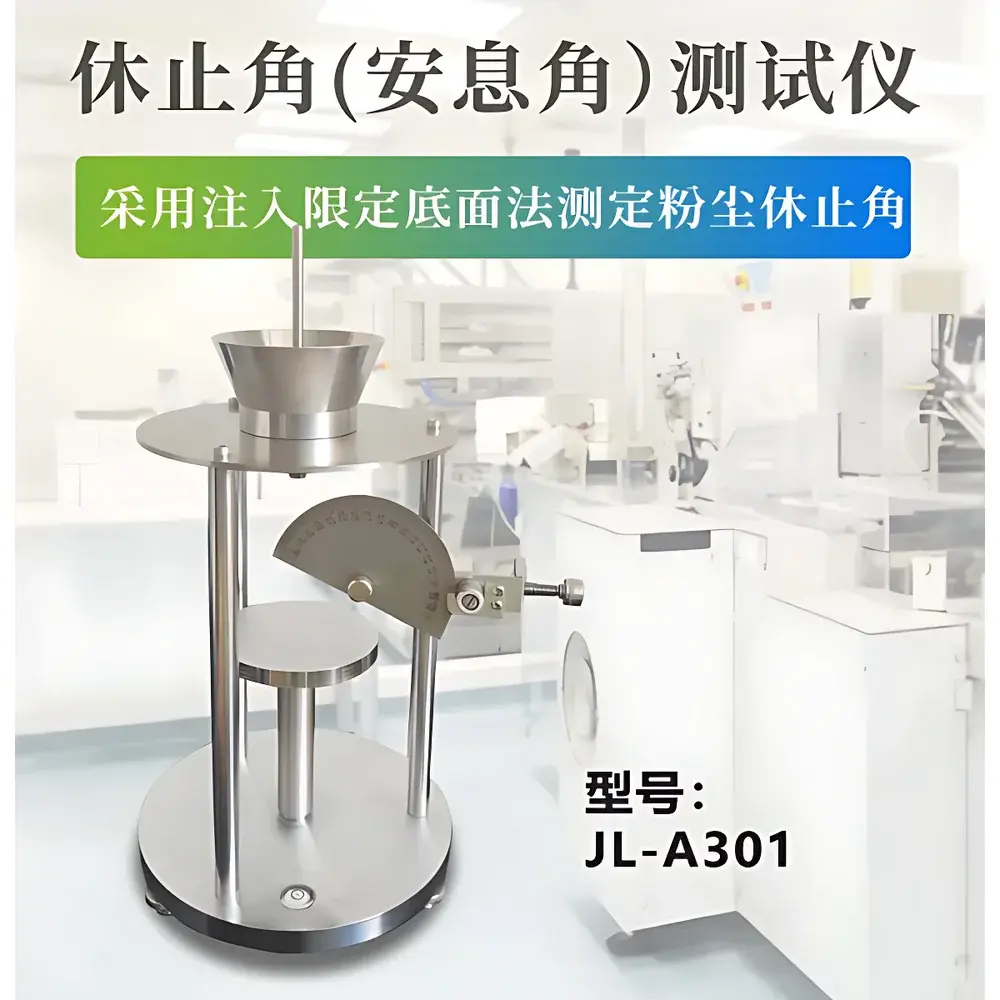
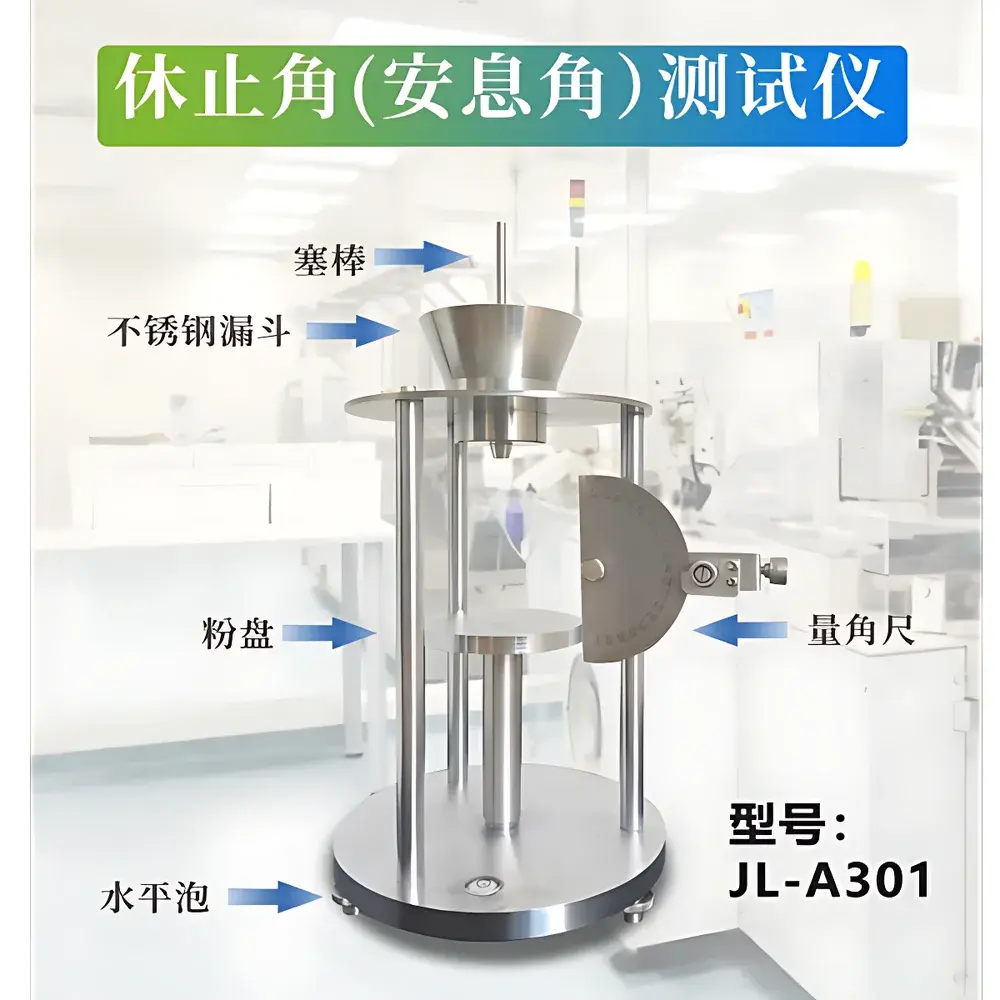
Chengdu Jingxin JL-A3-01 Powder Flowability Tester (Angle of Repose / Angle of Rest Instrument)
| Brand | Chengdu Jingxin (CDJX) |
|---|---|
| Origin | Sichuan, China |
| Manufacturer Type | Direct Manufacturer |
| Country of Origin | China |
| Model | JL-A3-01 |
| Price Range | USD 310 – 395 |
| Standard Compliance | GB/T 16913–2008, GB/T 31057.3–2018 |
| Funnel Cone Angle | 60° ± 0.5° |
| Funnel Orifice Diameter | 5 mm (customizable to 10 mm) |
| Receiving Pan Diameter | 80 mm |
| Vertical Distance Between Funnel Tip and Pan Surface | 80 mm ± 2 mm |
| Protractor Scale Range | 7.5–10 cm |
| Probe Rod Material | Stainless Steel |
| Test Principle | Fixed-base funnel deposition method for conical pile formation on horizontal metallic substrate |
Overview
The Chengdu Jingxin JL-A3-01 Powder Flowability Tester is a precision-engineered instrument designed for the standardized determination of the angle of repose (also referred to as angle of rest) of free-flowing and cohesive powders. It operates on the fixed-base funnel deposition principle: dry powder is discharged from a calibrated conical funnel onto a flat, horizontal metal plate, forming a conical pile. The angle between the cone’s sloping surface and the horizontal plane—i.e., the angle of repose—is measured directly using an integrated protractor or calculated trigonometrically from the cone’s height and base diameter. As a fundamental indicator of dynamic powder behavior, the angle of repose correlates strongly with bulk flowability, interparticle friction, and cohesion. This parameter is critical in process engineering contexts—including hopper design, pneumatic conveying system validation, dust collection efficiency modeling, and pharmaceutical blend uniformity assessment—where predictable powder handling performance under gravity-driven conditions is essential.
Key Features
- Compliant with two primary Chinese national standards: GB/T 16913–2008 “Test methods for characterization of dust—Determination of angle of repose” and GB/T 31057.3–2018 “Granular materials—Determination of physical properties—Part 3: Angle of repose”.
- Stainless steel probe rod ensures corrosion resistance and long-term dimensional stability during repeated manual manipulation of powder flow.
- Precision-machined brass funnel with nominal 60° ± 0.5° cone angle and interchangeable orifices (standard 5 mm; optional 10 mm) enables method flexibility across varying particle size distributions.
- Fixed vertical drop distance of 80 mm ± 2 mm between funnel tip and receiving pan surface maintains consistent kinetic energy input, minimizing operator-induced variability.
- Calibrated protractor with 7.5–10 cm scale range allows direct angular readout with visual alignment verification; supports both analog measurement and post-test digital image analysis workflows.
- Modular, benchtop-compatible mechanical architecture requires no electrical power, pneumatics, or software—ideal for QC labs, R&D facilities, and field-deployable material screening.
Sample Compatibility & Compliance
The JL-A3-01 accommodates dry, non-agglomerated, and moderately cohesive powders with particle sizes ranging from ~10 µm to 2 mm. It is routinely employed for metal powders (e.g., stainless steel 316L, Ti-6Al-4V), ceramic granules, catalyst carriers, food-grade starches, and pharmaceutical excipients. While not intended for hygroscopic, electrostatically charged, or moisture-sensitive materials without environmental control, its mechanical simplicity permits integration into ISO 17025-accredited testing environments when paired with documented calibration procedures and operator qualification records. The instrument supports traceability per GLP and GMP-aligned workflows through manual logbook entries and repeatable test documentation aligned with ASTM D6393 (Standard Practice for Flowability of Powders Using the Angle of Repose) conceptual framework.
Software & Data Management
The JL-A3-01 is a fully manual, hardware-only instrument with no embedded electronics or proprietary software. All measurements are recorded manually in laboratory notebooks or LIMS-integrated spreadsheets. Users may digitize results via external imaging systems (e.g., high-resolution side-view photography with reference scale bars) followed by geometric analysis in ImageJ or MATLAB-based scripts—enabling automated cone fitting, pixel-to-angle conversion, and statistical reporting (mean ± SD, CV%). This analog-digital hybrid approach satisfies audit requirements under FDA 21 CFR Part 11 when paired with controlled document management practices and electronic signature protocols for data review.
Applications
- Pre-screening of metal powders prior to additive manufacturing feedstock qualification (ASTM F3049, ISO/ASTM 52900).
- Batch-to-batch consistency evaluation in powder metallurgy production lines.
- Supporting hazard analysis for combustible dust risk assessment (NFPA 652, EN 14041).
- Correlating angle of repose with shear cell data (e.g., Jenike shear tester outputs) for hopper design calculations.
- Educational use in materials science laboratories for illustrating powder rheology fundamentals.
FAQ
What standards does the JL-A3-01 comply with?
It is validated for use in accordance with GB/T 16913–2008 and GB/T 31057.3–2018, which define procedural requirements for angle of repose measurement including funnel geometry, drop height, and repeatability criteria.
Can the instrument be used for wet or aerated powders?
No. The JL-A3-01 is strictly intended for dry, free-flowing or slightly cohesive powders under ambient atmospheric conditions. Moisture content or fluidization alters packing density and invalidates standard interpretation.
Is calibration certification provided with the instrument?
The unit ships with dimensional verification documentation for funnel angle, orifice diameter, and drop height. End-user calibration against traceable angle standards (e.g., NIST-traceable protractors) is recommended annually or per internal QA schedule.
How many replicate tests are required for a valid result?
Per GB/T 16913–2008, a minimum of three independent determinations must be performed; the arithmetic mean is reported as the final angle of repose, with standard deviation indicating measurement precision.
Does the instrument support automated data export?
No. Data capture is manual. However, users may implement third-party image analysis tools to extract and export quantitative metrics in CSV or Excel format.



