
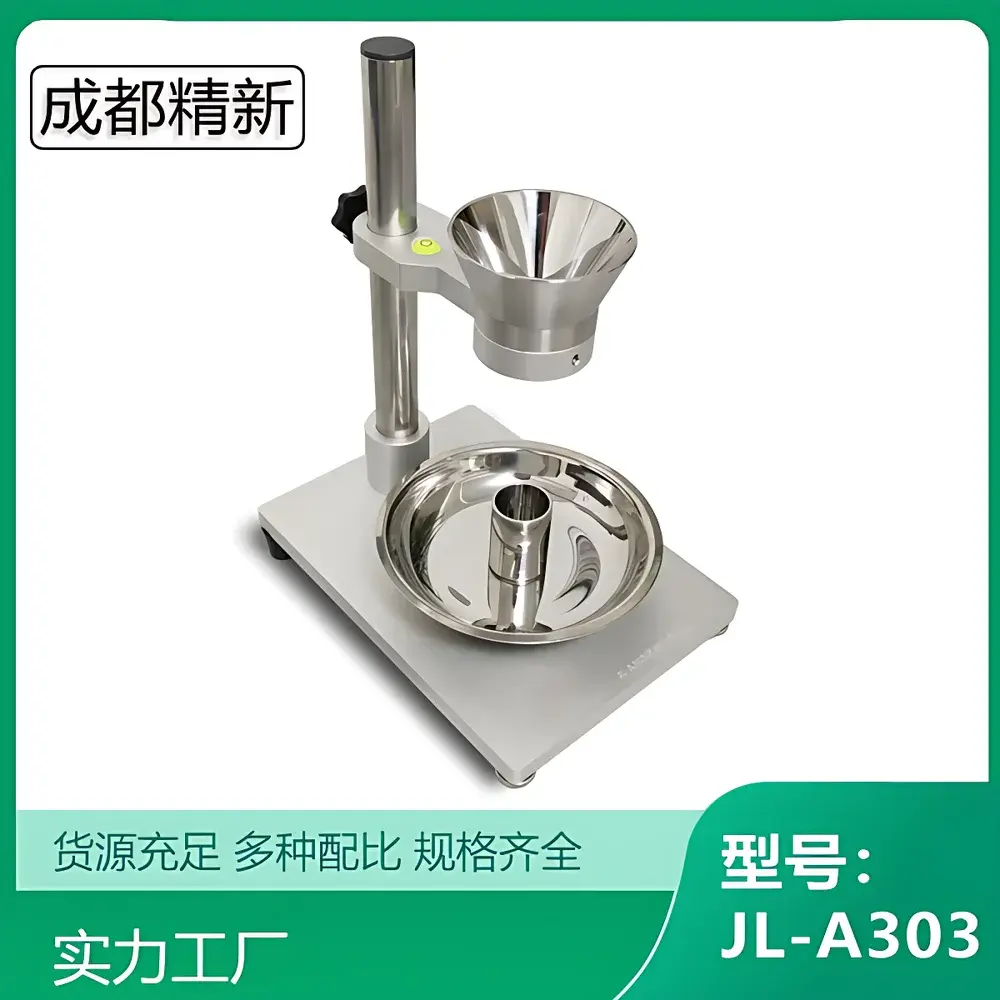
Jingxin JL-A303 Metal Powder Bulk Density and Flow Rate Tester
| Brand | Jingxin (Chengdu) |
|---|---|
| Origin | Sichuan, China |
| Manufacturer Type | Direct Manufacturer |
| Regional Category | Domestic (China) |
| Model | JL-A303 |
| Instrument Type | Bulk Density & Flow Tester |
| Design | Benchtop (Non-Portable) |
| Measurement Principle | Standard Funnel Flow Method (Hall Flowmeter) & Gravimetric Bulk Density Determination |
| Applicable Standards | GB/T 1482–2010, GB/T 1479.1–2011 |
| Funnel Orifice Diameters | 2.5 mm and 5.0 mm |
| Funnel-to-Cylinder Distance | 25 mm ± 2 mm (adjustable) |
| Funnel Cone Angle | 60° |
| Cylinder Volume | 25 mL (stainless steel 304) |
| Scraper Blade | Stainless steel 304, 25 mm wide |
| Stopper Rod | Stainless steel 304 |
| Dimensions | 230 × 170 × 300 mm |
| Weight | 3.7 kg |
| Timer Resolution | 0.01 s |
| Required Ancillary Equipment | Analytical balance (max 1000 g, readability 0.02 g) |
Overview
The Jingxin JL-A303 Bulk Density and Flow Rate Tester is a precision-engineered benchtop instrument designed for the standardized determination of two critical physical properties of free-flowing metal powders: apparent (bulk) density and flow rate. It operates in strict accordance with internationally harmonized test methodologies—specifically GB/T 1482–2010 (equivalent in principle to ASTM B212 and ISO 4490 for Hall flow measurement) and GB/T 1479.1–2011 (aligned with ASTM B527 and ISO 3953 for bulk density). The device employs a gravity-driven funnel flow configuration, where powder flows under its own weight through a calibrated orifice into a volumetric cylinder. This method eliminates mechanical agitation or vibration, ensuring measurement repeatability under controlled static conditions. The JL-A303 is not a real-time online sensor but a manual, operator-guided testing system intended for QC laboratories, R&D facilities, and third-party testing centers requiring traceable, standards-compliant results for powder processability evaluation.
Key Features
- Stainless steel 304 construction throughout—including funnel, stopper rod, scraper blade, and 25 mL volumetric cylinder—ensuring corrosion resistance, dimensional stability, and long-term surface integrity.
- Dual-orifice funnel with interchangeable 2.5 mm and 5.0 mm discharge apertures, enabling method flexibility for coarse and fine metal powders per GB/T 1482 classification requirements.
- Precision-adjustable funnel height mechanism maintaining a fixed 25 mm ± 2 mm vertical clearance between orifice exit and cylinder rim—critical for consistent flow dynamics and reproducible density packing.
- 60° conical funnel geometry optimized to minimize wall adhesion and promote laminar powder discharge, reducing bridging and channeling artifacts.
- Integrated base-mounted powder collection tray and rigid support frame ensure mechanical stability during repeated operation and eliminate lateral displacement errors.
- High-resolution digital timer (0.01 s resolution) enables accurate flow time capture; full compliance with timing accuracy requirements specified in GB/T 1482–2010 Annex A.
Sample Compatibility & Compliance
The JL-A303 is validated for use with free-flowing metallic powders—including stainless steel, titanium alloys, aluminum, nickel-based superalloys, and tungsten carbide—that pass freely through either the 2.5 mm or 5.0 mm orifice without tapping or vibration. It excludes cohesive, hygroscopic, or highly electrostatic powders requiring fluidization assistance. All test procedures adhere to national and de facto international metrological frameworks: GB/T 1482–2010 (metal powder flow rate), GB/T 1479.1–2011 (bulk density), and referenced equivalents including ASTM B212, ASTM B527, ISO 4490, and ISO 3953. While the instrument itself does not embed electronic audit trails or user authentication, its manual protocol supports GLP-compliant documentation when paired with calibrated ancillary equipment (e.g., Class II analytical balance meeting OIML R76 requirements) and controlled environmental logging (temperature/humidity).
Software & Data Management
The JL-A303 operates as a hardware-only platform with no embedded firmware, touchscreen interface, or proprietary software. All calculations—flow rate (g/s) = 50 g / measured time (s); bulk density (g/cm³) = net powder mass (g) / 25 mL—are performed manually or via external spreadsheet tools. Users are required to maintain handwritten or digitally recorded test logs that include operator ID, date/time, ambient conditions, balance calibration status, and raw measurements (time, mass). This analog workflow ensures full transparency and avoids software validation overhead—making it suitable for environments where regulatory simplicity, cost control, or legacy lab infrastructure prevail. For labs implementing LIMS integration, raw data fields (flow time, tare/mass values, orifice used, replicate ID) can be mapped directly into structured databases without middleware dependency.
Applications
This tester serves core quality assurance functions across powder metallurgy supply chains—from raw material acceptance at alloy producers to final-part qualification in additive manufacturing (AM) feedstock certification. Typical use cases include: incoming inspection of gas-atomized Ti-6Al-4V powder prior to EBM or laser PBF processing; batch release testing of stainless steel 316L powders against OEM specifications; comparative screening of surface-modified vs. untreated aluminum powders for improved die-filling uniformity; and academic research on particle morphology–flow behavior correlations using SEM/EDS cross-validation. Its robust mechanical design and standard-compliant geometry also make it appropriate for inter-laboratory round-robin studies where method harmonization—not automation—is the priority.
FAQ
What standards does the JL-A303 comply with?
It is engineered to execute GB/T 1482–2010 (flow rate) and GB/T 1479.1–2011 (bulk density), which align with ASTM B212, ASTM B527, ISO 4490, and ISO 3953.
Is the instrument portable?
No—it is a benchtop unit with fixed structural geometry; portability is not a design objective, as dimensional stability is essential for measurement fidelity.
What balance specifications are required?
A Class II analytical balance with maximum capacity ≥1000 g and readability ≤0.02 g is mandatory per GB/T 1479.1–2011 Section 5.2.
Can non-metallic powders be tested?
Only if they meet the “free-flowing” criterion defined in GB/T 1482—i.e., uninterrupted passage through the 2.5 mm orifice without auxiliary aid. Ceramic or polymer powders may be assessed conditionally, but validation against reference materials is advised.
Does the system include data export or USB connectivity?
No—data acquisition and calculation remain manual or externally managed to preserve method transparency and reduce validation complexity.



