
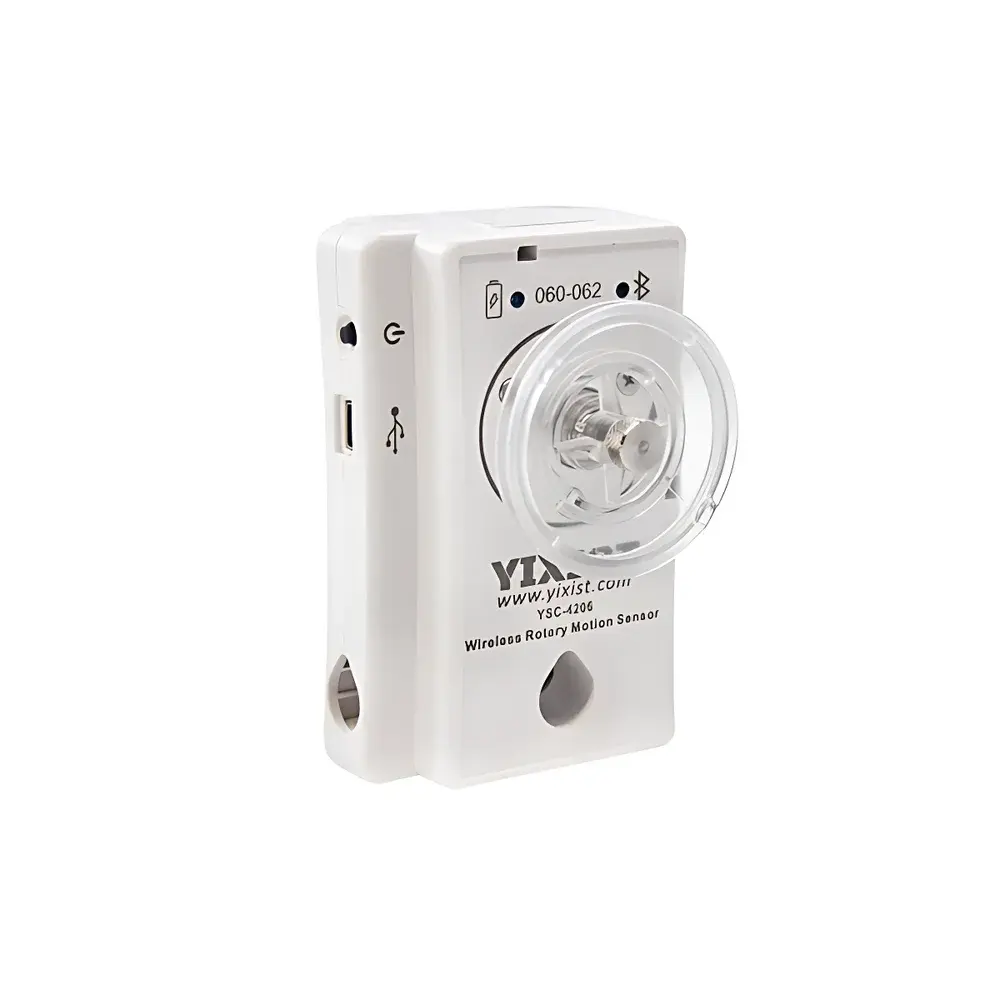
YIXIST YSC-4206 Wireless Rotary Motion Sensor
| Brand | YIXIST |
|---|---|
| Model | YSC-4206 |
| Connection | Bluetooth 5.0 & USB Type-C |
| Battery | 800 mAh Li-polymer (≥12 h runtime in Bluetooth mode) |
| Angular Resolution | High-resolution bidirectional optical encoder |
| Max Rotational Speed | 30 rps |
| Operating Range | Bluetooth ≤30 m (line-of-sight) |
| Wheel Options | Three interchangeable precision-calibrated wheels |
| Compliance | CE-marked, RoHS-compliant |
| Software | SmartLAB Data Acquisition Suite (Windows/macOS) |
| Application Domain | Physics education, industrial condition monitoring, mechatronics R&D, biomechanics instrumentation |
Overview
The YIXIST YSC-4206 Wireless Rotary Motion Sensor is an engineered measurement instrument designed for high-fidelity acquisition of angular displacement, angular velocity, and derived linear velocity during rotational motion. It operates on the principle of quadrature-based optical encoding—utilizing a dual-channel photointerrupter system to resolve direction and incremental position with sub-degree angular resolution. Unlike contactless proximity sensors or Hall-effect tachometers, the YSC-4206 employs direct mechanical coupling via interchangeable calibrated wheels, ensuring traceable kinematic linkage between rotating shafts and encoded output. This architecture delivers deterministic temporal alignment between physical rotation and digital signal output—critical for time-domain analysis of transient dynamics such as motor startup transients, stepper motor step loss detection, or inertial load characterization. Its dual-mode interface (Bluetooth 5.0 LE and USB Type-C) enables flexible deployment across isolated lab benches, mobile field setups, and embedded educational workstations without sacrificing synchronization fidelity.
Key Features
- Tri-wheel modular interface: Includes three factory-calibrated wheels (diameters: 25 mm, 50 mm, and 100 mm), each with laser-etched scale markings and low-inertia aluminum hubs—enabling consistent conversion from encoder pulses to both angular (rad/s, °/s) and linear (m/s, cm/s) metrics per ISO 5725-2 traceability guidelines.
- Bidirectional optical encoder core: Quadrature A/B channel output with 360 PPR (pulses per revolution) native resolution; supports software-interpolated resolution up to 1440 counts/rev for enhanced low-speed stability and zero-crossing detection.
- Dual communication architecture: Bluetooth 5.0 LE provides peer-to-peer streaming at up to 100 Hz sampling rate over ≤30 m (unobstructed); USB Type-C offers full-speed CDC ACM serial interface (12 Mbps) with microsecond-level timestamping for deterministic data capture under real-time OS environments.
- Industrial-grade mechanical design: Reinforced stainless-steel axle with ceramic-coated bearing raceway; rated for continuous operation at ≤5 N·m radial load and ≥10⁶ actuation cycles—validated per IEC 60068-2-64 shock/vibration profiles.
- Intelligent power management: 800 mAh Li-polymer battery with integrated fuel-gauge IC; three-color LED indicator (red = <20%, orange = 20–70%, green = >70%) and auto-cut-off at 4.2 V ±0.05 V; supports concurrent charging and active sensing via USB PD 2.0.
Sample Compatibility & Compliance
The YSC-4206 interfaces directly with rotating shafts, pulleys, flywheels, conveyor rollers, robotic joint actuators, and exercise equipment flywheels via press-fit or set-screw wheel mounting. It requires no external power supply at the sensor node and imposes negligible inertial loading (<0.8 g·cm² moment of inertia). All firmware and SmartLAB software comply with GLP-aligned audit trail requirements—including user session logging, parameter change history, and exportable CSV/TDMS data containers with embedded UTC timestamps. The device meets CE Directive 2014/53/EU (Radio Equipment Directive) and RoHS 2011/65/EU material restrictions. While not FDA 21 CFR Part 11 certified out-of-box, its data export structure supports integration into validated LIMS/QMS platforms through documented API endpoints.
Software & Data Management
SmartLAB Data Acquisition Suite (v3.2+) provides synchronized multi-channel visualization, real-time FFT spectral analysis, derivative-based acceleration calculation, and customizable trigger logic (e.g., angular threshold crossing, dwell-time gating). Raw encoder data is stored in IEEE 754 double-precision floating-point format with hardware-timestamped metadata. Export options include CSV (with header metadata), MATLAB .mat, and NI TDMS—each preserving sample index, absolute UTC time, and sensor configuration state. Batch processing tools support angular displacement integration, slip ratio computation, and cyclic average profiling—commonly applied in motor efficiency benchmarking (per ISO 1940-1) and gearbox wear trend analysis.
Applications
- Undergraduate physics laboratories: Quantitative verification of rotational kinematics equations (θ(t), ω(t), α(t)), moment of inertia determination via torsional pendulum decay analysis, and conservation of angular momentum experiments using coupled rotating platforms.
- Mechatronics R&D: Closed-loop feedback validation for servo-controlled robotic joints; identification of backlash and hysteresis in harmonic drive systems; dynamic response characterization of BLDC motor controllers under variable inertial loads.
- Preventive maintenance engineering: Baseline vibration signature correlation with rotational speed harmonics; early detection of bearing cage defects via amplitude modulation sideband analysis at 1×, 2×, and 3× RPM frequencies.
- Sports science instrumentation: Flywheel resistance training analytics—including instantaneous torque estimation from angular acceleration profiles—and ergometer calibration against ISO 20957-1 Class H standards.
FAQ
What is the maximum supported sampling frequency in Bluetooth mode?
The sensor streams at a fixed 100 Hz in Bluetooth mode, with jitter <±2 ms (95% CI), verified using NIST-traceable timing analyzers.
Can multiple YSC-4206 units be synchronized wirelessly?
Yes—SmartLAB supports time-aligned multi-sensor acquisition via Bluetooth master-slave topology with hardware-assisted clock skew compensation (±50 µs inter-unit drift over 8-hour sessions).
Is firmware upgrade supported in-field?
Yes—over-the-air (OTA) updates are delivered via SmartLAB’s secure signed package mechanism, preserving configuration integrity and supporting rollback to prior versions.
Does the sensor provide absolute angular position?
No—it outputs relative angular displacement only; absolute referencing requires external homing (e.g., optical limit switch) or integration with a known initial condition.
What environmental conditions are specified for continuous operation?
Operating temperature: −10 °C to +50 °C; relative humidity: 20–80% non-condensing; IP52-rated enclosure for dust resistance and limited drip protection.




