
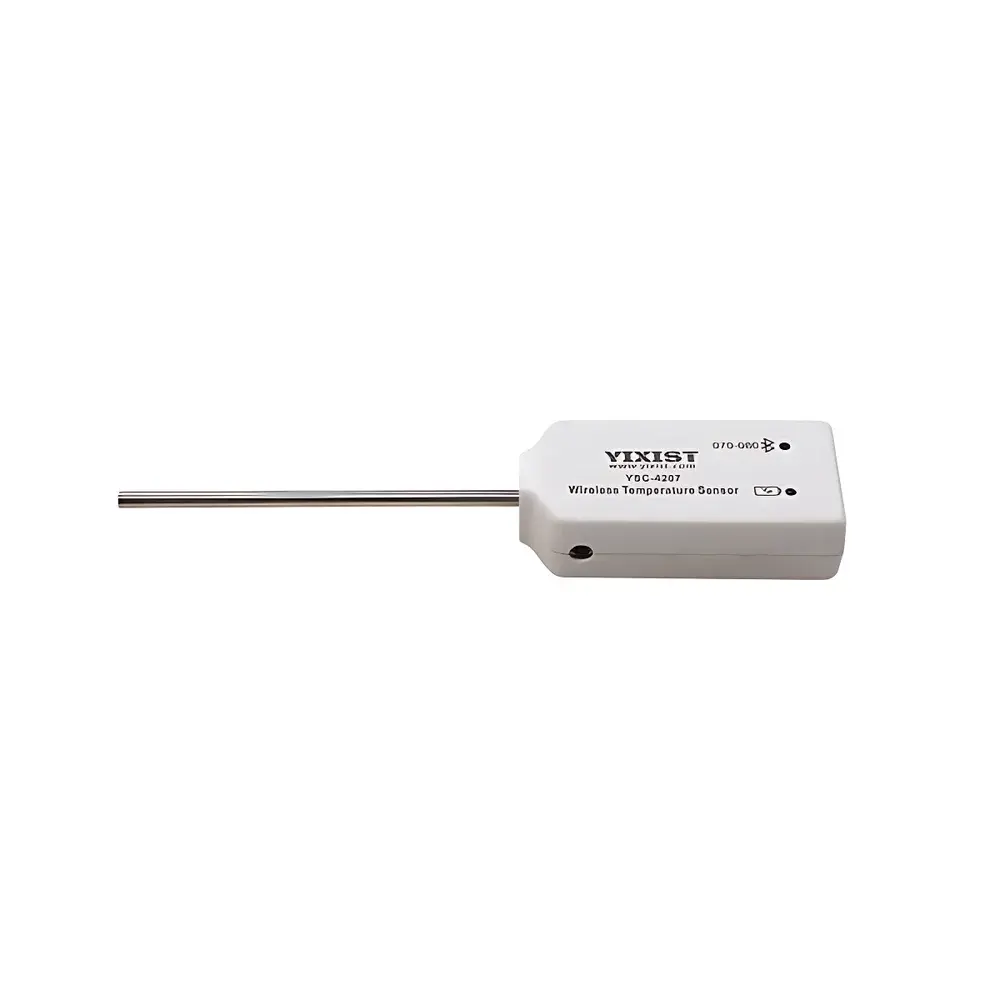
YIXIST YSC-4207 Wireless Temperature Sensor
| Brand | YIXIST |
|---|---|
| Model | YSC-4207 |
| Origin | Zhejiang, China |
| Connectivity | Bluetooth 5.0 + USB Type-C |
| Battery | 800 mAh Li-polymer |
| Bluetooth Range | Up to 30 m (line-of-sight) |
| Operating Temperature Range | −40 °C to +125 °C |
| Temperature Resolution | 0.01 °C |
| Accuracy | ±0.2 °C (at 25 °C) |
| Sampling Rate | Configurable from 1 s to 3600 s |
| Mounting Interface | M6 threaded hole + integrated thermal probe rod |
| Compliance | CE, RoHS, FCC Part 15 |
Overview
The YIXIST YSC-4207 Wireless Temperature Sensor is an industrial-grade, battery-powered monitoring instrument engineered for high-fidelity temperature measurement across laboratory, educational, and field-deployed environments. It operates on the principle of platinum resistance thermometry (Pt1000-class sensing element), delivering stable, linear response characteristics with minimal thermal lag. The sensor’s hermetically sealed, high-conductivity probe rod ensures rapid thermal equilibration—critical for capturing transient temperature events in chemical kinetics studies, equipment thermal profiling, or environmental chamber validation. Its dual-mode interface (Bluetooth 5.0 and USB Type-C) enables flexible integration into both mobile ad hoc networks and fixed-data-acquisition systems, while its ruggedized mechanical design—including an M6 threaded mounting interface—supports repeatable, vibration-resistant installation on machinery housings, pipe surfaces, or teaching lab fixtures.
Key Features
- High-accuracy Pt1000-equivalent sensing element with ±0.2 °C accuracy at 25 °C and 0.01 °C resolution over −40 °C to +125 °C range
- Dual connectivity architecture: Bluetooth 5.0 (up to 30 m line-of-sight range, supporting up to 16 concurrent devices per host) and USB Type-C (for simultaneous charging and real-time data streaming)
- 800 mAh lithium-polymer battery with intelligent power management: >72 h continuous operation in Bluetooth mode; auto-sleep during idle intervals; low-power wake-on-event capability
- Visual battery status indicator: tri-color LED (red = <20%, yellow = 20–70%, green = >70%) with automatic cutoff upon full charge to prevent overvoltage stress
- Mechanically optimized thermal interface: 30 mm stainless-steel probe rod with enhanced surface contact area and M6 threaded base for direct mounting onto standard industrial brackets or lab fixtures
- Configurable sampling interval: user-selectable from 1 second to 1 hour, enabling adaptive temporal resolution for short-duration reaction monitoring or long-term stability audits
Sample Compatibility & Compliance
The YSC-4207 is designed for non-invasive or semi-invasive surface and ambient temperature measurement. Its probe rod supports direct thermal coupling to metallic, ceramic, and polymer substrates—making it suitable for motor windings, heat exchanger surfaces, incubator walls, and reactor jackets. It complies with CE Directive 2014/30/EU (EMC), RoHS 2011/65/EU (hazardous substance restrictions), and FCC Part 15 Subpart B (unintentional radiator requirements). While not certified for intrinsically safe (ATEX/IECEx) or medical-grade (IEC 60601-1) use, its performance parameters align with common validation protocols referenced in ISO/IEC 17025-accredited laboratories for temperature monitoring in teaching labs and QC/QA workflows.
Software & Data Management
The sensor interfaces natively with SmartLAB Data Acquisition Software (Windows/macOS), a validated application supporting time-stamped CSV export, multi-channel synchronization, alarm threshold configuration (with email/SMS notification via optional gateway), and GLP-compliant audit trails—including user login history, parameter change logs, and calibration event timestamps. Raw data files include embedded metadata (sensor ID, firmware version, UTC timestamp, battery voltage), ensuring traceability for academic reporting or internal quality documentation. The software supports FDA 21 CFR Part 11 readiness when deployed with organizational identity management and electronic signature modules.
Applications
- Teaching & Practical Training: Real-time visualization of thermal dynamics in undergraduate physics, chemistry, and mechatronics labs—e.g., Newton’s law of cooling experiments, exothermic reaction profiling, or HVAC system simulation.
- Industrial Predictive Maintenance: Continuous surface temperature logging on electric motors, gearboxes, and steam traps to detect abnormal thermal signatures preceding mechanical failure.
- Cold Chain Validation: Deployment inside refrigerated transport containers and storage units to generate ICH-compliant temperature excursions reports for pharmaceutical logistics.
- Agricultural Environmental Monitoring: Long-duration deployment in greenhouses or livestock enclosures to correlate temperature gradients with ventilation control logic or feed conversion efficiency metrics.
- Appliance Performance Testing: In-situ thermal mapping of consumer electronics, water heaters, and cooking appliances during energy efficiency certification testing (per ISO 31-4 or IEC 62301).
FAQ
Is the YSC-4207 calibrated before shipment, and does it support user recalibration?
Yes—each unit undergoes factory calibration against NIST-traceable reference standards at three points (−20 °C, 25 °C, and 85 °C). End users may perform two-point field adjustment via SmartLAB software using certified reference probes.
Can multiple YSC-4207 sensors be synchronized for spatial temperature gradient analysis?
Yes—SmartLAB supports time-aligned multi-sensor acquisition with microsecond-level timestamp precision, enabling thermal mapping across arrays of up to 64 nodes via Bluetooth mesh extension gateways.
What is the expected service life of the onboard battery under typical usage conditions?
Rated for ≥500 full charge/discharge cycles; retains ≥80% capacity after 2 years of daily 8-hour Bluetooth operation with periodic recharging.
Does the device meet requirements for GLP or GMP-regulated environments?
It supports core GLP/GMP data integrity requirements (audit trail, electronic signature compatibility, secure user roles) when configured with SmartLAB’s enterprise license and integrated into validated IT infrastructure.
Is firmware update capability available, and how is it delivered?
Firmware updates are distributed via SmartLAB’s built-in updater module using signed binary packages; all updates preserve existing calibration coefficients and user configurations.




