
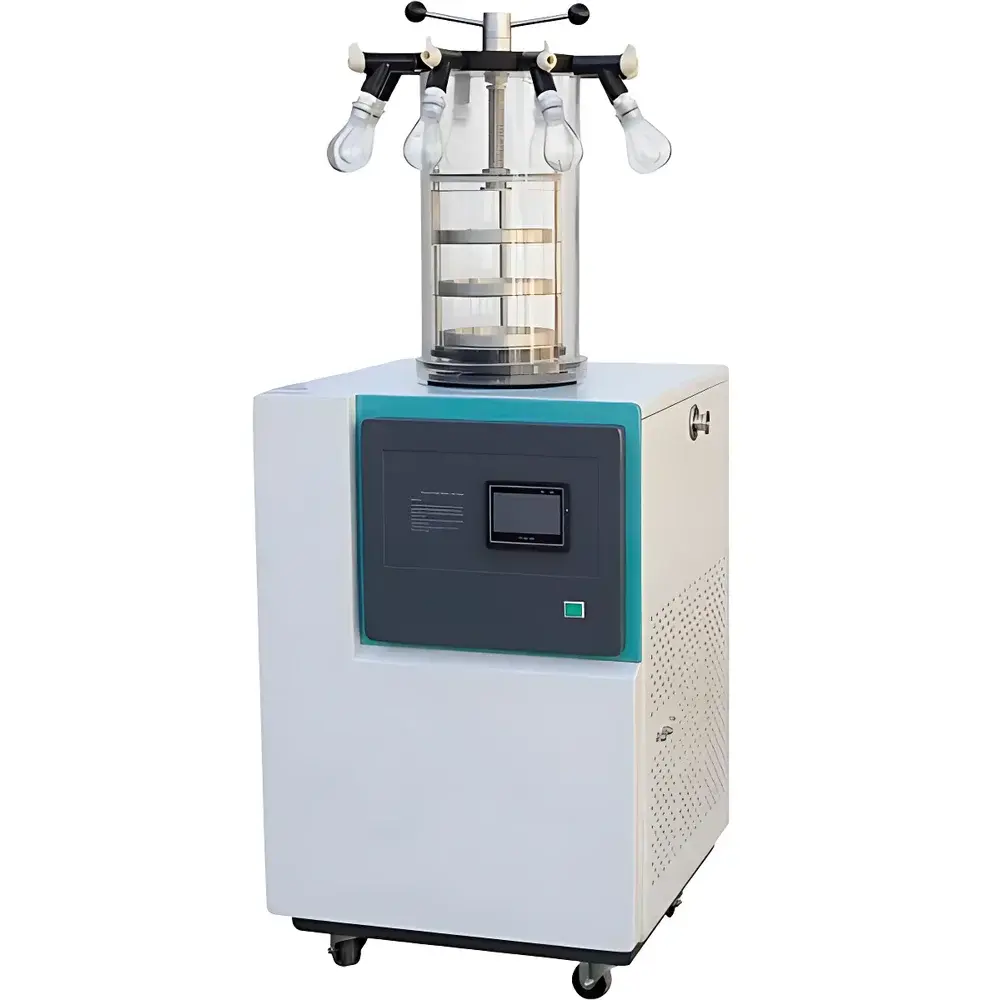
BIOCOOL Lab-1C-110 Laboratory Freeze Dryer
| Brand | BIOCOOL |
|---|---|
| Origin | Beijing, China |
| Model | Lab-1C-110 |
| Instrument Type | Standard Shelf-Type Freeze Dryer |
| Application | Laboratory-Scale Lyophilization |
| Freeze-Drying Area | 0.12 m² |
| Ultimate Vacuum | <3 Pa |
| Condenser Temperature | −110 °C |
| Condensate Capacity (24 h) | 3 L |
| Refrigeration System | Industrial Compressor with Dual-Stage Cascade Cooling |
| Vacuum Pump | Korean-Made Rotary Vane Pump (2 L/s) |
| Chamber Material | Aerospace-Grade Acrylic (Seamless, Leak-Free Construction) |
| Control System | PLC-Based Touchscreen HMI with Programmable Logic |
| Data Logging | Internal Memory (3-month retention), USB Export (Optional), PC Database Integration (Optional) |
| Compliance | Designed for GLP/GMP-aligned workflows |
Overview
The BIOCOOL Lab-1C-110 is a laboratory-scale shelf-type freeze dryer engineered for reproducible, high-fidelity lyophilization of thermolabile biologicals, pharmaceutical intermediates, and organic-solvent-containing formulations. It operates on the fundamental principle of sublimation under deep vacuum: frozen water (or solvent) transitions directly from solid to vapor phase without passing through liquid, preserving structural integrity, activity, and stability of sensitive samples. Its −110 °C dual-stage cascade condenser enables efficient capture of volatile organic solvents—including acetone, ethanol, ethyl acetate, and acetonitrile—at concentrations up to 95% (v/v), mitigating corrosion risks common in conventional −50 °C or −80 °C systems. The seamless aerospace-grade acrylic drying chamber eliminates gasket-related leakage and facilitates full visual process monitoring without compromising vacuum integrity.
Key Features
- Deep-cold condenser (−110 °C) with 3 L/24 h condensate capacity, optimized for organic solvent-laden matrices
- Programmable freeze-drying control system with PID-regulated shelf heating, real-time temperature feedback (50 ms sampling interval), and 500-user-defined recipe storage
- Non-electric, rapid mechanical defrosting mechanism—eliminates thermal shock, avoids condenser ice cracking, and prevents cross-contamination during maintenance
- Three-mode pulse backfill system (slow/medium/fast) for controlled inert gas (N₂ or Ar) reintroduction, minimizing particle dispersion in fragile lyophilized cakes or powders
- Integrated vacuum regulation module (optional) enabling dynamic pressure modulation during primary and secondary drying to suppress boil-over, foam collapse, or vial breakage
- Industrial-grade PLC controller with 7-inch resistive touchscreen HMI—no manual required; intuitive workflow navigation across manual parameter tuning and fully automated cycles
- Comprehensive safety architecture: 36 V low-voltage heating circuits, overtemperature cutoff, vacuum interlock on drain valve, compressor overload protection, and pump oil-backflow prevention
Sample Compatibility & Compliance
The Lab-1C-110 accommodates aqueous solutions, suspensions, emulsions, and organic-aqueous mixtures with eutectic points ≥ −20 °C. Its solvent-tolerant design complies with ISO 22058 (freeze-drying equipment performance testing) and supports method development aligned with USP and ICH Q5C guidelines. When configured with optional calibration modules (temperature and vacuum), it meets internal validation requirements for GLP environments. Optional co-located eutectic point determination (via integrated probe) assists in rational cycle design per ASTM F2370-22. All firmware and data logging functions are structured to support 21 CFR Part 11 compliance when deployed with validated third-party PC-based database software (e.g., LabArchives or custom SQL server integration).
Software & Data Management
Data acquisition occurs at 50 ms resolution across all critical parameters: shelf temperature, condenser temperature, chamber pressure, and elapsed time. Internal flash memory retains up to three months of continuous logs (timestamped, CRC-verified). USB export enables raw CSV transfer for offline analysis in MATLAB, Python (Pandas), or JMP. Optional PC database connectivity allows centralized archival, role-based access control, and electronic signature-enabled report generation. Audit trail functionality—covering user login, recipe modification, cycle start/stop, alarm events, and calibration actions—is available via external software integration. Remote monitoring (up to 1.5 km via RS485/Ethernet bridge) permits real-time status verification and alarm notification without physical presence.
Applications
This system is routinely deployed in academic research labs for protein stabilization, vaccine formulation studies, and botanical extract preservation. In QC/QA settings, it supports reference standard preparation, stability-indicating method development, and batch consistency verification of lyophilized APIs. Its solvent-handling capability makes it suitable for small-molecule drug candidates dissolved in DMSO/ethanol blends, polymer nanoparticle suspensions, and chromatographic fraction drying where residual solvent removal is critical. Regulatory submissions often cite Lab-1C-110-generated lyophilization curves as part of process characterization dossiers under ICH Q5A(R2) and Q8(R2).
FAQ
What types of organic solvents can be safely processed?
The Lab-1C-110 is validated for acetone, methanol, ethanol, isopropanol, acetonitrile, ethyl acetate, and tetrahydrofuran at concentrations ≤95% (v/v), provided the total vapor pressure remains within the condenser’s capture envelope.
Is the chamber pressure sensor calibrated traceably to NIST standards?
Yes—optional factory calibration includes NIST-traceable documentation for both Pirani and capacitance manometers, with recalibration intervals recommended every 12 months under continuous operation.
Can the system operate unattended overnight?
Fully—auto-cycle termination, alarm-triggered shutdown, and power-fail resume functionality ensure safe extended runs; however, inert gas supply and condensate tank level must be verified pre-cycle.
Does the PLC support Modbus TCP for integration into facility SCADA systems?
Yes—the standard communication interface includes Modbus TCP/IP (port 502), enabling bidirectional data exchange with central lab management platforms.
What is the typical shelf temperature uniformity across the 0.12 m² surface?
Measured uniformity is ±1.2 °C at −40 °C setpoint and ±0.8 °C at +25 °C, verified per ISO 22058 Annex B using 9-point thermocouple mapping.



