
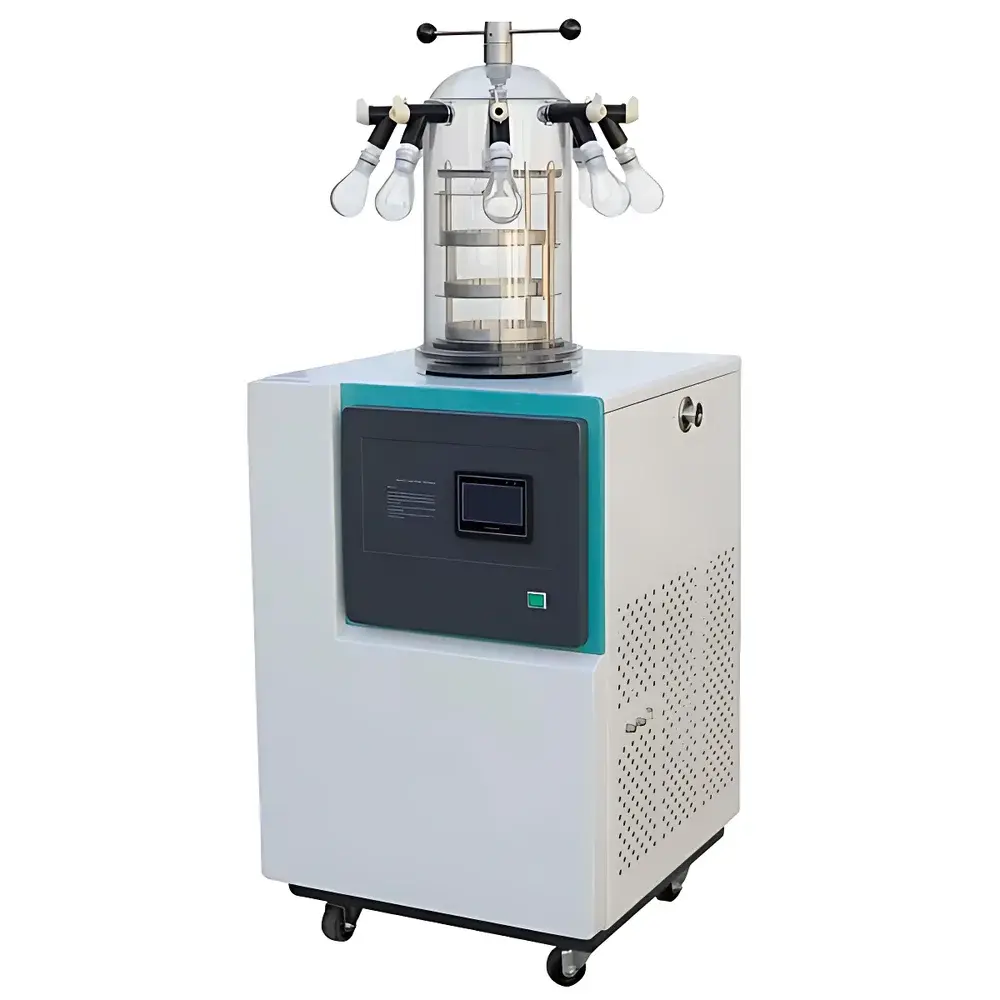
BioCool FD-1B-110+ Benchtop Freeze Dryer with -110°C Cold Trap and Stoppering Function
| Brand | BioCool |
|---|---|
| Origin | Beijing, China |
| Model | FD-1B-110+ |
| Instrument Type | Stoppering Freeze Dryer |
| Application | Laboratory-Scale Lyophilization |
| Shelf Area | 0.08 m² |
| Ultimate Vacuum | <3 Pa |
| Condenser Temperature (No Load) | -110°C |
| Water Capture Capacity (24 h) | 3 L |
| Refrigeration Compressor | Imported Industrial-Grade Unit |
| Control System | PLC + Touchscreen Interface |
| Sample Temperature Monitoring | Dual Pt100 Sensors |
| Reconstitution Gas Inlet | Pulse-Controlled Inert Gas Backfilling (N₂ or Argon) |
| Compliance | Designed for GLP-compliant workflows |
Overview
The BioCool FD-1B-110+ is a laboratory-grade benchtop freeze dryer engineered for reproducible, scalable lyophilization of heat-sensitive biologicals, pharmaceutical intermediates, and organic-solvent-based formulations. It operates on the fundamental principles of sublimation under deep vacuum: frozen water (or solvent) transitions directly from solid to vapor phase without passing through liquid state, preserving structural integrity and bioactivity. Its defining feature is the ultra-low temperature condenser (-110°C), which enables efficient capture of volatile organic solvents—including acetone, ethanol, acetonitrile, and ethyl acetate—commonly used in peptide synthesis, small-molecule APIs, and polymer formulations. Unlike conventional -50°C or -80°C systems, this condenser prevents solvent backstreaming, protects vacuum pump integrity, and eliminates cross-contamination risks during multi-batch processing. The unit integrates a mechanical stoppering mechanism compatible with standard 10–20 mL serum vials (e.g., 20R, 22R), allowing sterile, in-chamber closure post-drying—a critical requirement for aseptic development and stability testing under ICH Q5C guidelines.
Key Features
- Deep-cold condenser (-110°C no-load) with high-efficiency copper coil geometry and dual-stage cascade refrigeration system
- Integrated stoppering actuator with programmable pressure control and force feedback, ensuring consistent rubber stopper seating across batches
- Patented airflow guide cylinder design enhances vapor path uniformity and reduces primary drying time by up to 18% (vs. non-guided systems)
- Dual Pt100 sample temperature probes with real-time display and logging—enabling precise monitoring of product interface temperature during primary drying
- Pulse-controlled inert gas backfill system with calibrated solenoid valve and integrated filter; supports N₂, Ar, or custom gas mixtures per ISO 8573-1 Class 2 purity standards
- PLC-based controller with 7-inch resistive touchscreen, onboard recipe storage (≥100 cycles), and password-protected user levels (Operator/Engineer/Admin)
- Auto-defrost function with timed condenser heating and drain management to minimize downtime between cycles
Sample Compatibility & Compliance
The FD-1B-110+ accommodates samples with eutectic temperatures above -20°C—including aqueous buffers, protein solutions, colloidal suspensions, and organic-aqueous mixtures containing ≤95% (v/v) miscible solvents. Its stainless-steel drying chamber (304 grade) and electropolished condenser chamber meet ASME BPE-2021 surface finish requirements (Ra ≤ 0.4 µm). All wetted parts are non-porous and autoclavable. The system supports process validation documentation per FDA Guidance for Industry: Process Validation (2011) and EU Annex 15. When configured with optional audit-trail-enabled software, it complies with 21 CFR Part 11 electronic record and signature requirements—including user authentication, change history, and secure data export via USB 2.0 (FAT32 formatted drive only).
Software & Data Management
Data acquisition includes real-time logging of shelf temperature, condenser temperature, chamber pressure, sample temperature (dual channel), and elapsed cycle time at configurable intervals (1–60 s). Freeze-drying curves (temperature vs. time, pressure vs. time) are auto-generated and stored in CSV format. U disk export supports raw sensor values, derivative calculations (e.g., dP/dt for endpoint detection), and annotated event markers (e.g., “stopper down”, “gas backfill start”). Optional BioCool LyoView™ software (v3.2+) adds comparative curve overlay, statistical batch trending (X-bar/R charts), and PDF report generation compliant with ALCOA+ principles (Attributable, Legible, Contemporaneous, Original, Accurate, Complete, Consistent, Enduring, Available).
Applications
- Lyophilization of monoclonal antibody formulations prior to stability studies (ICH Q5C)
- Drying of organic-solvent-based nanosuspensions for pulmonary delivery
- Stabilization of CRISPR-Cas9 ribonucleoprotein complexes for gene editing research
- Processing of diagnostic reagent kits requiring long-term ambient storage
- Preparative-scale dehydration of microbial cultures and enzyme preparations
- Development of lyophilized excipient blends for hot-melt extrusion compatibility screening
FAQ
What types of organic solvents can be safely processed in the FD-1B-110+?
Methanol, ethanol, isopropanol, acetone, acetonitrile, tetrahydrofuran (THF), and ethyl acetate—provided final concentration does not exceed 95% (v/v) and total solvent mass remains within 3 L/24 h condensation capacity.
Is the stoppering function compatible with ISO 8362-1 vials?
Yes—mechanical stroke and force profile are calibrated for 13 mm and 20 mm rubber stoppers meeting ISO 8362-1 dimensional tolerances.
Can the system operate under GMP conditions?
The base hardware meets GMP infrastructure requirements; full compliance requires IQ/OQ/PQ execution, 21 CFR Part 11–enabled software, and documented change control procedures.
What vacuum pump is recommended for optimal performance?
A 2 L/s oil-sealed rotary vane pump with integrated anti-suckback valve and hydrocarbon mist filter (e.g., Welch 2056 or Edwards RV8) is factory-validated and supplied as standard.
Does the unit support remote monitoring?
RS-485 Modbus RTU port is provided for integration into lab-wide SCADA or MES platforms; Ethernet/IP and OPC UA require optional gateway module.



