
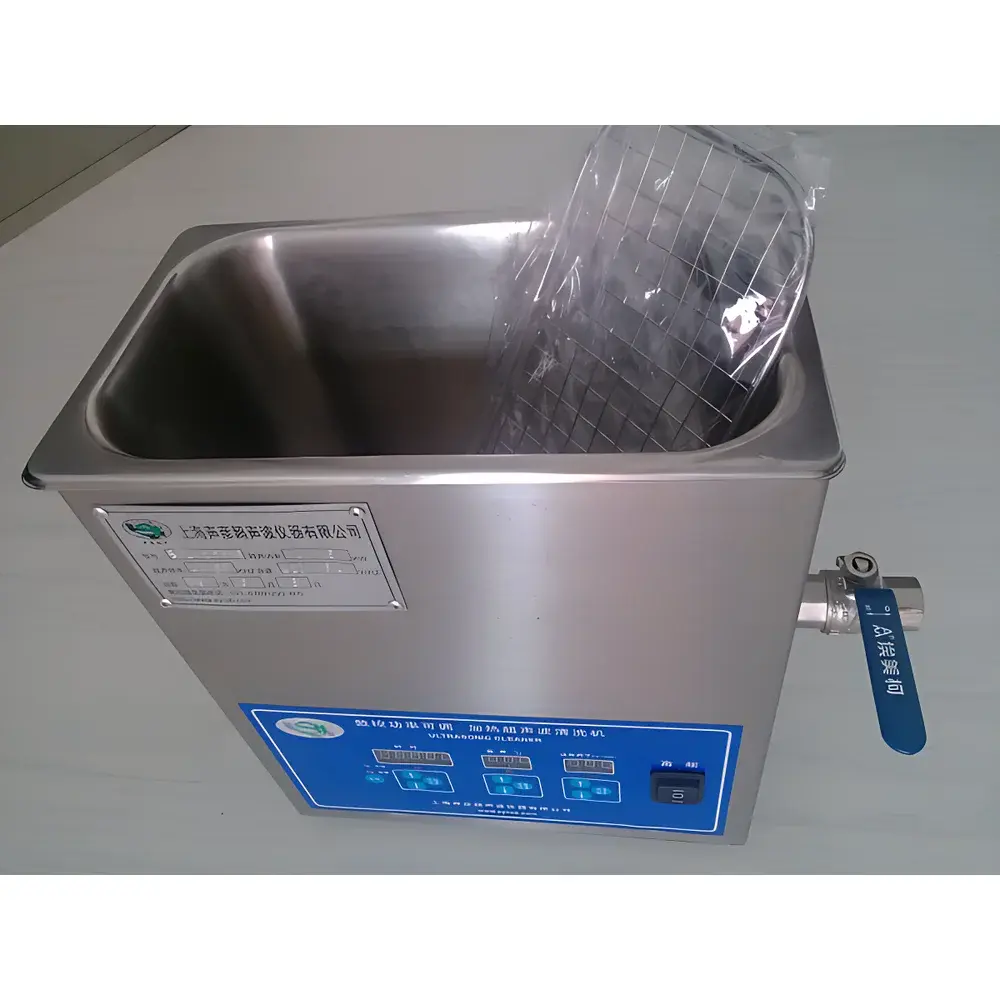
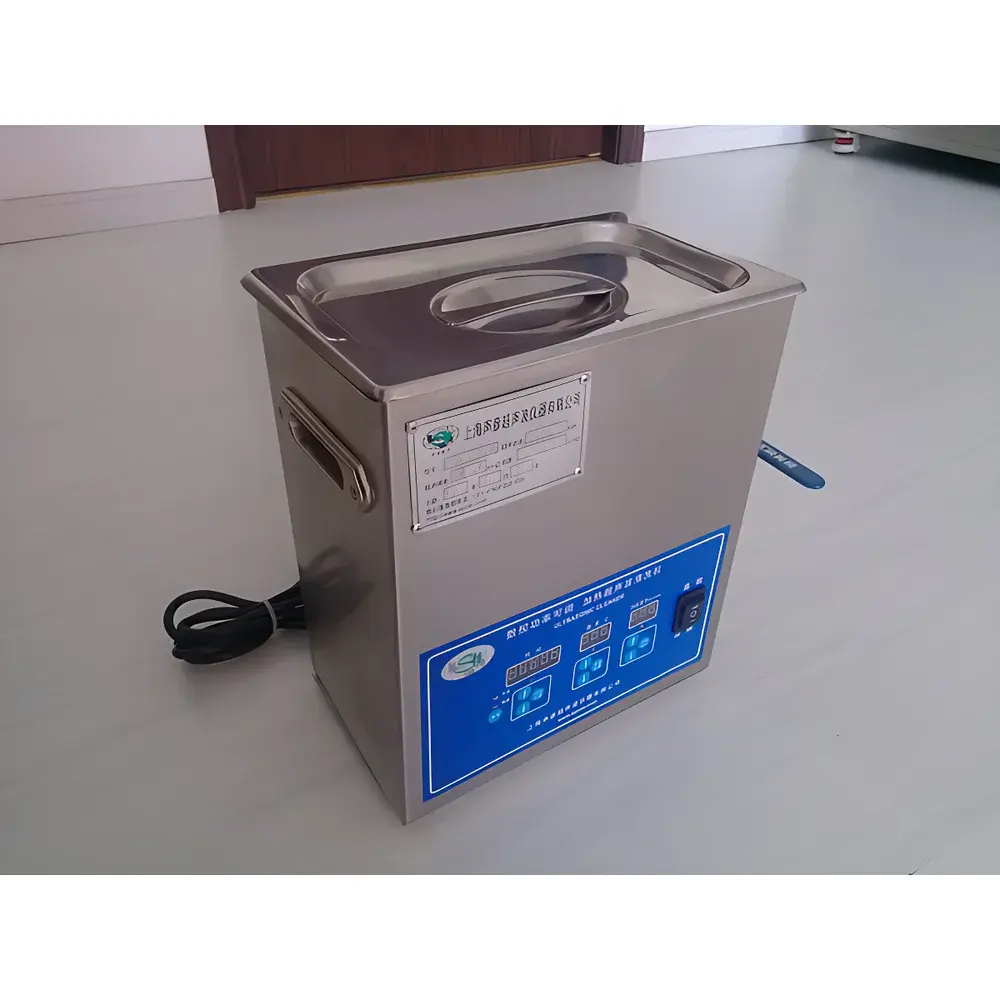
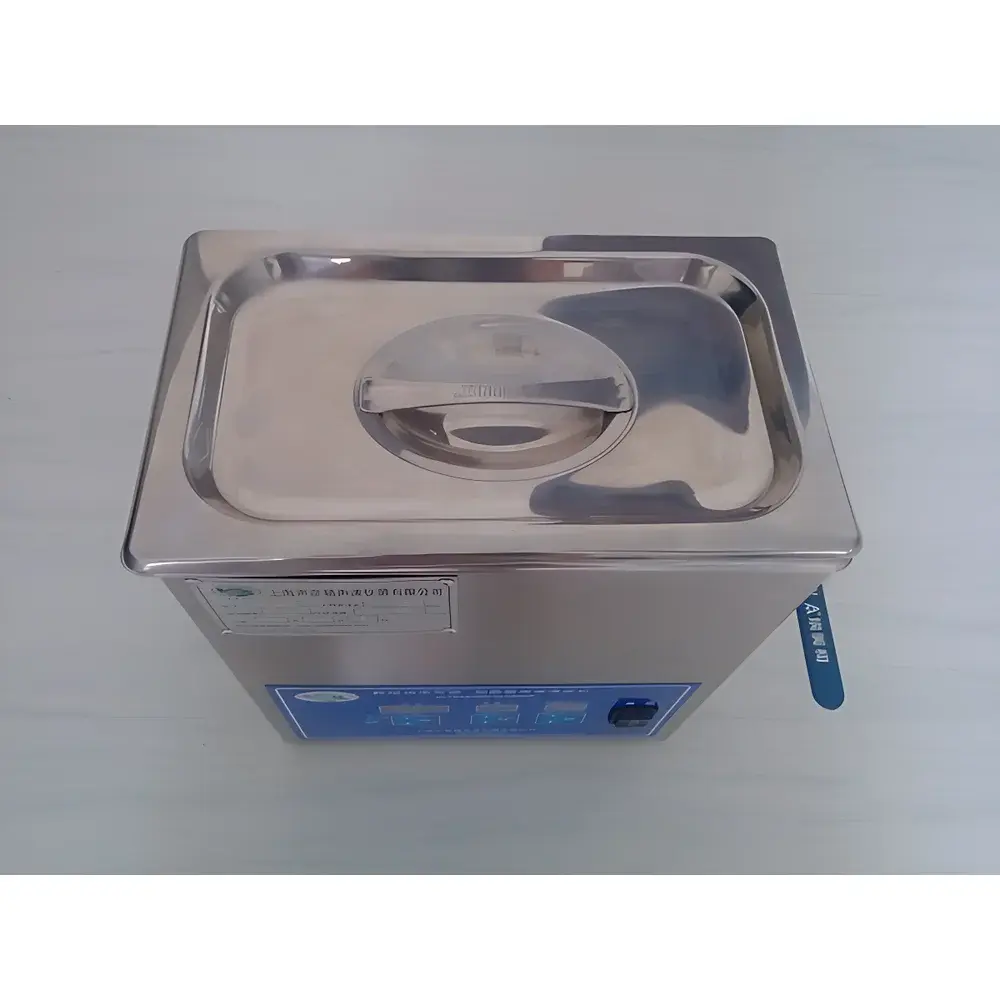
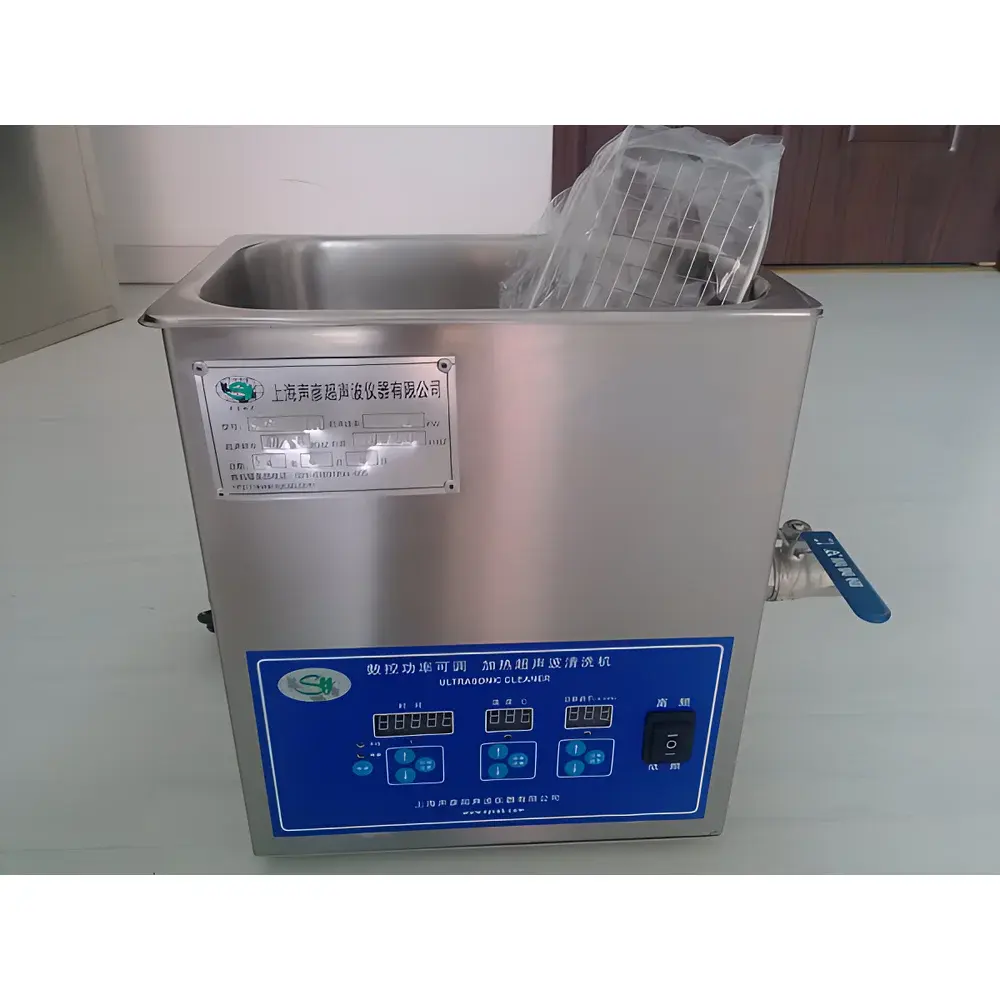
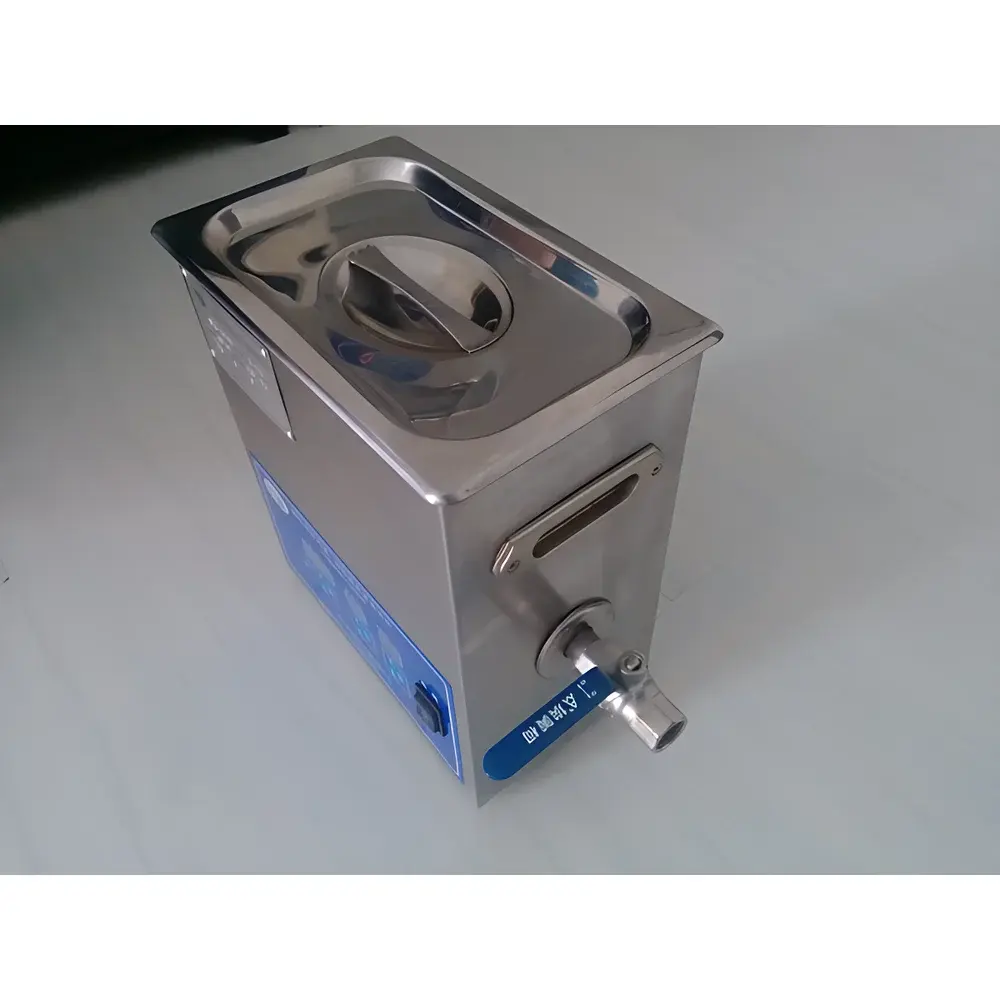
SYC Sycs SCQ-2211 Ultrasonic Cleaner
| Brand | SYC Sycs |
|---|---|
| Origin | Shanghai, China |
| Model | SCQ-2211 |
| Capacity | 4 L |
| Ultrasonic Frequency | 40 kHz |
| Ultrasonic Power | 150 W |
| Adjustable Power | No |
| Adjustable Temperature | No |
| Timer Range | 1–60 min |
| Sound-Dampening Lid | Yes |
| Manual Fill/Drain | Yes |
| Construction | Stainless Steel Tank & Housing |
| Input Voltage | 220 V / 50 Hz |
Overview
The SYC Sycs SCQ-2211 Ultrasonic Cleaner is a compact, benchtop ultrasonic cleaning system engineered for precision and reliability in routine laboratory and light industrial applications. It operates on the principle of ultrasonic cavitation—high-frequency sound waves (40 kHz) generate microscopic vacuum bubbles in the cleaning solution that rapidly collapse, producing localized shockwaves and microstreaming effects. This physical mechanism effectively dislodges particulate contaminants, organic residues, biofilms, and loosely adhered inorganic deposits from complex geometries—including blind holes, crevices, and porous surfaces—without mechanical abrasion or hazardous chemical solvents. Designed for consistent performance in regulated environments, the SCQ-2211 meets fundamental requirements for equipment used in analytical sample preparation, glassware decontamination prior to spectroscopic or chromatographic analysis, and pre-sterilization cleaning of reusable labware. Its fixed-frequency, fixed-power architecture ensures stable energy delivery across repeated cycles, supporting method reproducibility in GLP-aligned workflows.
Key Features
- Stainless steel tank (230 × 140 × 150 mm) and housing for corrosion resistance and long-term structural integrity
- 150 W nominal ultrasonic power output at 40 kHz—optimized for general-purpose cleaning of glassware, metal parts, and polymer components
- Digital timer with adjustable duration from 1 to 60 minutes, enabling precise control over cleaning cycle length
- Integrated sound-dampening lid to reduce airborne noise emissions during operation (typical SPL < 65 dB(A) at 1 m)
- Manual fill-and-drain interface compatible with standard lab faucets and waste lines; no built-in pump or auto-fill system
- Robust transducer mounting using hybrid adhesive bonding and argon arc welding—validated for >10,000 operational hours without delamination
- CE-compliant electrical design with thermal cutoff protection and grounded chassis for operator safety
Sample Compatibility & Compliance
The SCQ-2211 accommodates a broad range of sample types and container formats, including borosilicate glass test tubes, volumetric flasks, pipette tips, stainless steel forceps, ceramic crucibles, and small plastic components (e.g., HPLC vial caps, microcentrifuge tubes). It is routinely deployed in preparatory steps for ISO/IEC 17025-accredited testing laboratories, particularly for cleaning prior to trace-metal analysis (per ASTM D5191, EPA Method 200.7), residue verification (USP ), and microbiological sampling equipment sanitation. While the unit does not include heating or degassing functions, its cavitation efficiency remains effective in ambient-temperature aqueous or mild detergent solutions. Users must select chemically compatible cleaning media—non-corrosive, low-foaming, and non-volatile—to avoid tank erosion or transducer damage. The device complies with IEC 61000-6-3 (EMC emission limits) and IEC 61000-6-2 (immunity standards), and its construction adheres to ISO 9001 manufacturing protocols.
Software & Data Management
The SCQ-2211 is a standalone hardware-only instrument with no embedded software, network interface, or data logging capability. All operational parameters are controlled via front-panel push-button interface with LED display. As such, it does not support FDA 21 CFR Part 11 electronic record or signature functionality. However, its simplicity supports audit-ready manual documentation: users may log cleaning cycles (date, time, duration, solution type, load composition) in bound laboratory notebooks or LIMS-integrated forms. For labs requiring traceability, the timer’s ±1% accuracy and repeatable acoustic output allow correlation of cleaning duration with validated residue removal thresholds—enabling inclusion in SOPs for QC/QA procedures under ISO/IEC 17025 or GMP Annex 15.
Applications
- Decontamination of analytical glassware (e.g., cuvettes, NMR tubes, HPLC autosampler vials) prior to UV-Vis, FTIR, or mass spectrometry analysis
- Cleaning of surgical instruments, dental tools, and endoscope components in clinical research settings
- Pre-extraction treatment of botanical matrices (e.g., dried herbs, root powders) to remove surface soil and microbial load before solvent-based extraction
- Dispersion and homogenization of colloidal suspensions, emulsions, and nanoparticle precursors in materials science workflows
- Maintenance cleaning of optical components (lens mounts, mirrors, fiber-optic connectors) where solvent wiping poses scratching risk
- Routine maintenance of filtration housings, syringe filters, and membrane modules used in water quality testing
FAQ
Does the SCQ-2211 support temperature control or heating?
No. This model operates at ambient bath temperature only. External heating plates or thermostatically controlled water baths must be used if elevated temperature cleaning is required.
Can the ultrasonic frequency be changed on this unit?
No. The SCQ-2211 is factory-configured for fixed 40 kHz operation. Frequency selection is available only on multi-frequency variants (e.g., SCQ-2211-F series), not on this base configuration.
Is the unit suitable for cleaning delicate MEMS devices or semiconductor wafers?
Not recommended without process validation. The 40 kHz cavitation intensity may exceed safe thresholds for sub-micron features. Lower-frequency (25–30 kHz) or megasonic (≥800 kHz) systems are preferred for such applications.
What maintenance is required for long-term reliability?
Routine tasks include periodic descaling of the tank interior using dilute acetic acid (5%), inspection of the lid gasket for compression set, and visual verification of transducer bond integrity every 6 months. Avoid prolonged operation with low liquid levels to prevent transducer overheating.
Does SYC provide calibration certificates or IQ/OQ documentation?
Yes—upon request, SYC supplies factory-verified performance reports (including timer accuracy, power stability, and acoustic output mapping) and customizable IQ/OQ templates aligned with ISO/IEC 17025 and GxP expectations. These are delivered as PDF documents with digital signatures.



