
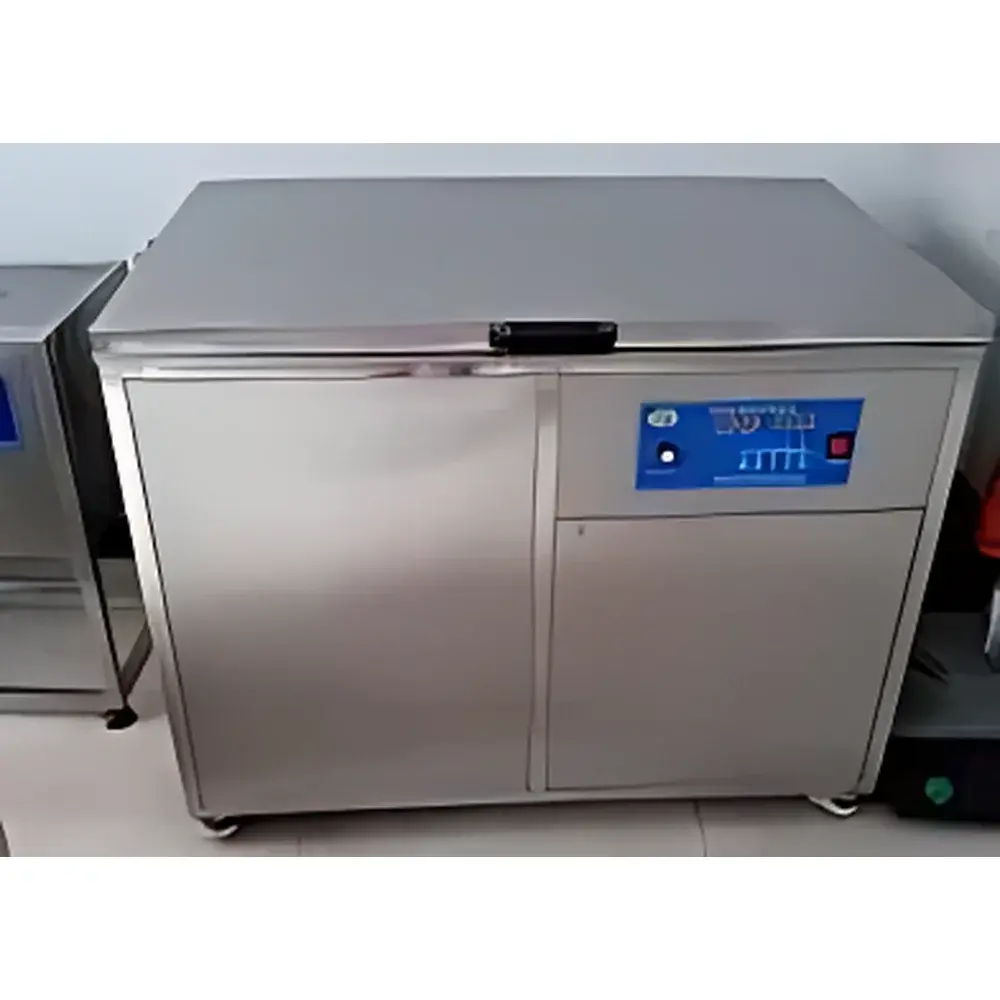
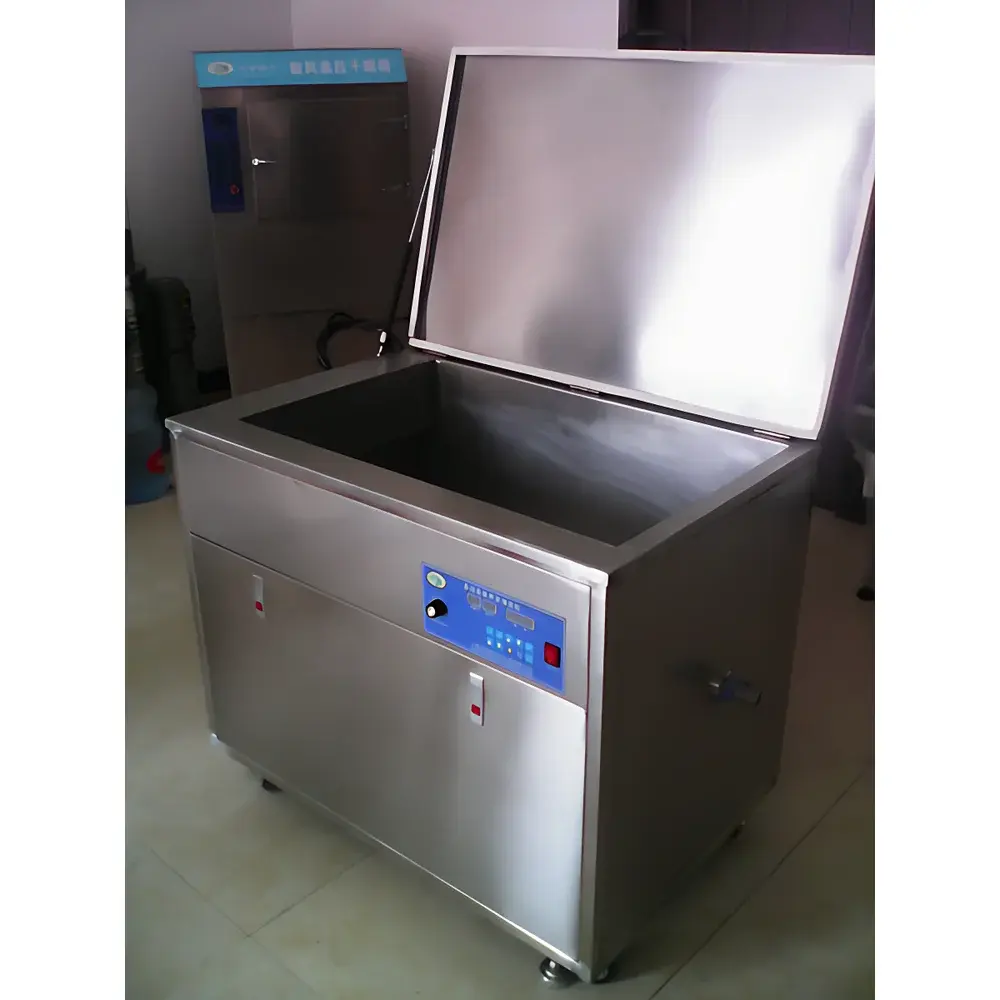
SYC Sycs SCQ-1010D Desktop Dual-Frequency Ultrasonic Cleaner
| Brand | SYC Sycs |
|---|---|
| Origin | Shanghai, China |
| Model | SCQ-1010D |
| Tank Capacity | 132 L |
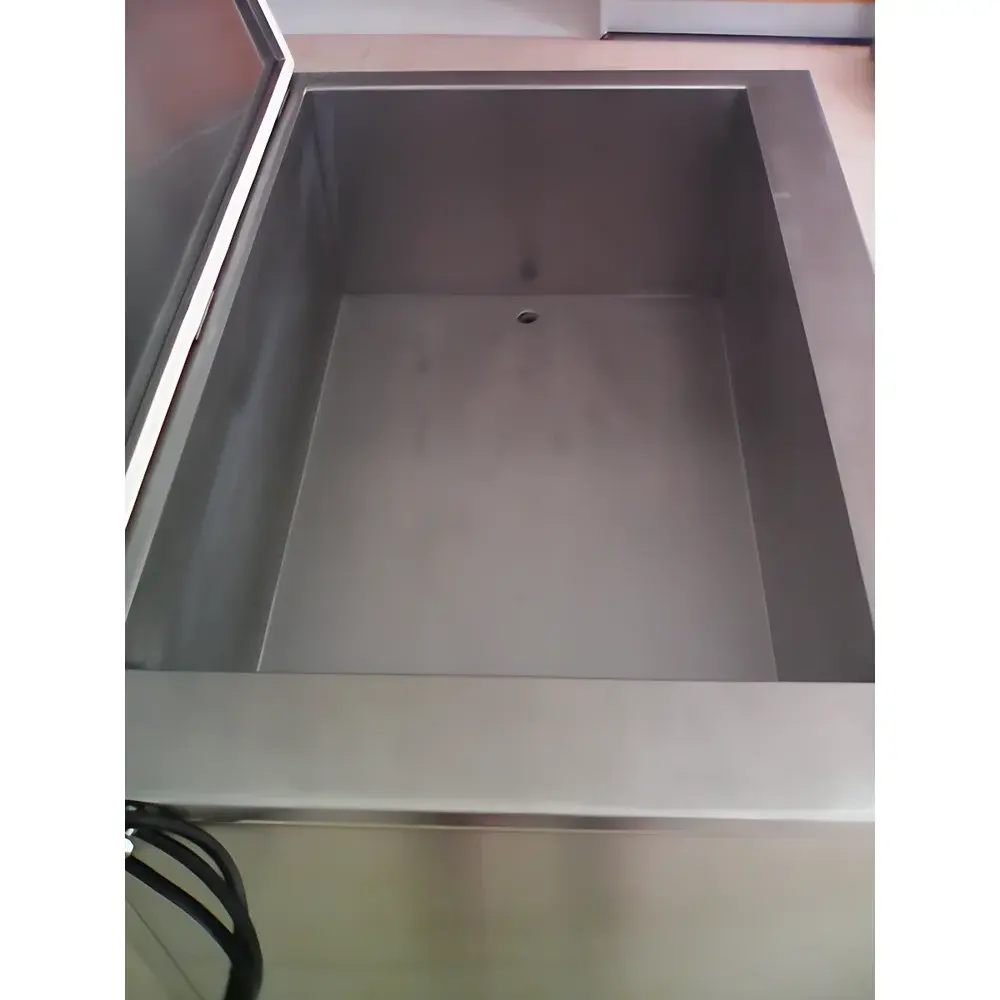
| Internal Tank Dimensions | 830 × 530 × 300 mm |
| Ultrasonic Frequencies | 20/40, 25/40, 28/40, or 28/63 kHz (selectable dual-frequency modes) |
| Ultrasonic Power Output | 2000 W |
| Timer Range | 1–600 min |
| Lid | Sound-dampening cover included |
| Drain | Manual valve |
| Heating | Not equipped |
| Temperature Control | Not available |
| Power Adjustment | Fixed output (non-adjustable) |
| Compliance | CE-marked design for laboratory use |
Overview
The SYC Sycs SCQ-1010D is a high-capacity desktop dual-frequency ultrasonic cleaner engineered for demanding laboratory and industrial cleaning applications where consistent cavitation intensity and broad contaminant removal capability are required. Operating on the principle of acoustic cavitation—where high-frequency sound waves generate microscopic vacuum bubbles in liquid media that implode with localized energy—the SCQ-1010D delivers effective particle dislodgement from complex geometries, porous surfaces, and delicate instrumentation components. Its dual-frequency architecture enables users to select between complementary frequency pairings (20/40, 25/40, 28/40, or 28/63 kHz), each optimized for distinct cleaning mechanisms: lower frequencies (e.g., 20–28 kHz) produce larger, more energetic bubbles suited for heavy particulate or tenacious organic residue removal, while higher frequencies (40–63 kHz) generate finer, more numerous bubbles ideal for precision cleaning of microstructures, optical elements, and MEMS devices without surface erosion. Designed as a single-tank benchtop system, the SCQ-1010D integrates structural rigidity, thermal stability, and acoustic isolation to maintain uniform energy distribution across its 132 L working volume—making it suitable for batch processing of large fixtures, glassware arrays, filtration housings, or multi-component assemblies in QC labs, R&D facilities, and medical device reprocessing environments.
Key Features
- Large-capacity stainless steel tank (830 × 530 × 300 mm internal dimensions) constructed from 304-grade austenitic stainless steel for corrosion resistance and long-term durability under repeated solvent exposure.
- Dual-frequency transducer array supporting four preset frequency pairings (20/40, 25/40, 28/40, 28/63 kHz), enabling application-specific optimization without hardware modification.
- Fixed 2000 W ultrasonic power output—engineered for high reproducibility and minimal drift during extended operation cycles up to 600 minutes.
- Integrated sound-dampening lid with safety interlock, reducing ambient noise to ≤65 dB(A) at 1 m distance and preventing solvent evaporation during prolonged cleaning intervals.
- Manual drain valve located at the tank base for controlled fluid evacuation; compatible with standard laboratory floor drains or waste collection systems.
- Microprocessor-based timer with digital display and non-volatile memory retention—ensures repeatable cycle execution even after power interruption.
- No built-in heating or temperature regulation circuitry, preserving compatibility with thermally sensitive solvents (e.g., acetone, isopropanol, fluorinated ethers) and eliminating risk of thermal degradation for polymer substrates or calibration standards.
Sample Compatibility & Compliance
The SCQ-1010D accommodates a wide range of sample types—including metal, ceramic, borosilicate glass, anodized aluminum, and certain engineering plastics—provided solvent compatibility is verified per material safety data sheets (MSDS). Its open-tank configuration supports immersion of irregularly shaped parts, stacked trays, and oversized components such as chromatography columns, filter cartridges, or semiconductor wafer carriers. The unit complies with IEC 61000-6-3 (EMC emission limits) and IEC 61000-6-2 (immunity requirements) for laboratory electromagnetic environments. While not certified to ISO 13485 or FDA 21 CFR Part 11 out-of-the-box, its operational parameters and mechanical design align with GLP-aligned cleaning validation protocols when integrated into documented SOPs—particularly for pre-analytical sample preparation in environmental testing, pharmaceutical component cleaning, and electronics manufacturing support.
Software & Data Management
The SCQ-1010D operates via embedded firmware without external PC connectivity or proprietary software. All operational parameters—including selected frequency pair, elapsed time, and cycle completion status—are displayed on a front-panel LED interface. No audit trail, electronic signature, or remote monitoring capability is provided; however, the fixed-power, fixed-timer architecture ensures deterministic process repeatability—a prerequisite for manual cleaning validation workflows. Users may document cycle parameters using laboratory notebooks or LIMS-integrated log templates. For regulated environments requiring traceability, third-party data loggers (e.g., calibrated temperature/humidity sensors placed externally near the tank) can be deployed alongside timed photographic records to satisfy basic ALCOA+ principles (Attributable, Legible, Contemporaneous, Original, Accurate).
Applications
- Cleaning of HPLC/GC autosampler vials, syringe filters, and column frits prior to analytical use.
- Removal of polishing compounds, oxides, and flux residues from precision machined optics and metrology artifacts.
- Decontamination of reusable surgical instruments and endoscopic components in research animal facilities (non-sterile applications only).
- Preparation of catalyst supports, zeolite pellets, and ceramic substrates for surface characterization (SEM, XRD, BET).
- Batch cleaning of printed circuit board (PCB) assemblies prior to conformal coating or functional testing.
- Supporting ASTM D2240 (Shore hardness) sample conditioning by removing mold release agents from elastomer test specimens.
FAQ
Does the SCQ-1010D include a heater or temperature control function?
No. The unit is designed exclusively for ambient-temperature ultrasonic cleaning and does not incorporate heating elements or thermostatic regulation.
Can the ultrasonic power output be adjusted during operation?
No. The 2000 W output is fixed and non-variable; intensity modulation is achieved solely through frequency selection and cleaning duration.
Is the tank compatible with chlorinated or highly aggressive solvents?
The 304 stainless steel construction resists mild aqueous and alcoholic solutions but is not recommended for prolonged exposure to concentrated hydrochloric acid, sodium hypochlorite, or undiluted halogenated solvents without verification against corrosion charts.
What maintenance is required for long-term reliability?
Routine inspection of the transducer mounting integrity, periodic descaling of the tank interior using dilute citric acid solution, and verification of lid gasket elasticity every 6 months are recommended.
Does the unit meet international electrical safety standards?
Yes—it conforms to IEC 61010-1 for laboratory electrical equipment and carries CE marking indicating compliance with EU Low Voltage and EMC directives.



