
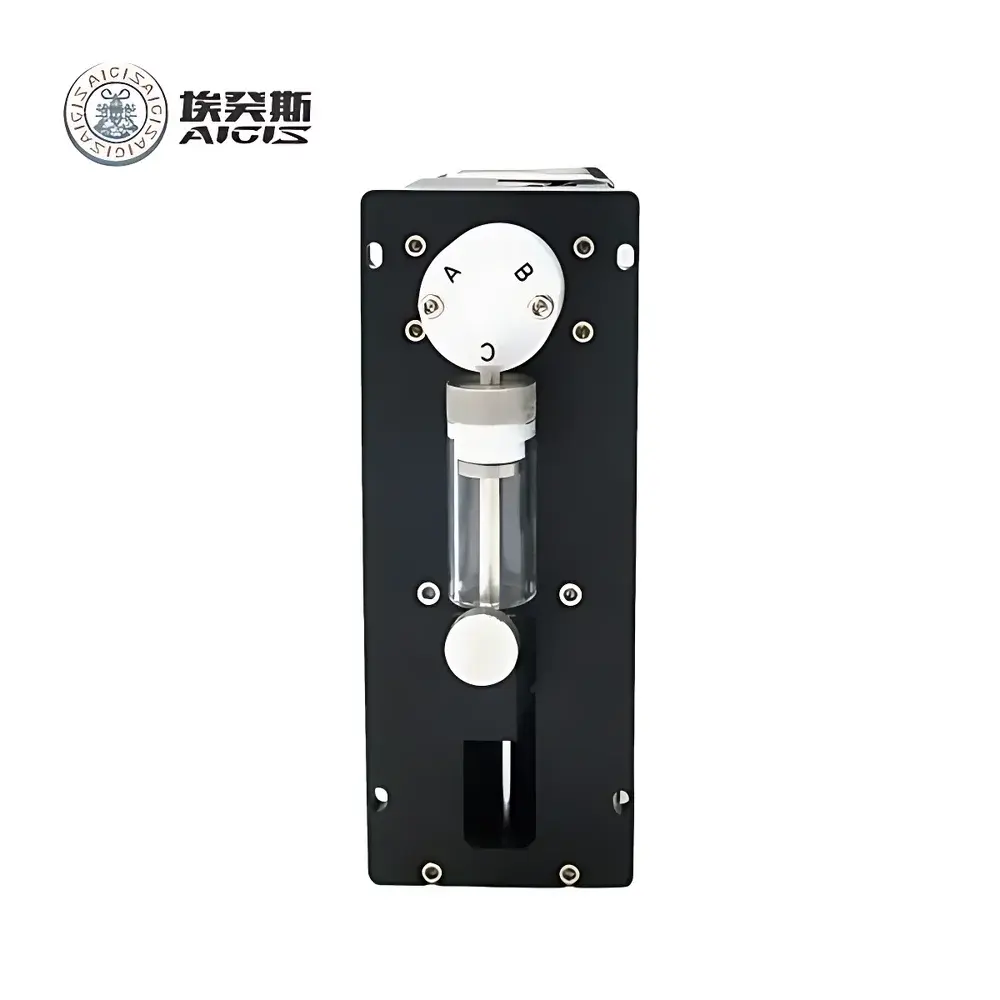
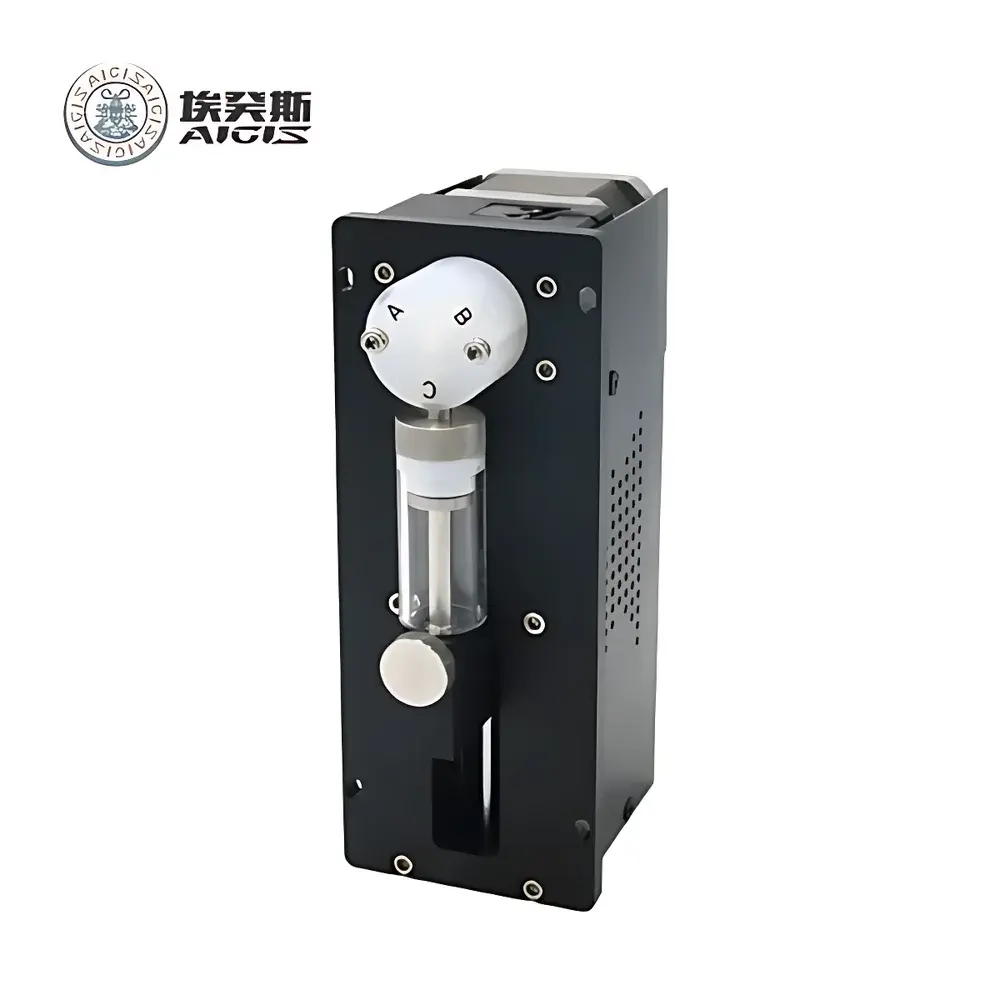
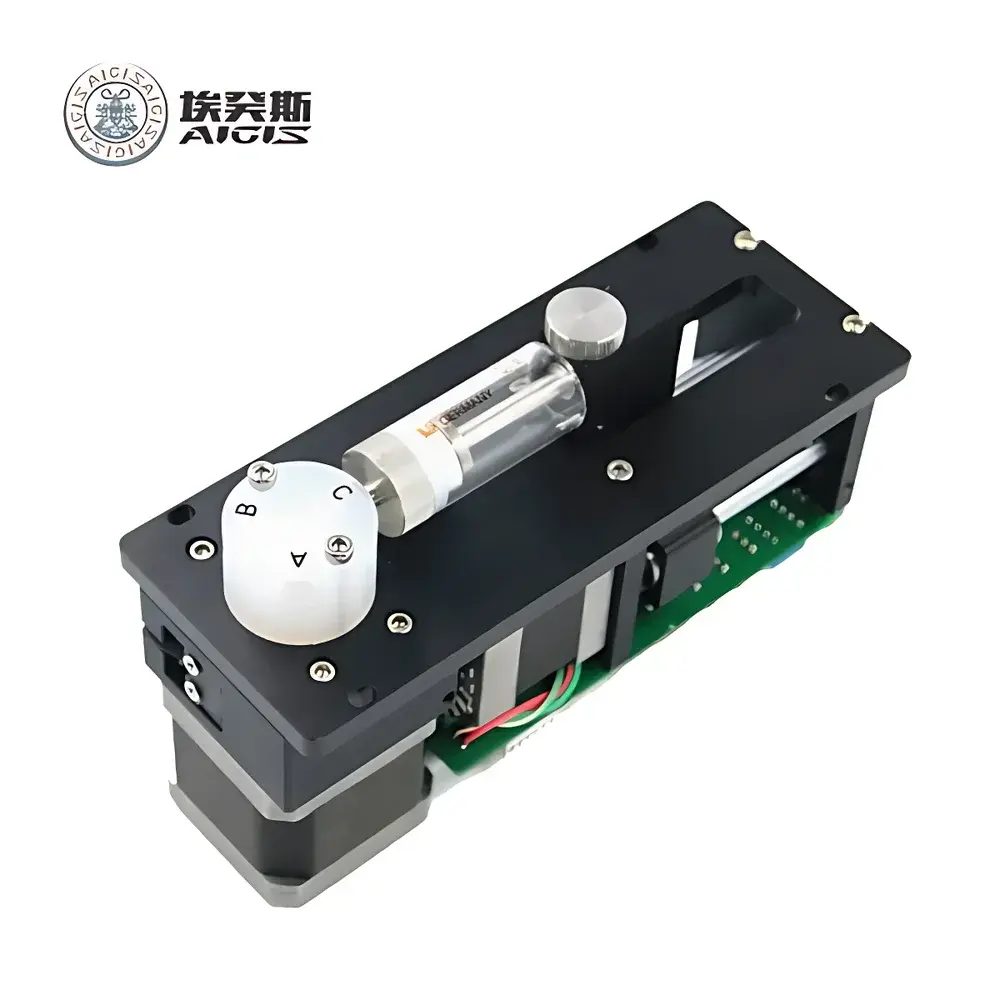
AIGIS Microfluidic 10 mL Syringe Pump AGS-PB06-PT-L10-B-C
| Brand | AIGIS |
|---|---|
| Origin | Fujian, China |
| Manufacturer Type | Direct Manufacturer |
| Country of Origin | China |
| Model | AGS-PB06-PT-L10-B-C |
| Pump Type | Industrial Syringe Pump |
| Interface Options | 2/3/6/8/10/12-channel |
| Port Thread | 1/4-28 UNF internal |
| Wetted Materials | Borosilicate glass (syringe), ceramic, PEEK, PPS, PCTFE, PVDF, PFA |
| Accuracy | ≤1% of rated stroke |
| Precision (Repeatability) | 0.3–0.5% of rated stroke |
| Rated Stroke | 30 mm (3778 steps) / 60 mm (7556 steps) |
| Minimum Step Resolution | 0.0079 mm/step |
| Full-Stroke Runtime | 5–1200 s |
| Valve Switching Time | ≤250 ms |
| Maximum Fluidic Pressure Rating | 0.7 MPa |
| Power Supply | DC 24 V / 3 A |
| Communication Interfaces | RS232, RS485 |
| Operating Temperature | 5–55 °C |
| Operating Humidity | ≤95% RH, non-condensing |
Overview
The AIGIS Microfluidic 10 mL Syringe Pump AGS-PB06-PT-L10-B-C is an industrial-grade, multi-channel precision fluid delivery system engineered for reproducible, low-pulsation volumetric dosing in demanding laboratory and process environments. Built upon a closed-loop stepper motor architecture with microstepping control, the pump delivers precise linear displacement of syringe plungers via high-resolution lead screws—enabling deterministic flow rates from nanoliter-per-minute to milliliter-per-minute ranges. Its core operational principle relies on calibrated mechanical translation rather than pressure-based feedback, ensuring intrinsic volumetric accuracy independent of fluid viscosity or backpressure within its specified operating envelope (≤0.7 MPa). Designed for integration into automated workflows—including chromatography sample introduction, microreactor feeding, organ-on-chip perfusion, and reagent dispensing in IVD platforms—the AGS-PB06-PT-L10-B-C supports scalable channel configurations (2 to 12 independent syringe drivers) without sacrificing synchronization fidelity or positional repeatability.
Key Features
- Multi-channel modularity: Configurable for 2, 3, 6, 8, 10, or 12 independent syringe drive units on a single controller chassis, each with dedicated motion control and real-time status monitoring.
- High-fidelity mechanical actuation: Stepper motor-driven lead screw mechanism with 3778 steps over 30 mm (or 7556 steps over 60 mm), yielding a minimum linear resolution of 0.0079 mm/step—translating to sub-microliter per step accuracy with standard 10 mL glass syringes.
- Chemically inert wetted path: Compatible with borosilicate glass syringes and valve components fabricated from ceramic, PEEK, PPS, PCTFE, PVDF, and PFA—ensuring long-term stability with aggressive solvents, acids, bases, and biological media.
- Rapid electro-mechanical valving: Integrated solenoid or piezoelectric valves achieve ≤250 ms switching latency between fluid paths, minimizing dead volume and cross-contamination risk during sequential or parallel delivery protocols.
- Industrial communication readiness: Native support for RS232 and RS485 serial interfaces enables seamless integration with PLCs, SCADA systems, and custom LabVIEW or Python-based orchestration software under Modbus RTU or ASCII command protocols.
- Thermally robust operation: Certified for continuous duty across 5–55 °C ambient temperature and up to 95% relative humidity (non-condensing), suitable for controlled-environment labs and cleanroom-adjacent installations.
Sample Compatibility & Compliance
The AGS-PB06-PT-L10-B-C accommodates standard Luer-lock or 1/4-28 UNF-threaded 10 mL syringes, including those manufactured from high-borosilicate glass (e.g., SCHOTT Type I), as well as polymer alternatives where chemical compatibility dictates material selection. Its wetted material set complies with USP Class VI and ISO 10993-5 cytotoxicity requirements for short-term fluid contact applications. While not certified to IEC 61000-6-2/6-3 for EMC immunity/emission out-of-the-box, the unit meets CE marking essential requirements when installed per manufacturer-specified grounding and cable separation guidelines. It supports audit-ready operation in GLP and GMP-aligned environments when paired with validated firmware and external logging systems compliant with FDA 21 CFR Part 11 data integrity principles.
Software & Data Management
The pump operates via ASCII-command protocol over RS232/RS485, allowing full parameterization—including target volume, flow rate, acceleration profile, hold time, and valve sequencing—through host-side applications. AIGIS provides a Windows-compatible configuration utility for commissioning and diagnostics; however, production deployments typically leverage third-party middleware (e.g., EPICS, TwinCAT, or custom Python scripts using PySerial) for traceable command logging, timestamped event capture, and error-code mapping. All motion commands generate synchronous status acknowledgments, enabling closed-loop verification of plunger position and valve state. Optional firmware upgrades may introduce enhanced buffer management and CRC-protected command framing to support deterministic multi-pump synchronization in distributed architectures.
Applications
- Automated sample introduction for HPLC, UHPLC, and preparative chromatography systems requiring pulseless, programmable gradient elution support.
- Controlled perfusion of microfluidic organ-on-chip devices at physiologically relevant shear stresses (0.1–20 dyn/cm²) with tunable interstitial flow profiles.
- Sequential reagent metering in clinical diagnostic analyzers, especially where carryover minimization and calibration traceability are mandated by CLIA or IVDR.
- Calibration standard delivery in metrology labs performing volumetric accuracy validation per ISO 8655-3 and ASTM D3244.
- Parallel synthesis platforms requiring synchronized, independent flow control across multiple reaction vessels under inert atmosphere.
FAQ
What syringe sizes and types are supported?
The system is optimized for 10 mL syringes with 1/4-28 UNF or Luer-lock interfaces; compatibility with other volumes (e.g., 1–50 mL) is achievable through mechanical adapter kits and recalibration of stroke-to-volume mapping.
Is the pump compatible with corrosive or high-viscosity fluids?
Yes—provided wetted materials (glass syringe barrel, ceramic plunger seal, PFA/PVDF tubing) are selected per chemical compatibility charts; maximum viscosity handling is limited by motor torque and backpressure (≤0.7 MPa); pre-wetting and priming protocols are recommended for fluids >1000 cP.
Can multiple pumps be synchronized for coordinated delivery?
Yes—via hardware-triggered start signals or master-slave RS485 daisy-chaining with <50 ms inter-unit timing skew under default firmware; advanced synchronization requires external clock distribution and firmware-enabled phase-lock modes.
Does the device support regulatory-compliant electronic records?
The pump itself does not store audit trails; however, when integrated with validated host software that captures timestamps, user IDs, parameter sets, and execution logs—and enforces electronic signatures—it satisfies ALCOA+ principles for 21 CFR Part 11 compliance.
What maintenance intervals are recommended?
Lead screw lubrication and optical encoder cleaning every 6 months under continuous operation; annual verification of step accuracy against NIST-traceable calibrators is advised for GLP-critical use cases.



