
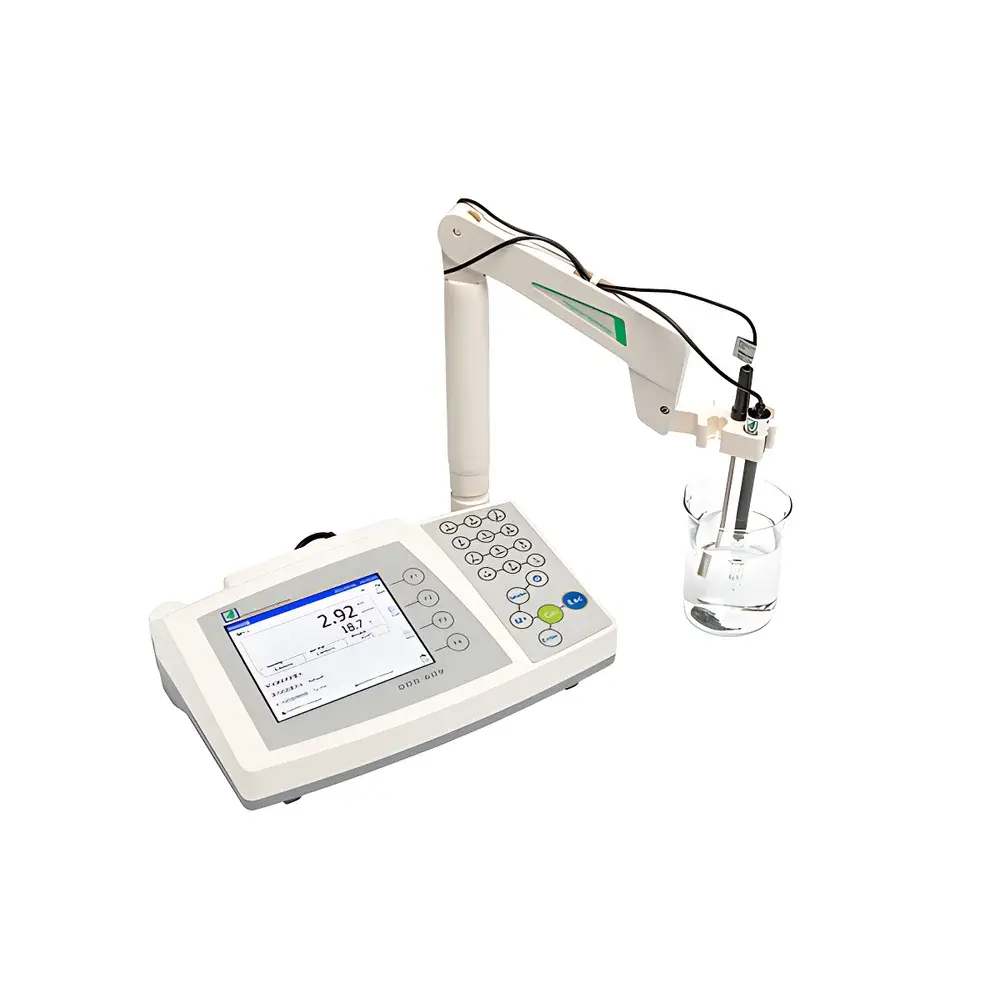
FangZhou DDS-609 Sulfuric Acid-Compatible Conductivity Meter
| Brand | FangZhou |
|---|---|
| Origin | Sichuan, China |
| Manufacturer Type | Authorized Distributor |
| Product Category | Domestic |
| Model | DDS-609 Sulfuric Acid Conductivity Meter |
| Detection Parameters | Multi-parameter (Conductivity, Resistivity, TDS, Salinity, Conductivity Ash, Temperature) |
| Portability | Benchtop |
| Application Environment | Laboratory |
| Conductivity Range | (0–2×10⁵) µS/cm |
| TDS Range | (0.00–300.0) g/L |
| Resistivity Range | (5.00–10⁸) Ω·cm |
| Salinity Range | (0.00–80.00) ppt |
| Temperature Range | (−25.0–135.0) °C |
| Accuracy | ±0.5% FS |
| Minimum Resolution | 0.0001 µS/cm |
Overview
The FangZhou DDS-609 Sulfuric Acid-Compatible Conductivity Meter is a high-precision benchtop electrochemical analyzer engineered for reliable, trace-level conductivity measurement in aggressive acidic environments—particularly concentrated sulfuric acid solutions used in electroplating, battery electrolyte R&D, chemical synthesis, and industrial process control. Unlike standard conductivity meters, the DDS-609 incorporates corrosion-resistant electrode interface design, chemically inert sensor housing materials (e.g., PEEK and borosilicate glass), and optimized signal conditioning circuitry to ensure stable readings under low-pH, high-ionic-strength conditions where conventional sensors exhibit drift or electrode passivation. It operates on the principle of two-electrode or four-electrode AC conductance measurement (frequency-swept 1 kHz–10 kHz), minimizing polarization errors and enabling accurate quantification across eight auto-ranging decades—from ultrapure water (sub-µS/cm) to highly conductive industrial acid streams (>200 mS/cm). The instrument complies with IEC 61000-4 electromagnetic compatibility standards and meets functional safety requirements for laboratory-grade electrochemical instrumentation.
Key Features
- Eight auto-ranging conductivity scales (0.0000–0.2000 µS/cm to 200.0–2000 mS/cm), dynamically selected based on measured signal magnitude and user-configured cell constant (DJS = 0.01, 0.1, 1.0, or 10.0 cm⁻¹)
- Dual-mode temperature compensation: linear (α = 0.000–0.030 °C⁻¹, adjustable) and non-linear (for H₂SO₄-specific curves per ISO 8573-1 Annex B and ASTM D1125)
- Multi-parameter simultaneous output: conductivity, resistivity, TDS (with configurable conversion factor 0.2–1.0), salinity (ppt), conductivity ash (%), and temperature
- Lab-grade calibration architecture: supports up to 4 Chinese national standard points (GB/T 6682), 6 international reference points (NIST SRM 3199, ASTM D1125 Table 1), and 1 user-defined solution
- GLP-compliant data integrity: full audit trail including operator ID, electrode ID & calibration history, method timestamp, sample ID, ambient temperature/humidity metadata, and diagnostic logs
- Corrosion-hardened hardware: platinum-black or titanium oxide electrodes (optional), PTFE-sealed connectors, and acid-resistant front-panel membrane keypad
Sample Compatibility & Compliance
The DDS-609 is validated for direct measurement of aqueous sulfuric acid solutions up to 98% w/w at temperatures ≤60 °C, with demonstrated stability over 72-hour continuous immersion testing per ISO 9223 classification C5-I. It accommodates samples with suspended solids ≤50 mg/L and turbidity <100 NTU without filtration. All measurement modes conform to ISO/IEC 17025:2017 clause 7.7 (uncertainty estimation), USP (Water Conductivity), and EP 2.2.38 (Conductivity of Purified Water). The firmware implements FDA 21 CFR Part 11-compliant electronic signatures, role-based access control (RBAC), and immutable data storage—enabling compliance with GMP, GLP, and ISO 13485 quality systems in pharmaceutical and biotech QC labs.
Software & Data Management
Data are stored internally in a non-volatile flash memory array (≥1 million measurement records), each tagged with ISO 8601 timestamps, operator credentials, electrode serial number, calibration certificate ID, and environmental context. Export is supported via RS-232 (ASCII protocol) and USB 2.0 (mass storage mode), generating native Excel (.xlsx), CSV, or PDF reports in three formats: Simple (raw values only), Standard (with metadata headers), and GLP (including digital signature, calibration traceability, and system suitability checks). The embedded software includes method templates for USP , ASTM D1125, ISO 7888, and pharmacopeial purified water grades (WFI, PW, HPW), all with configurable alarm thresholds and automatic pass/fail flagging.
Applications
- Quality control of sulfuric acid electrolytes in lead-acid and flow battery manufacturing
- In-process monitoring of pickling bath concentration in metal surface treatment lines
- Validation of deionized water purity in semiconductor fab UPW loops (Type EW-I/EW-II per SEMI F63)
- Pharmaceutical water system qualification per USP , EP 2.2.38, and JP 17
- Environmental lab analysis of acid mine drainage and industrial effluents
- R&D of conductive polymer electrolytes and proton exchange membranes
FAQ
Is the DDS-609 suitable for measuring concentrated H₂SO₄ above 50% w/w?
Yes—when equipped with optional DJS=0.01 or DJS=0.1 corrosion-resistant electrodes and operated within −10 °C to 60 °C, it maintains ±0.5% FS accuracy up to 98% w/w H₂SO₄ per internal validation per ISO 8573-1 Annex B.
Does the instrument support four-electrode (Kelvin) measurement?
No—the DDS-609 uses a precision two-electrode AC bridge topology with active polarization cancellation; four-electrode capability is available in the higher-tier DDS-809 series.
Can calibration data be exported for regulatory submission?
Yes—calibration certificates, raw standard measurements, and uncertainty budgets are exportable in PDF format with embedded digital signatures compliant with 21 CFR Part 11 Subpart D.
What is the maximum allowable sample temperature during measurement?
The temperature probe is rated to 135 °C, but for sulfuric acid applications, continuous operation is validated only up to 60 °C to ensure long-term electrode stability and seal integrity.
How does the non-linear temperature compensation differ from standard linear α-correction?
It applies empirically derived H₂SO₄-specific conductivity vs. temperature polynomials (per NIST IR 6397 and DIN EN 27888), eliminating systematic bias >±2% observed with fixed α-values in strong acid media.
Related Products




