
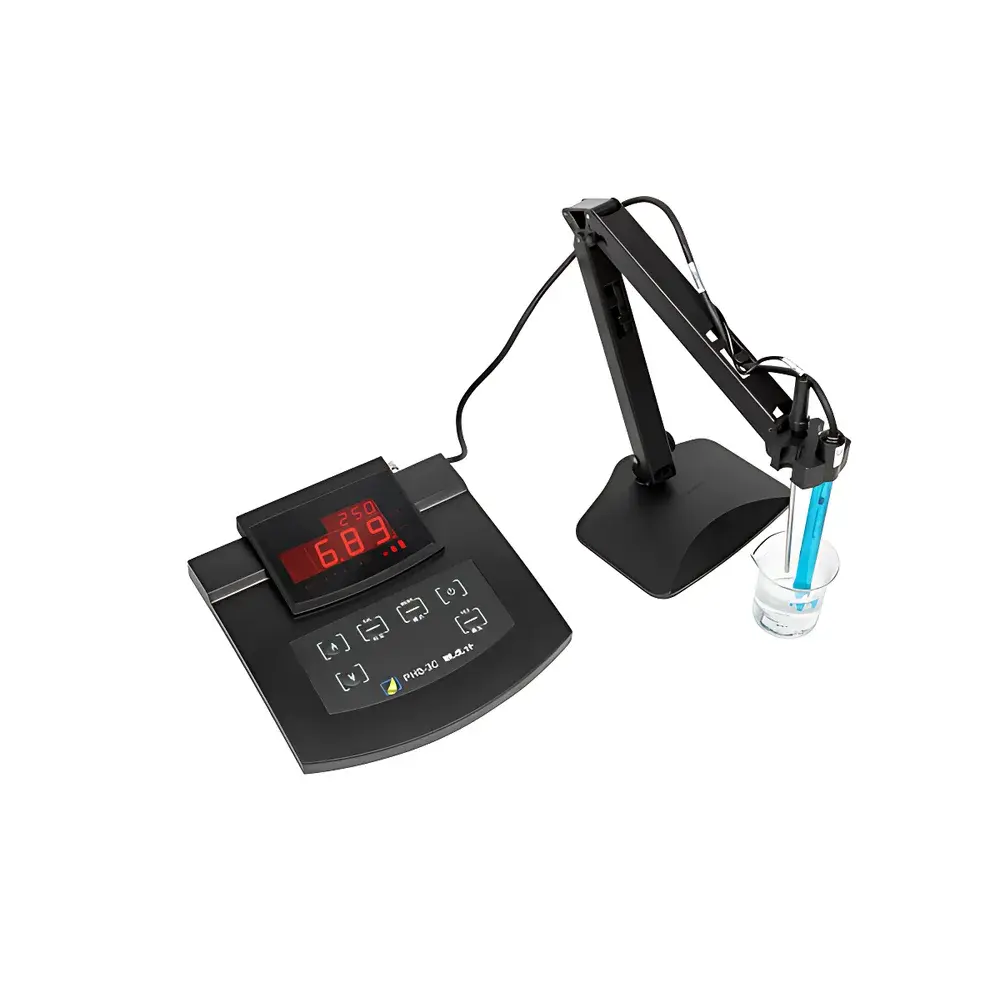
FangZhou PHS-3C Benchtop pH Meter
| Brand | FangZhou |
|---|---|
| Origin | Sichuan, China |
| Model | PHS-3C |
| Instrument Type | Benchtop |
| Measurement Parameters | pH, mV/ORP, Temperature |
| pH Accuracy | ±0.01 pH |
| pH Range | 0.00–14.00 pH |
| pH Resolution | 0.01 pH |
| mV Range | −1999 to +1999 mV |
| mV Resolution | 1 mV |
| Temperature Range | −5.0 to 105.0 °C |
| Temperature Resolution | 0.1 °C |
| Temperature Accuracy | ±0.3 °C ±1 digit |
| Input Impedance | ≥1 × 10¹² Ω |
| Calibration | 1–3 point automatic buffer recognition (NIST-traceable standards) |
| Temperature Compensation | Automatic (ATC) or manual |
| Interface | BNC electrode port, thermistor temperature input, RS232 serial output |
| Power Supply | DC 9 V, 300 mA (center-positive) |
Overview
The FangZhou PHS-3C is a precision benchtop pH meter engineered for routine and quality-critical electrochemical measurements in laboratory, environmental monitoring, and industrial QC settings. It operates on the potentiometric principle—measuring the potential difference between a pH-sensitive glass electrode and a stable reference electrode—to determine hydrogen ion activity in aqueous solutions. Designed to meet international metrological requirements for Class 0.01 pH instruments (per IEC 62257-8 and GB/T 11165–2005), the PHS-3C delivers high reproducibility and long-term stability across its full 0.00–14.00 pH range. Its microprocessor-controlled architecture ensures consistent response time, robust noise rejection, and reliable operation under variable ambient conditions—including high humidity or chemically aggressive environments—thanks to its corrosion-resistant housing and IP-rated front panel sealing.
Key Features
- Microprocessor-based control with intuitive touch-key interface and programmable measurement routines
- Simultaneous real-time display of pH (or mV/ORP) and temperature values
- Automatic temperature compensation (ATC) with thermistor probe support; manual compensation also available
- Intelligent multi-point calibration (1-, 2-, or 3-point) with auto-recognition of NIST-traceable standard buffers (e.g., pH 4.00, 6.86, 9.18 at 25 °C)
- Auto-endpoint detection algorithm minimizes operator dependency and improves inter-user consistency
- Persistent memory retains calibration coefficients, measurement history, and system settings after power loss
- Universal electrode compatibility—including combination, refillable, gel-filled, and double-junction pH electrodes—with visual electrode status indicator
- RS232 serial interface enables direct data transfer to LIMS or PC-based analysis software (cable and driver included)
- High-input-impedance circuitry (≥1 × 10¹² Ω) prevents loading errors and ensures accurate readings with high-resistance electrodes
Sample Compatibility & Compliance
The PHS-3C is validated for use with aqueous and mildly buffered samples across environmental, pharmaceutical, food & beverage, and academic research applications. It supports standard pH electrode configurations compliant with ASTM D1293 (water pH), ISO 7888 (electrical conductivity and pH of natural waters), and USP (pH measurement in pharmaceutical preparations). While not certified for GMP production environments out-of-the-box, its calibration traceability to NIST-standard buffers, audit-ready calibration logs (via RS232 export), and configurable date/time stamping make it suitable for GLP-compliant workflows. The instrument’s mechanical design conforms to IEC 61010-1 safety standards for electrical equipment used in laboratory environments.
Software & Data Management
Data acquisition and archival are supported via the built-in RS232 port, compatible with standard terminal emulators (e.g., Tera Term, PuTTY) and third-party laboratory software platforms. All calibration events—including date/time stamp, buffer IDs, slope (%), offset (mV), and temperature—are stored in non-volatile memory and can be exported as CSV or ASCII text files. No proprietary software installation is required; raw serial output follows ASCII protocol with configurable baud rate (default: 9600 bps, 8N1). For regulated environments, users may integrate the PHS-3C into broader data integrity frameworks by pairing exported logs with electronic lab notebooks (ELNs) that enforce 21 CFR Part 11-compliant audit trails.
Applications
- Environmental water quality testing (surface water, wastewater, leachate)
- Pharmaceutical formulation development and stability studies
- Food processing line monitoring (e.g., dairy, brewing, fermentation)
- Academic teaching labs for fundamental electrochemistry experiments
- Calibration verification of field-portable pH meters using reference-grade buffers
- QC/QA release testing of chemical reagents and buffer solutions
FAQ
What calibration standards are supported?
The PHS-3C automatically recognizes common NIST-traceable pH buffers (4.00, 6.86, 9.18 at 25 °C) and allows user-defined buffer tables for non-standard solutions.
Does the instrument support GLP/GMP documentation requirements?
It provides timestamped calibration records and supports external data logging; however, full 21 CFR Part 11 compliance requires integration with validated ELN or LIMS systems.
Can the PHS-3C measure ORP (redox potential)?
Yes—it offers full mV mode with ±1999 mV range and 1 mV resolution, suitable for oxidation-reduction potential assessments per ASTM D3223.
Is temperature compensation mandatory during pH measurement?
No—both automatic (ATC) and manual temperature entry modes are available, allowing flexibility when measuring non-aqueous or viscous samples where ATC probes may be impractical.
What electrode types are compatible?
Standard BNC-connectable pH electrodes—including refillable, gel-filled, double-junction, and combination electrodes—are fully supported; the unit displays electrode impedance status to assist troubleshooting.




