
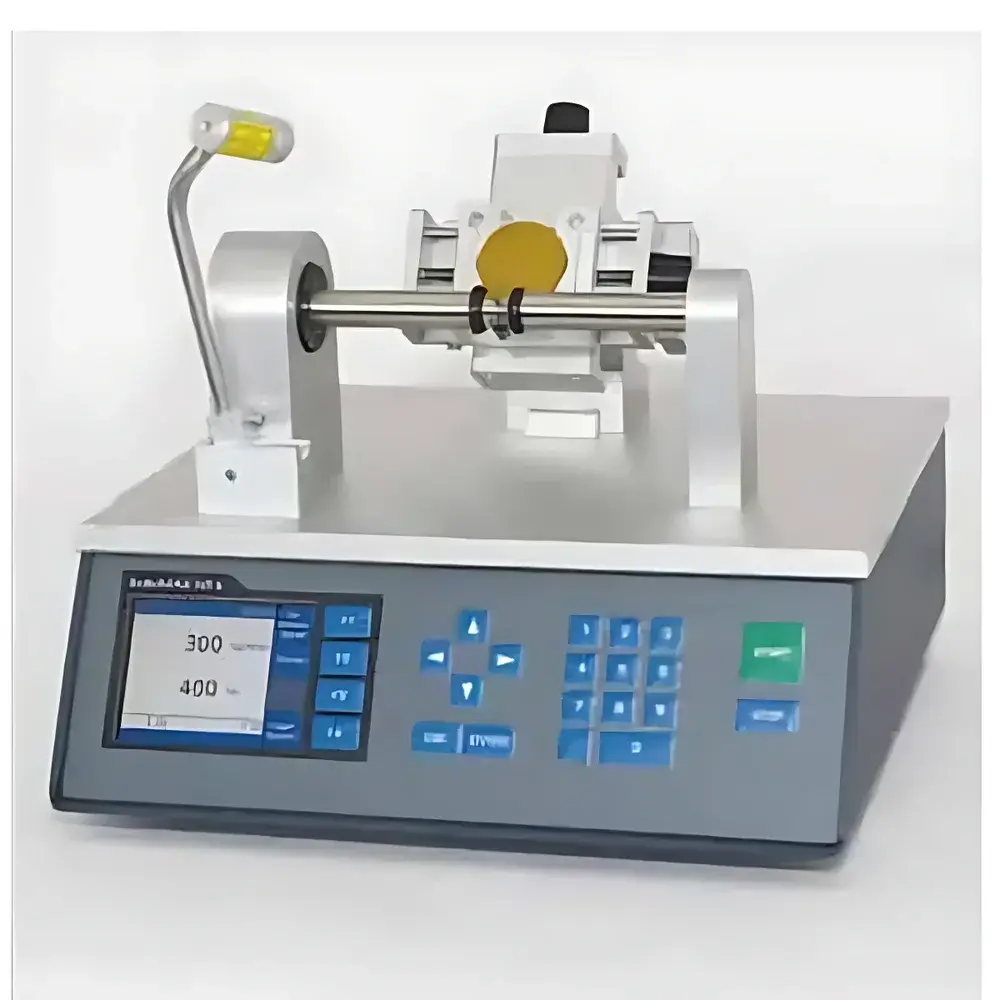
BAQ KaloMAS II S Ball Cratering Thickness & Wear Coefficient Tester
| Brand | BAQ |
|---|---|
| Origin | Germany |
| Model | KaloMAS II S |
| Ball Diameter | 15–40 mm |
| Planar Sample Clamp Range | 50 mm (customizable) |
| Cylindrical Sample Clamp Range | 3–30 mm (customizable) |
| Cross-Stage Travel | 25 × 25 mm |
| Display | 480 × 640 px color LCD |
| Rotational Speed | 50–1000 rpm |
| Grinding Time | Programmable |
| Dimensions (W×D×H) | 300 × 295 × 270 mm |
| Power Supply | 85–264 VAC, 47–63 Hz |
| Weight | ~8 kg |
| Measurable Coating Thickness | 0.3–50 µm |
| Ball Cap Diameter | 0.1–3 mm |
| Thickness Measurement Accuracy | 1–5% (surface roughness dependent) |
Overview
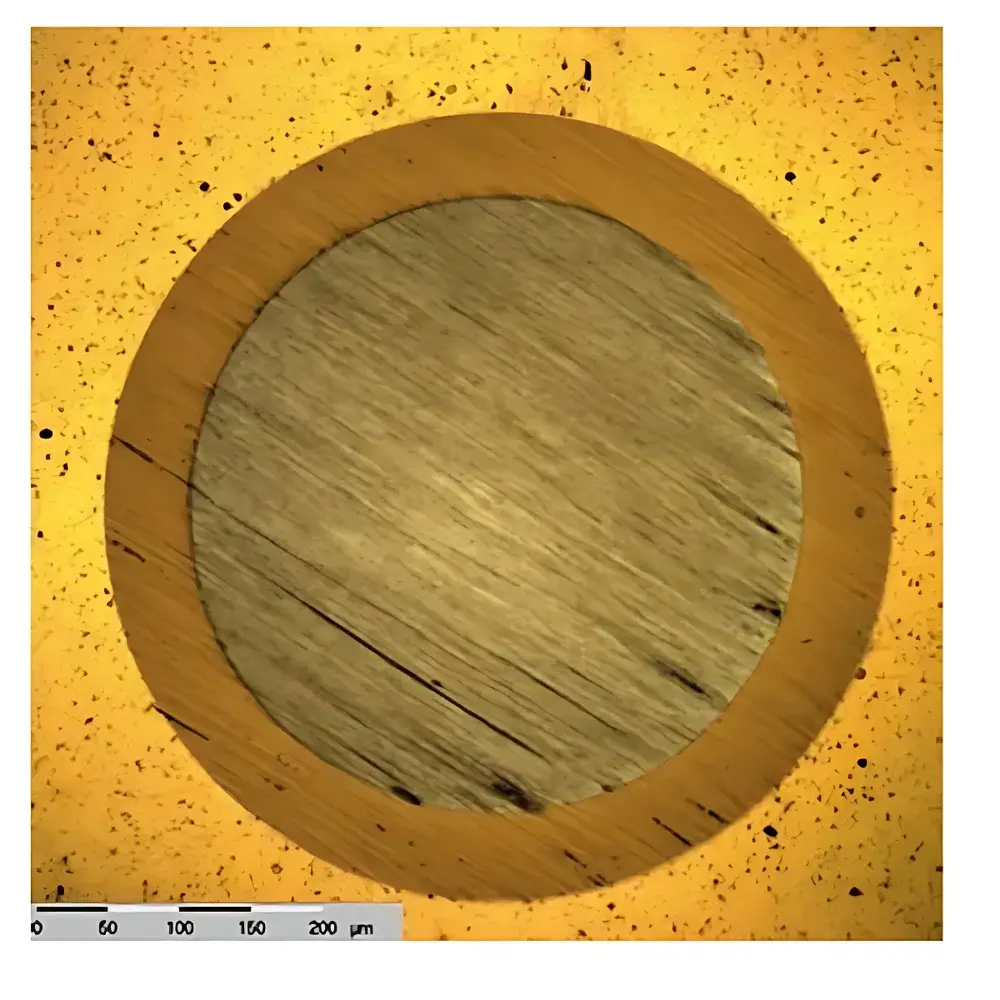
The BAQ KaloMAS II S is a precision-engineered ball cratering instrument designed for non-destructive, geometry-based determination of coating thickness and wear coefficient in single- and multi-layer systems. It operates on the well-established principle of controlled mechanical abrasion: a hardened steel ball—rotated under precisely regulated speed and load—is immersed in a proprietary abrasive suspension and brought into contact with the coated surface. As rotation proceeds, the ball generates a hemispherical crater (ball cap), progressively removing material layer-by-layer until substrate exposure. In planar samples, fully penetrated layers appear as concentric rings under optical microscopy; in cylindrical substrates, they manifest as elliptical contours. The diameters—or major diagonals—are measured digitally and converted into absolute thickness values via geometric calibration embedded in kaloSOFT software. This method eliminates reliance on X-ray fluorescence (XRF), beta-backscatter, or eddy current assumptions about density, atomic number, or conductivity—making it universally applicable across metallic, ceramic, polymer, and composite coatings on any substrate.
Key Features
- Universal material compatibility: No restriction by coating composition, crystallinity, or substrate conductivity—valid for PVD/CVD hard coatings (e.g., TiN, CrN, DLC), electroplated Ni/Co alloys, anodized Al₂O₃, and polymer overlays.
- Zero-calibration operation: Thickness calculation derives directly from Euclidean geometry and verified ball kinematics—not empirical calibration curves—ensuring traceability to SI units.
- Integrated wear coefficient quantification: By limiting grinding to the topmost layer and monitoring volume removal rate vs. applied energy (rpm × time × normal force), the system computes specific wear rate (mm³/N·m) per ASTM G99 and ISO 20808 standards.
- Programmable process control: Independent adjustment of rotational speed (50–1000 rpm), grinding duration (0.1–999 s), and vertical engagement force enables optimization for soft polymers or ultra-hard ceramics.
- Modular optical integration: Optional USB 3.0 microscope camera supports real-time crater imaging at ≥10 MP resolution, with auto-focus and LED ring illumination synchronized to grinding cycles.
- Robust mechanical architecture: Precision-ground cross-stage (25 × 25 mm travel), motorized Z-axis lift, and vibration-damped base ensure repeatability ≤2% RSD across ≥50 replicate craters.
Sample Compatibility & Compliance
The KaloMAS II S accommodates flat specimens up to 50 mm in width and cylindrical parts with diameters from 3 mm to 30 mm—configurable fixtures extend this range for turbine blades, medical implants, or MEMS components. Surface roughness (Ra) up to 5 µm does not compromise measurement validity, provided crater depth exceeds 3× Ra. All hardware and firmware comply with CE marking requirements (2014/30/EU EMC Directive, 2014/35/EU LVD). Data acquisition and report generation support audit-ready workflows aligned with ISO/IEC 17025, GLP, and FDA 21 CFR Part 11 when paired with kaloSOFT’s electronic signature, user access control, and immutable audit trail modules.
Software & Data Management
kaloSOFT is a Windows-based analytical suite delivering full metrological traceability. It performs automatic ring detection using adaptive threshold segmentation, applies curvature correction for cylindrical geometries, and exports thickness profiles—including standard deviation, min/max, and Cp/Cpk indices—to CSV, PDF, or XML formats. Raw image archives, grinding parameters, operator ID, and timestamp are embedded in each result file. Version-controlled software updates include validation documentation (IQ/OQ protocols) and optional 21 CFR Part 11 compliance packages with role-based permissions, biometric login, and electronic signature logging.
Applications
- Quality assurance of functional coatings in automotive powertrain components (e.g., piston rings, valve train parts).
- Process development and bath monitoring for electroless Ni-P and hard chrome plating lines.
- Failure analysis of delamination or interfacial oxidation in thermal barrier coatings (TBCs).
- Wear resistance benchmarking of diamond-like carbon (DLC) films used in orthopedic joint replacements.
- Validation of thickness uniformity across wafer-scale ALD-deposited dielectrics in semiconductor packaging.
- Research-grade quantification of diffusion barrier integrity in Cu/low-k interconnect stacks.
FAQ
Does the KaloMAS II S require reference standards or certified calibration foils?
No. Thickness is derived from first-principles geometry—ball radius, crater diameter, and layer interface angles—eliminating dependency on physical standards.
Can it measure coatings thinner than 0.3 µm?
Not reliably; sub-0.3 µm layers fall below the spatial resolution limit of optical ring detection. For such cases, TEM cross-section remains the recommended method.
Is the abrasive slurry composition standardized?
Yes—BAQ-supplied slurries are batch-certified for particle size distribution (D50 = 0.5–3.0 µm) and chemical inertness; alternative formulations require re-validation of kaloSOFT’s wear coefficient algorithm.
How is measurement uncertainty quantified?
kaloSOFT reports expanded uncertainty (k=2) based on Type A (repeatability) and Type B (ball sphericity, stage positioning error, pixel size) contributions per GUM (JCGM 100:2018).
Can the system be integrated into automated production lines?
Via RS-232 and Ethernet TCP/IP interfaces, the KaloMAS II S supports PLC-triggered grinding cycles and SCADA data push—custom OEM firmware variants available upon request.



