
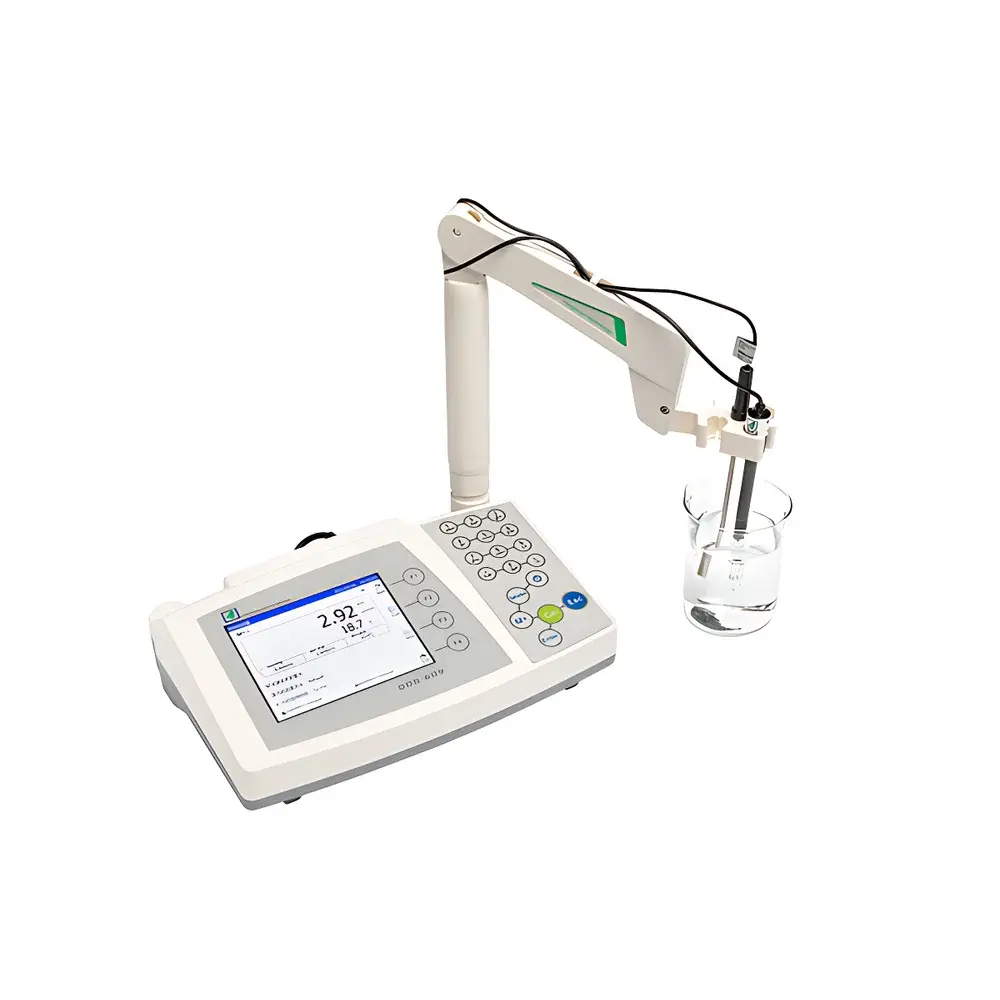
FangZhou DDS-609 Benchtop Conductivity Meter
| Brand | FangZhou |
|---|---|
| Origin | Sichuan, China |
| Manufacturer Type | Authorized Distributor |
| Product Origin | Domestic (China) |
| Model | DDS-609 |
| Price | USD 920 (FOB) |
| Measurement Parameters | Conductivity, Resistivity, TDS, Salinity, Conductivity Ash, Temperature |
| Portability | Benchtop |
| Application Environment | Laboratory |
| Conductivity Range | (0–2×10⁵) µS/cm |
| TDS Range | (0.00–300.0) g/L |
| Resistivity Range | (5.00–10⁸) Ω·cm |
| Salinity Range | (0.00–80.00) ppt |
| Temperature Range | (−25.0–135.0) °C |
| Accuracy | ±0.5% FS |
| Minimum Conductivity Resolution | 0.0001 µS/cm |
| Instrument Class | 0.5 Grade |
| Calibration Points | 4 Chinese Standard, 6 US/EU Standard, 1 Custom Solution |
| TDS Factor Adjustment | 0.2–1.00 (default 0.5) |
| Temperature Compensation | Automatic (ATC) / Manual (MTC), Reference Temp Adjustable (15.0–25.0 °C) |
| Data Storage Capacity | ≥100,000 measurement records |
| Interface | RS-232, USB, 0–20 mV analog output |
| GLP Compliance | Full audit trail, user ID/password, method & electrode management, timestamped data export |
Overview
The FangZhou DDS-609 Benchtop Conductivity Meter is a high-precision, multi-parameter electrochemical analyzer engineered for rigorous laboratory environments requiring trace-level conductivity quantification and regulatory-compliant data integrity. It operates on the principle of two-electrode or four-electrode conductometric measurement—applying an alternating current (AC) voltage across a conductive cell to determine solution conductance, corrected for cell geometry via adjustable cell constant (DJS = 0.01, 0.1, 1.0, or 10.0 cm⁻¹). The instrument supports dual-mode temperature compensation (linear and non-linear), including specialized algorithms for ultrapure water applications per ISO 3696 (Grade I–III), USP , EP 2.2.38, and SEMI F63-0217 (EW-I to EW-III electronic-grade water standards). Its architecture integrates real-time sensor diagnostics, automatic range switching across eight decades (0.0000–2000 mS/cm), and simultaneous calculation of derived parameters—including resistivity (Ω·cm), total dissolved solids (TDS in g/L), salinity (ppt), and conductivity ash (%)—all traceable to NIST-traceable reference standards.
Key Features
- 8-range auto-scaling conductivity measurement with dynamic resolution (0.0001–1 µS/cm, variable by range)
- High-resolution 7-inch color TFT display with adjustable backlight and intuitive icon-based navigation
- Comprehensive GLP/GMP functionality: user authentication (1000+ accounts), method versioning, electrode lifecycle tracking (ID, calibration history, K-factor log), and full audit trail
- Dual temperature compensation: ATC (Pt1000 or NTC probe) and MTC; reference temperature adjustable from 15.0 to 25.0 °C in 0.1 °C increments
- Preloaded calibration library: 4 Chinese GB/T standards, 6 international standards (e.g., ASTM D1125, ISO 7888), and 1 user-defined solution
- Advanced water-grade modes: Lab Grade I/II/III, Pharmaceutical Purified Water (PW), Water for Injection (WFI), and Electronic Grade Water (EW-I/II/III) with configurable alarm thresholds
- Three report formats: Simple (raw values), Standard (with metadata), and GLP-compliant (including operator ID, method ID, electrode ID, calibration date, ambient conditions)
Sample Compatibility & Compliance
The DDS-609 accommodates aqueous samples ranging from deionized water (≥18.2 MΩ·cm) to concentrated brines and industrial process streams. Electrode compatibility includes standard 2-electrode cells (DJS-0.01 for ultrapure water) and robust 4-electrode sensors (DJS-1.0/DJS-10.0) for high-conductivity or fouling-prone matrices. All measurements adhere to ISO/IEC 17025 principles for testing laboratories and support compliance with FDA 21 CFR Part 11 (when paired with validated software), EU Annex 11, and WHO TRS 992 Annex 4 for pharmaceutical water systems. Built-in self-diagnostics verify electrode integrity, cable continuity, and temperature sensor accuracy prior to each measurement cycle.
Software & Data Management
Data are stored internally in non-volatile memory (≥100,000 records) with full metadata: timestamp (date/time), operator ID, sample ID, method name, electrode serial number, calibration status, ambient temperature, and diagnostic flags. Export is supported via RS-232 (ASCII protocol) or USB mass storage mode directly to Excel (.xlsx), Word (.docx), or CSV files—no proprietary drivers required. The instrument’s embedded firmware implements secure user privilege levels (Admin, Supervisor, Operator), password-protected method editing, and automatic backup upon power loss. Audit logs record all critical events—including login attempts, calibration actions, parameter changes, and report generation—with immutable timestamps.
Applications
- Pharmaceutical QC: PW/WFI conductivity verification per USP and EU Ph. Eur. 2.2.38
- Semiconductor manufacturing: Monitoring EW-grade rinse water purity (SEMI F63)
- Environmental labs: TDS/salinity profiling in estuarine and wastewater effluent per EPA Method 120.1
- Power generation: Boiler feedwater and condensate resistivity monitoring (ASTM D1125)
- Food & beverage: Salt content validation in brines, sauces, and dairy processing water
- Academic research: Electrolyte characterization, membrane permeability studies, and ion exchange column eluent monitoring
FAQ
What electrode constants are supported?
The DDS-609 accepts DJS-0.01, DJS-0.1, DJS-1.0, and DJS-10.0 conductivity cells—each selectable via menu-driven configuration.
Does the instrument meet FDA 21 CFR Part 11 requirements?
Yes, when operated with enabled user authentication, electronic signatures, and audit-trail logging, it satisfies core Part 11 criteria for closed systems; full validation requires site-specific IQ/OQ/PQ protocols.
Can calibration standards be customized beyond the built-in library?
Yes—users may define one custom standard solution with programmable conductivity value and uncertainty budget.
Is non-linear temperature compensation available for natural water samples?
Yes—the instrument implements the DIN 38404-16 algorithm for accurate compensation across wide temperature ranges in environmental matrices.
How is data security enforced during multi-user operation?
Role-based access control restricts method modification, calibration execution, and data deletion to authorized privilege levels; all actions are logged with user ID and timestamp.
Related Products




