
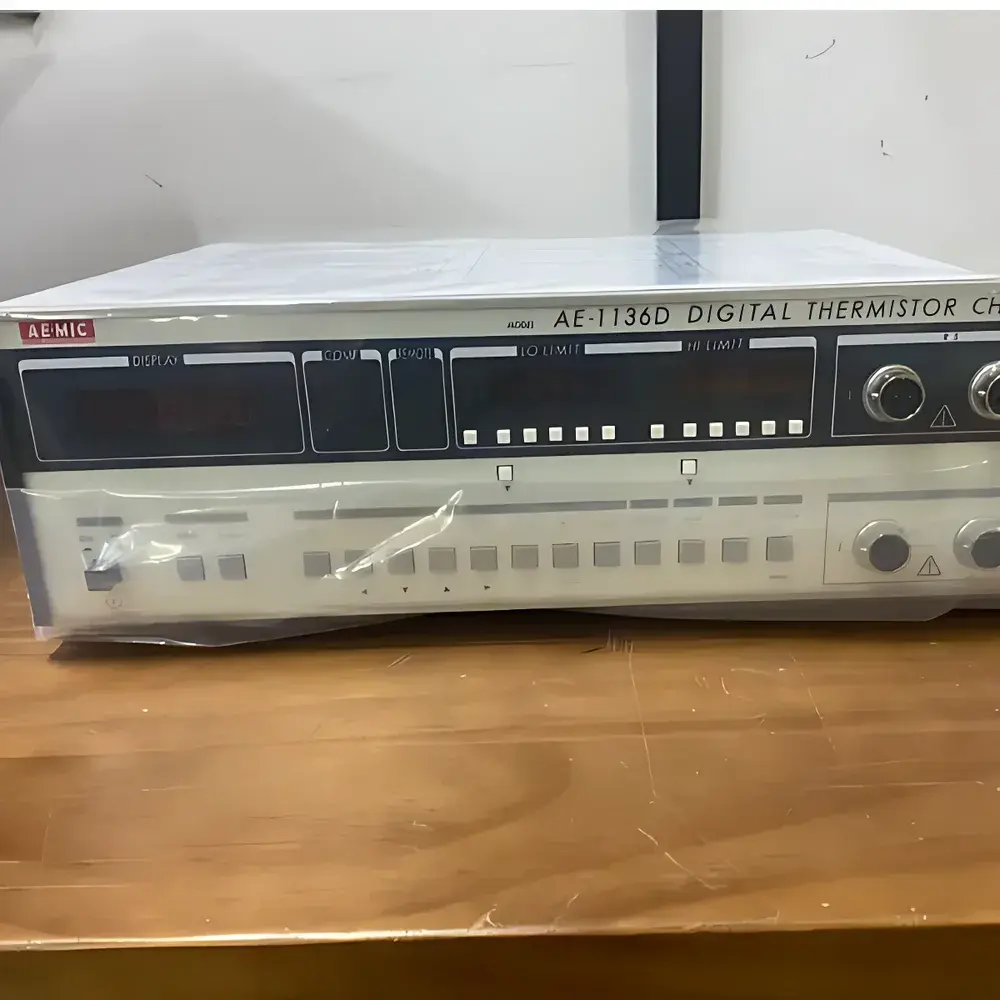
AEMIC AE-1136D Digital Thermistor Tester with External Reference Standard
| Brand | AEMIC |
|---|---|
| Model | AE-1136D |
| Origin | Japan |
| Measurement Principle | Ratio-based comparative resistance measurement against external reference thermistor |
| Temperature Compensation | Automatic thermoelectric EMF cancellation |
| Measurement Speed | Ultra-high-speed (7-class sorting capability) |
| Output | Percentage deviation from reference standard (%) |
| Compliance | Designed for industrial QC environments |
| Power Supply | AC 100–240 V, 50/60 Hz |
Overview
The AEMIC AE-1136D Digital Thermistor Tester is a precision industrial measurement instrument engineered for high-throughput, ratio-based resistance evaluation of thermistors and other highly temperature-sensitive resistive components. Unlike conventional ohmmeters or LCR meters, the AE-1136D employs a comparative measurement architecture that references an externally connected, certified thermistor standard—enabling direct expression of test device resistance as a percentage deviation (%) from the reference value at ambient temperature. This method inherently eliminates errors induced by thermoelectric EMF (Seebeck effect), self-heating due to measurement current, and thermal drift during sequential testing. The instrument operates without requiring temperature-controlled chambers or active thermal stabilization, making it suitable for inline production verification where environmental control is impractical. Its core design addresses two persistent challenges in thermistor manufacturing: (1) accurate quantification of low-resistance thermistors (<100 Ω) under unregulated ambient conditions, and (2) reproducible classification across wide resistance ranges (e.g., 10 Ω to 1 MΩ) without recalibration between lots.
Key Features
- Ultra-fast measurement cycle: Capable of completing full-ratio comparison and classification in <100 ms per unit—enabling integration into automated sorting systems with 7 discrete pass/fail bins.
- External reference standard interface: Dedicated BNC and shielded terminal block for stable connection to a user-supplied, NIST-traceable thermistor reference—ensuring long-term metrological continuity independent of internal calibration drift.
- Thermoelectric EMF suppression: Real-time offset compensation algorithm continuously nulls parasitic voltages generated at junctions between dissimilar metals, critical for sub-milliohm-level stability in ambient environments.
- Low-current excitation: Uses programmable, microampere-range test current (1 µA–100 µA) to minimize Joule heating and preserve intrinsic thermistor temperature state during measurement.
- Digital percentage output: All results displayed and exported as % deviation from reference—eliminating manual calculation errors and simplifying SPC charting and statistical process control workflows.
- Rugged industrial enclosure: IP20-rated chassis with EMI-hardened signal path; designed for factory-floor deployment near welding equipment, conveyors, and variable-frequency drives.
Sample Compatibility & Compliance
The AE-1136D is optimized for discrete thermistor elements—including NTC chip thermistors (0402 to 2512 footprints), glass-encapsulated probes, and radial-lead disc types—with nominal resistances spanning 10 Ω to 1 MΩ at 25 °C. It does not require sample temperature equilibration prior to measurement, nor does it support embedded temperature sensing or real-time T–R curve generation. As a dedicated comparative tester, it complies with foundational requirements of ISO/IEC 17025 for test equipment used in accredited laboratories when operated with documented reference standards and periodic verification protocols. While not FDA 21 CFR Part 11–certified out-of-the-box, its ASCII serial output (RS-232) enables integration with validated LIMS or MES platforms supporting audit-trail-enabled data capture and electronic signature workflows.
Software & Data Management
The AE-1136D communicates via RS-232 (standard) or optional USB-to-serial interface, transmitting ASCII-formatted result strings containing timestamp, bin code, % deviation, and reference ID. No proprietary PC software is bundled; however, AEMIC provides open communication protocol documentation (including command syntax, response codes, and error handling conventions) to facilitate custom integration with LabVIEW, Python-based QA dashboards, or enterprise SCADA systems. Raw output supports CSV parsing for immediate import into Excel-based SPC templates or JMP/MiniTab for capability analysis (Cpk/Ppk). Internal non-volatile memory retains up to 1,000 measurement records with time/date stamp—accessible via front-panel navigation for offline review during shift handovers.
Applications
- Final electrical verification of NTC thermistors pre-packaging in automotive sensor module assembly lines.
- Lot acceptance testing (LAT) for thermistor suppliers supplying to medical device OEMs—where % deviation tolerance bands align with IEC 60738-1 Class B specifications.
- Process validation support for reflow soldering profiles, where thermistor resistance shift post-reflow must remain within ±0.5% of pre-solder baseline.
- Root-cause analysis of batch failures in HVAC thermostat production—correlating % deviation outliers with solder joint integrity or die attach voiding.
- Calibration lab support tool for verifying thermistor reference sets before distribution to field service technicians.
FAQ
Does the AE-1136D require annual calibration by an accredited lab?
No—its measurement validity depends entirely on the traceability and stability of the user’s external reference thermistor. Users must maintain documented calibration history for their reference standard per ISO/IEC 17025 or internal QA procedures.
Can it measure PTC thermistors or varistors?
No. The AE-1136D is specifically optimized for NTC thermistors with monotonic negative temperature coefficients. It does not support nonlinear curve fitting or voltage-dependent resistance characterization.
Is there a built-in temperature sensor for ambient correction?
No. Ambient temperature independence is achieved through EMF cancellation and ratio-based methodology—not through environmental sensing. Results reflect % deviation at actual measured ambient conditions.
What is the minimum measurable resistance?
The effective lower limit is governed by reference standard stability and lead resistance compensation; typical reliable operation begins at ~5 Ω with 4-wire Kelvin connection and verified reference.
How is measurement current selected?
Current is fixed per measurement range (auto-selected based on expected resistance); users cannot manually override excitation level—this ensures consistent thermal loading and repeatability across operators.
Related Products



