
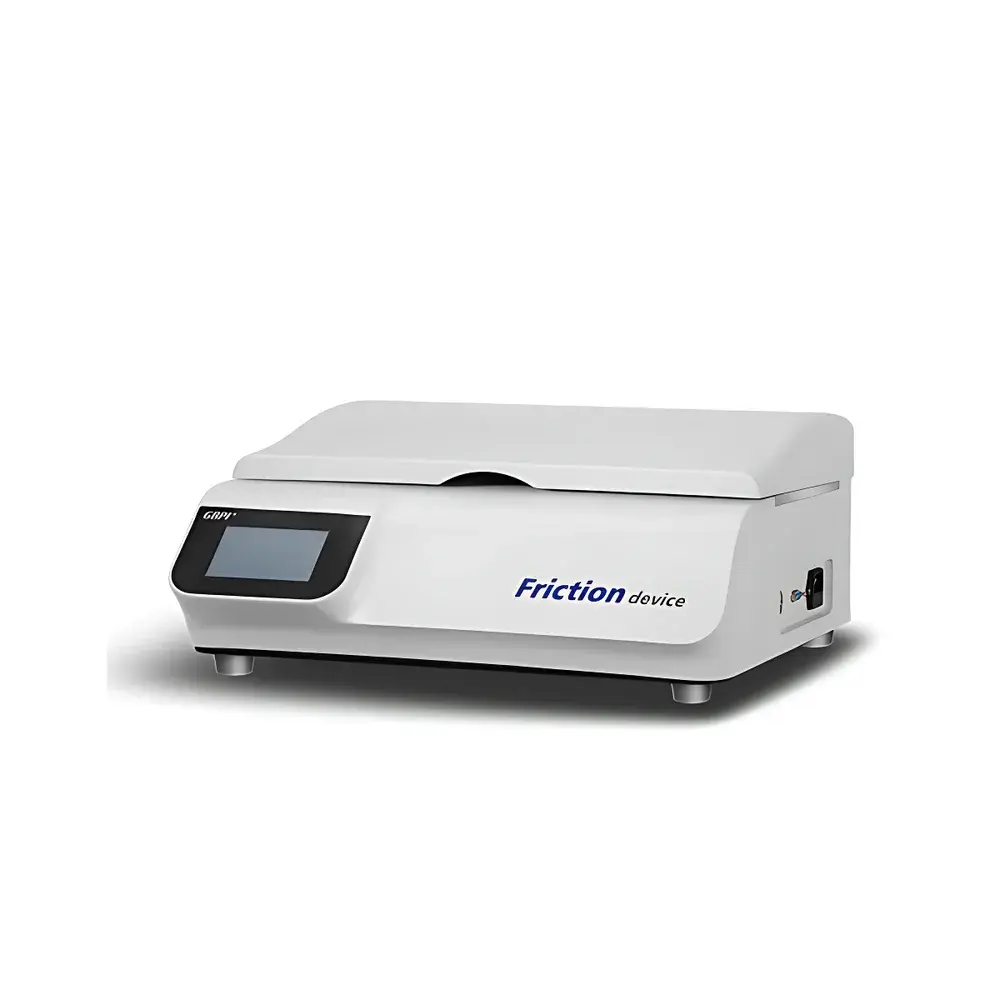
GBPI GM-6A Coefficient of Friction Tester for Packaging Materials
| Brand | GBPI |
|---|---|
| Model | GM-6A |
| Origin | Guangdong, China |
| Manufacturer Type | Direct Manufacturer |
| Country of Origin | China |
| Price Range | USD 1,400 – 7,000 |
| Standards Compliance | GB/T 10006–1988, ASTM D1894–2014, ISO 8295–2004, TAPPI T816 |
| COF Range | 0.01–0.999 |
| Measurement Accuracy | ±2% |
| Force Range | 0–10 N |
| Slider Mass | 200 ± 2 g |
| Slider Dimensions | 63 × 63 mm |
| Test Speed | Adjustable from 100 mm/min (stepless) |
| Temperature Control Option | Ambient to 75 °C |
| Specimen Thickness Limit | ≤2 mm |
| Test Platform Size | 200 × 470 mm |
| Overall Dimensions | 470 × 330 × 210 mm |
| Weight | 37 kg |
| Power Input | AC 220 V ±10%, 50 Hz, 1000 W |
Overview
The GBPI GM-6A Coefficient of Friction Tester is a precision-engineered instrument designed for quantitative measurement of static and kinetic coefficients of friction (COF) between flexible packaging materials—including plastic films, laminates, foils, paper, and coated substrates—under controlled mechanical and environmental conditions. It operates on the fundamental principle of horizontal pull testing, where a standardized slider is drawn across a stationary specimen at a defined velocity while force transducers record the peak (static) and sustained (kinetic) resistance forces. The resulting COF values are calculated as the ratio of measured frictional force to the normal load applied by the slider mass. This methodology aligns with internationally recognized test standards including ASTM D1894, ISO 8295, GB/T 10006, and TAPPI T816—ensuring data comparability across global laboratories and supply chains. The GM-6A is engineered for routine quality control in packaging R&D, production line verification, regulatory compliance documentation, and material development workflows.
Key Features
- High-accuracy dual-mode measurement: Simultaneous acquisition and real-time display of both static (μs) and kinetic (μk) coefficients of friction via integrated high-stability load cell (0–10 N range, ±2% full-scale accuracy)
- Stepless speed control: Adjustable test velocity centered at 100 mm/min, enabling method flexibility for non-standard or comparative protocols
- Self-contained operation: Standalone functionality with built-in LCD interface showing speed, μs, μk, and elapsed time—no external PC required for basic testing
- Modular hardware architecture: Field-replaceable sensor modules and tool-free access panels support rapid maintenance and long-term serviceability
- Overload protection circuitry: Automatic force-limiting logic prevents damage to the precision strain-gauge transducer during abnormal loading events
- Standardized test geometry: Compliant 63 × 63 mm slider with certified 200 ± 2 g mass ensures repeatability across laboratories
- Optional temperature-controlled test chamber: Enables COF evaluation under elevated thermal conditions (up to 75 °C), critical for heat-seal integrity and hot-fill packaging validation
Sample Compatibility & Compliance
The GM-6A accommodates flat, flexible specimens up to 2 mm in thickness and compatible with widths sufficient to cover the 200 × 470 mm test platform. It supports both auto-adhesive and clamped mounting configurations for specimens with varying surface energy or dimensional stability. All operational parameters—including slider mass, contact area, and pulling velocity—are traceably aligned with ASTM D1894–2014 (Standard Test Method for Coefficient of Friction of Plastic Film and Sheeting) and ISO 8295–2004 (Plastics — Film and Sheet — Determination of the Coefficients of Friction). The instrument’s mechanical design and calibration protocol satisfy GLP requirements for documented instrument qualification (IQ/OQ), and its digital output supports audit-ready data archiving compliant with FDA 21 CFR Part 11 when used with validated software.
Software & Data Management
The optional GBPI COF Control Suite provides Windows-based instrument control, real-time curve visualization (force vs. time), dynamic zoom/pan, automatic peak detection, and report generation in PDF or Excel formats. Raw data export includes timestamped force readings at ≥100 Hz sampling rate, enabling post-hoc statistical analysis (e.g., mean, SD, CV%) per ASTM E29. Software features include user-level access control, electronic signatures, and change-log tracking—meeting minimum requirements for GMP-regulated environments. Calibration records, test method templates, and operator logs are stored within a structured local database with configurable backup intervals.
Applications
- Quality assurance of roll-to-roll packaging films prior to printing, coating, or lamination
- Evaluation of slip additives (e.g., erucamide, oleamide) efficacy and migration kinetics
- Validation of anti-block performance in polyolefin-based food packaging
- Friction profiling of pharmaceutical blister lidding foils and pouch seals
- Comparative analysis of surface treatments (corona, plasma, flame) on PET and PE substrates
- Regulatory submission support for USP and ISO 15378 packaging integrity dossiers
- Root-cause investigation of high-speed packaging line jams or misfeeds
FAQ
What standards does the GM-6A comply with?
The instrument is fully aligned with ASTM D1894–2014, ISO 8295–2004, GB/T 10006–1988, and TAPPI T816 for static and kinetic COF measurement.
Can the GM-6A operate without a computer?
Yes—the device includes an integrated LCD interface and performs complete tests, calculations, and result storage independently.
Is calibration traceable to national standards?
Force calibration is performed using NIST-traceable reference weights; GBPI provides optional accredited calibration certificates upon request.
What is the maximum specimen thickness supported?
The test stage accommodates specimens up to 2 mm thick, suitable for most laminated structures and coated papers.
Does the system support multi-specimen batch testing?
While not automated for unattended sequencing, the software allows rapid method recall and sequential manual loading with consistent parameter retention.






