
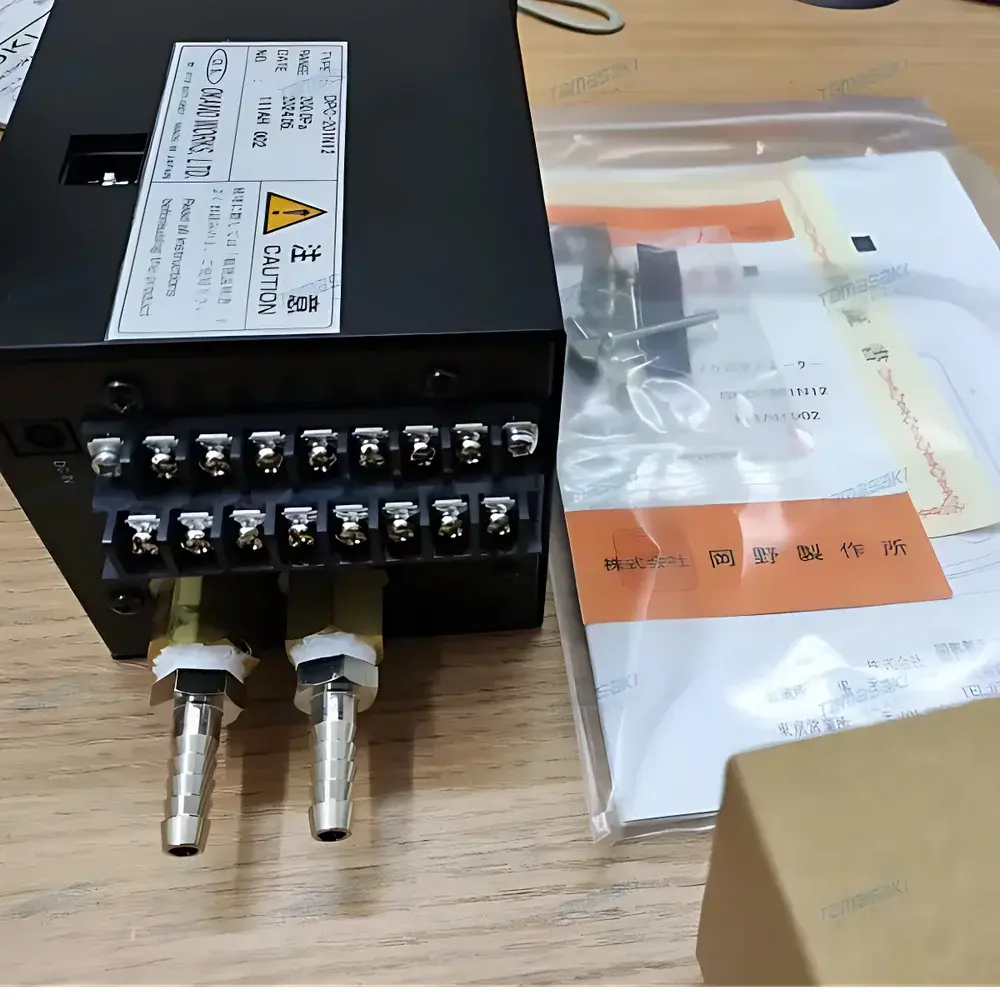
OKANO DPC-201N12 Differential Pressure Transmitter
| Brand | TAMASAKI |
|---|---|
| Origin | Japan |
| Manufacturer Type | Authorized Distributor |
| Origin Category | Imported |
| Model | DPC-201N12 |
| Drive Method | Manual |
| Measurement Range | ±200.0 Pa |
| Display Resolution | 0.1 Pa |
| Accuracy | ±0.1% FS ±1 digit |
| Temperature Drift | ±0.12% FS/°C |
| Display Update Interval | 0.1 s |
| Analog Output | 1–5 V (fully scalable) |
| Warm-up Time | 10 min |
| Sensor Type | Silicon Diaphragm |
| Compatible Media | Non-corrosive and mildly corrosive gases |
| Overpressure Limit | 10 kPa |
| Static Pressure Range | 30 kPa |
| Operating Ambient Temperature | 0–45°C (40°C max with AC adapter) |
| Dimensions | 96 × 96 × 141 mm (W × H × D) |
| Weight | 0.9 kg (excl. AC adapter) |
| Pressure Port | Φ8 mm hose barb (convertible to PT1/4 internal thread) |
| Power Supply | DC 12 V ±10% via included AC adapter (AC 100 V input, 10 W consumption) |
| Standard Functions | Hi/Go/Lo contact outputs (AC 250 V, 2 A), contact hysteresis setting (0–20 digits), moving average time setting (0–20 s), analog output scaling, zero-hold external signal input (dry contact) |
Overview
The OKANO DPC-201N12 is a high-stability, micro-differential pressure transmitter engineered for precise, real-time monitoring of low-pressure differentials in controlled laboratory and industrial process environments. Based on silicon diaphragm sensor technology, it operates on the principle of piezoresistive strain measurement—where minute deflections of a MEMS-fabricated silicon membrane under differential pressure induce proportional resistance changes, converted into calibrated voltage signals via integrated signal conditioning circuitry. Designed specifically for applications requiring resolution down to 0.1 Pa and accuracy of ±0.1% full scale (FS) ±1 digit, the DPC-201N12 delivers exceptional repeatability and long-term zero stability—even under dynamic pressure fluctuations. Its compact 96×96 mm panel-mount form factor and dual-port configuration (Φ8 mm push-fit hose connections, convertible to PT1/4 female thread) facilitate integration into laminar flow hoods, cleanroom HVAC monitoring systems, filter integrity test setups, and gas-phase reaction vessels where static pressure compensation and transient response control are critical.
Key Features
- Precision silicon diaphragm sensing element with thermal drift compensation (±0.12% FS/°C), ensuring stable operation across 0–45°C ambient range
- Configurable moving average time (0–20 s) to suppress high-frequency noise while preserving meaningful process transients
- Fully scalable analog output (1–5 V DC), programmable per user-defined pressure span to interface seamlessly with PLCs, DAQ systems, or SCADA platforms
- Dual-purpose dry-contact inputs: zero-reset trigger and measurement hold function—enabling synchronized calibration or pause during maintenance interventions
- Three independent relay outputs (Hi / Go / Lo) rated at AC 250 V / 2 A, each with independently adjustable hysteresis (0–20 digits) to prevent chattering in pressure control loops
- Robust overpressure tolerance (10 kPa) and static pressure handling capacity (30 kPa), supporting safe operation in variable-backpressure environments
- Comprehensive self-diagnostics including power-on initialization check, sensor health monitoring, and output continuity verification
Sample Compatibility & Compliance
The DPC-201N12 is validated for use with non-corrosive and mildly corrosive gases—including air, nitrogen, CO₂, and diluted process gases—provided condensation and particulate loading are minimized upstream. It complies with IEC 61000-6-2 (immunity) and IEC 61000-6-4 (emissions) standards for industrial environments. While not intrinsically safe certified, its low-power design (10 W max) and isolated analog output make it suitable for Class I, Division 2 hazardous location interfaces when installed behind appropriate barriers. The device supports GLP-aligned documentation workflows through traceable calibration records and configurable timestamped event logging (e.g., zero-adjustment triggers, alarm activations). All firmware and configuration parameters are retained during power cycling, meeting basic data integrity requirements under FDA 21 CFR Part 11 Annex 11 principles for non-critical measurement functions.
Software & Data Management
No proprietary PC software is required for basic operation; all parameter configuration—including analog scaling, contact thresholds, hysteresis, and averaging time—is performed locally via the front-panel keypad and 4-digit LED display. However, optional ASCII-based serial communication (RS-232, TTL level, 9600 bps) enables remote interrogation of live pressure values, status flags, and configuration registers using standard terminal emulators or custom LabVIEW/Python scripts. Output data streams include ASCII-formatted pressure value (e.g., “+123.4 Pa”), unit identifier, and CRC checksum. Configuration changes are stored in non-volatile EEPROM with write-cycle endurance exceeding 100,000 cycles. Audit trail functionality is implemented via timestamped internal logs of critical events (e.g., zero calibration, output range change), accessible only via serial command—supporting ISO/IEC 17025 clause 7.7 traceability requirements.
Applications
- Filter efficiency testing in pharmaceutical isolators and biosafety cabinets (EN 1822, ISO 14644-3)
- Differential pressure monitoring across HEPA/ULPA filters in cleanroom HVAC systems
- Leak detection and flow characterization in low-flow gas delivery manifolds (e.g., carrier gas lines for GC, ICP-MS)
- Process validation of pressure-controlled reactors and glovebox inerting systems
- Calibration reference for secondary pressure sensors in metrology labs (when used with NIST-traceable master gauges)
- Environmental chamber pressure differential control for humidity and temperature uniformity studies (ASTM E145, ISO 17025)
FAQ
What is the maximum allowable static pressure across the ports?
The DPC-201N12 supports a static pressure range of up to 30 kPa (absolute or gauge, depending on port referencing)—provided differential pressure remains within ±200 Pa.
Can the analog output be re-ranged in the field without recalibration?
Yes. Full-scale analog output scaling (1–5 V) is fully user-configurable via front-panel menu and does not require hardware recalibration or service intervention.
Is the device compatible with wet gas or condensing vapors?
No. The silicon diaphragm sensor is not rated for liquid ingress or prolonged exposure to saturated vapor. Install upstream particulate and coalescing filters if moisture or aerosol contamination is possible.
How is zero stability maintained during ambient temperature shifts?
Internal temperature compensation algorithms correct for thermal drift up to ±0.12% FS/°C, verified across the full 0–45°C operating envelope per factory calibration report.
Does the unit support Modbus RTU or other industrial protocols?
No. Communication is limited to ASCII over RS-232/TTL. For Modbus integration, an external protocol converter or gateway is required.
Related Products



