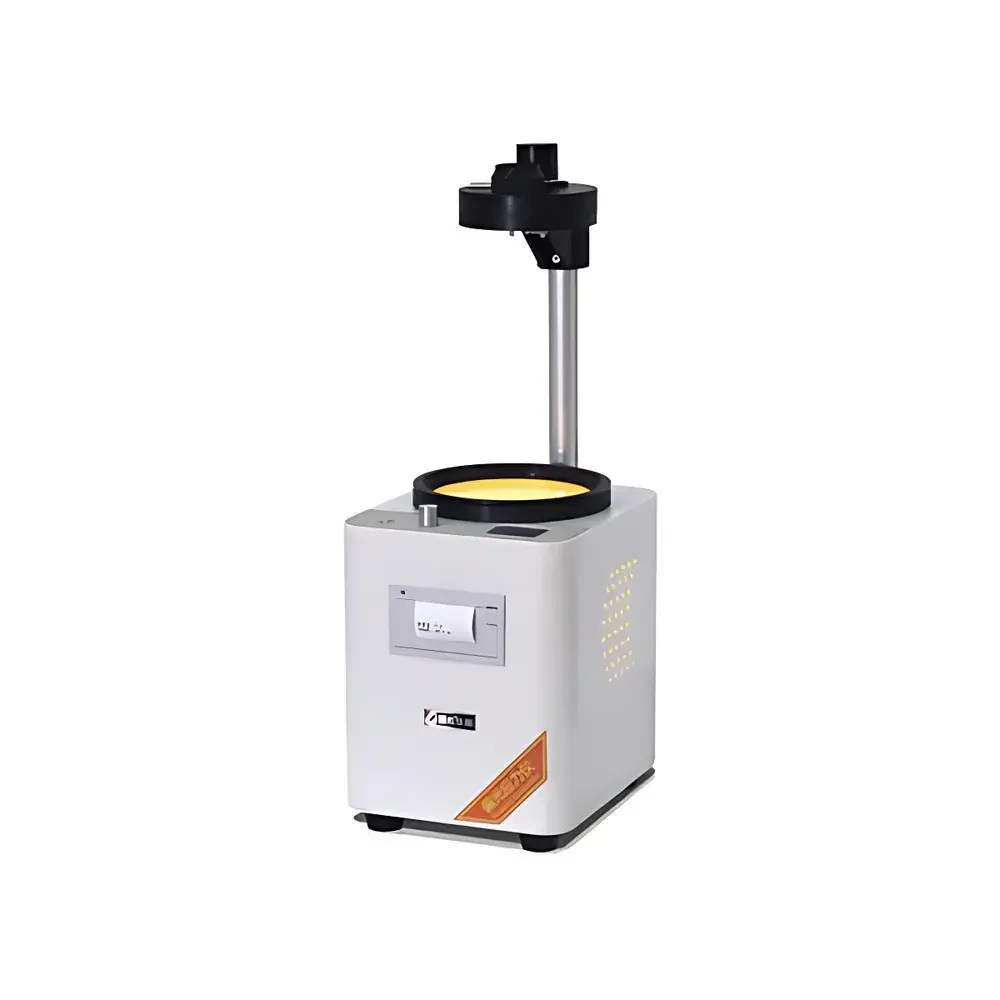
GBPI YLY-05 Digital Photoelastic Stress Analyzer for Glass
| Brand | GBPI |
|---|---|
| Origin | Guangdong, China |
| Manufacturer Type | Manufacturer |
| Country of Origin | Domestic (China) |
| Model | YLY-05 |
| Pricing | Upon Request |
Overview
The GBPI YLY-05 Digital Photoelastic Stress Analyzer is a precision optical instrument engineered for the quantitative and qualitative assessment of residual stress in transparent dielectric materials—primarily optical glass, pharmaceutical glass containers (e.g., ampoules, infusion bottles), and industrial glassware. It operates on the fundamental principle of photoelasticity: when stressed transparent materials are placed between crossed polarizers, they induce birefringence proportional to the local stress state. The instrument leverages monochromatic LED illumination combined with a calibrated ¼-wave plate compensation method and high-resolution angular encoding to convert phase retardation (optical path difference, OPD) into quantifiable stress values using the stress-optic coefficient (C) of the material (σ = Δ / (C·t), where t is thickness). Designed specifically for compliance-driven environments—including pharmaceutical QC labs, glass manufacturing QA departments, and metrology institutes—the YLY-05 delivers traceable, repeatable measurements aligned with international optical metrology practices.
Key Features
- Two operational modes: qualitative color-fringe interpretation and quantitative OPD measurement (0.1 nm resolution, ±2 nm accuracy)
- Motorized, dual-axis rotational stage with high-precision opposing-type angular encoder (resolution < 2.0 nm equivalent angular step)
- 150 mm diameter uniform polarized field with edge luminance > 120 cd/m² and central illuminance ≥ 800 lux
- Auto-zero dark-field alignment: eliminates manual zero-point calibration by anchoring the extinction position at absolute 0° via hardware-synchronized encoder reference
- Energy-efficient 525 nm green LED light source—reducing power consumption by >80% versus conventional tungsten-halogen lamps while ensuring stable spectral output and extended service life
- Integrated 4.3-inch color TFT-LCD display showing real-time retardation value (nm), rotation angle (°), and compensation status
- Adjustable interpolarizer distance (280 mm range) accommodates samples up to 25 mm thickness and irregular geometries
- Built-in thermal-printer module for immediate hardcopy output of test records including timestamp, operator ID, and measurement parameters
Sample Compatibility & Compliance
The YLY-05 supports flat, curved, and tubular glass specimens—including borosilicate, low-borosilicate, soda-lime, and aluminosilicate compositions—provided surface finish meets ISO 10110-7 (scratch-dig) requirements for optical testing. It is validated for use with wall-thickness gauges (e.g., ultrasonic or micrometer-based) to enable full stress calculation per ASTM C1357 and ISO 12778. The analyzer conforms to Chinese national metrological verification regulations and industry standards critical for pharmaceutical packaging validation: JJG 196–2006 (Calibration Procedures for Volumetric Glassware), GB/T 4545 (Test Method for Internal Stress in Glass Bottles), GB/T 12415 (Test Method for Internal Stress in Pharmaceutical Glass Containers), YBB00032005–2005 (Sodium-Calcium Glass Infusion Bottles), and YBB00332002–2015 (Low-Borosilicate Glass Ampoules). Its mechanical and electrical design complies with IEC 61010-1 for laboratory equipment safety.
Software & Data Management
While the YLY-05 operates as a standalone benchtop analyzer with embedded firmware, optional USB-to-PC connectivity enables data export in CSV format for integration into LIMS or statistical process control (SPC) platforms. Measurement logs include instrument serial number, calibration date, user-defined sample ID, angular position, OPD reading, ambient temperature (via internal sensor), and pass/fail flag against configurable thresholds. Audit-trail functionality supports GLP/GMP environments by recording all parameter changes and print events with timestamp and operator identifier—fully compatible with FDA 21 CFR Part 11 requirements when deployed with validated PC software and electronic signature protocols.
Applications
- Residual stress mapping of pharmaceutical glass primary packaging (vials, syringes, cartridges) prior to sterilization and fill-finish
- Quality control of optical lens blanks, prisms, and filter substrates during grinding/polishing cycles
- Validation of annealing furnace performance in float-glass production lines
- Failure analysis of thermally tempered architectural or automotive glass components
- Research-grade birefringence characterization of polymer films, crystalline wafers, and composite laminates
- Teaching laboratories for solid mechanics and optical physics curricula requiring hands-on photoelastic demonstration
FAQ
What is the minimum measurable optical path difference (OPD)?
The instrument resolves OPD down to 0.1 nm with a maximum error of ±2 nm across its full angular range.
Can the YLY-05 measure stress in non-glass materials?
Yes—any optically transparent, isotropic material exhibiting stress-induced birefringence (e.g., PMMA, polycarbonate, epoxy resins) can be assessed, provided its stress-optic coefficient is known and surface quality permits interference fringe formation.
Is external thickness measurement required for quantitative stress calculation?
Yes. Accurate stress magnitude requires concurrent wall-thickness measurement using a certified ultrasonic gauge or mechanical micrometer; the YLY-05 outputs only OPD, which must be converted using σ = Δ/(C·t).
Does the system require periodic recalibration?
Annual verification against NIST-traceable retardation standards (e.g., Berek or Soleil-Babinet compensators) is recommended; dark-field auto-zero eliminates daily calibration drift.
Is CE marking applicable to this instrument?
Yes—GBPI holds CE certification under the EU Machinery Directive 2006/42/EC and EMC Directive 2014/30/EU, confirmed by third-party Notified Body reports available upon request.