
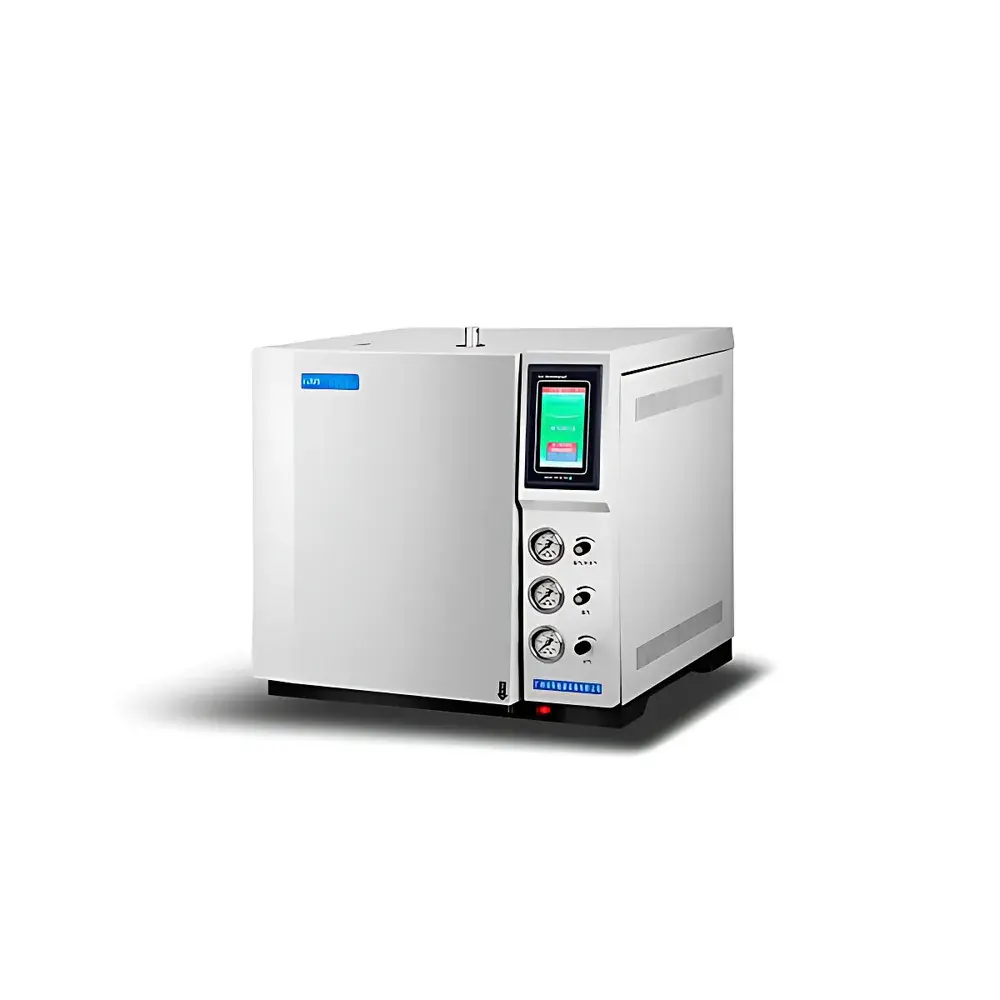
GBPI GC9802-K2 Gas Chromatograph for Ethylene Oxide Residue Testing in Protective Masks
| Brand | GBPI |
|---|---|
| Origin | Guangdong, China |
| Manufacturer Type | Direct Manufacturer |
| Regional Classification | Domestic (China) |
| Model | GC9802-K2 |
| Price Range | USD 7,000–14,000 |
| Instrument Type | Laboratory Gas Chromatograph |
| Application Scope | General-purpose |
| Detector | Flame Ionization Detector (FID), optional alternative detectors |
| Detection Limit | ≤3×10⁻¹² g/s (n-hexadecane) |
| Baseline Noise | ≤2×10⁻¹⁴ A |
| Baseline Drift | ≤1×10⁻¹³ A/30 min |
| Column | EO-specific capillary column (30 m × 0.32 mm × 0.5 µm), optional alternate columns |
| Headspace Sampler | 20-position |
| Oven Dimensions | 240 × 210 × 240 mm |
| Temperature Range | 4 °C above ambient to 450 °C (1 °C increments) |
| Temperature Control Accuracy | ±0.1 °C |
| Temperature Gradient Uniformity | ±1% |
| Independent Temperature Zones | 6 |
| Programmable Temperature Ramp Stages | 16 |
| Ramp Rate | 0.1–60 °C/min |
| Maximum Runtime Setting | 6000 min |
| Optional Air Generator | Oil-free, with oil/water removal, 3 L/min |
| Optional H₂ Generator | 300 mL/min, purity ≥99.999% |
| Carrier Gas | High-purity nitrogen (99.999%), supplied via cylinder with regulator (local procurement) |
| Certified EO Standard | Included |
| Data System | Dual-channel Chinese-language chromatography workstation with instrument control |
| Injection System | Split/splitless capillary inlet with septum purge function |
Overview
The GBPI GC9802-K2 is a dedicated laboratory gas chromatograph engineered for the precise quantification of residual ethylene oxide (EO) in medical protective masks and other sterilized medical devices. It operates on the fundamental principle of gas-phase separation followed by selective detection—specifically leveraging flame ionization detection (FID) for high-sensitivity, linear-response measurement of volatile organic compounds. EO, a widely used low-temperature sterilant, poses documented genotoxic and carcinogenic risks at trace levels; regulatory frameworks—including ISO 10993-7, USP , and YY/T 0681.13–2014—mandate strict limits (typically ≤10 µg/g for masks, ≤20 µg/g for device components). The GC9802-K2 meets these requirements through its thermally stable oven architecture, precisely calibrated FID detector, and optimized EO-specific capillary column (30 m × 0.32 mm × 0.5 µm), enabling reproducible retention time alignment and sub-µg/g detection capability when coupled with standardized headspace sampling.
Key Features
- Six independent temperature-controlled zones—including oven, injector, and detector—support complex method development and robust method transfer across laboratories.
- Programmable 16-stage temperature ramping (0.1–60 °C/min) ensures optimal resolution of EO from interfering volatiles such as ethanol or acetaldehyde, critical for compliant analysis of multi-material mask constructions.
- FID detector delivers ≤3×10⁻¹² g/s sensitivity (n-hexadecane), baseline noise ≤2×10⁻¹⁴ A, and drift ≤1×10⁻¹³ A/30 min—meeting ASTM D3699 and ISO 6416 performance benchmarks for routine QC applications.
- Integrated 20-position headspace autosampler enables unattended batch processing of vials per ISO 11358-1 protocols, minimizing operator variability and enhancing throughput for high-volume EO testing labs.
- Capillary split/splitless injection system with septum purge function maintains column integrity and reduces ghost peaks—essential for long-term method stability during repeated standard calibration and sample runs.
- Real-time dual-channel data acquisition and visualization allow simultaneous monitoring of EO peak elution and internal standard response, supporting immediate assessment of chromatographic fidelity.
Sample Compatibility & Compliance
The GC9802-K2 is validated for use with solid and semi-solid samples requiring headspace extraction—including surgical masks, N95 respirators, gowns, and packaging materials per GB 19083–2010, YY 0469–2011, and GB/T 32610–2016. Its hardware configuration aligns with GLP-compliant workflows: temperature logs, detector status flags, and method parameters are timestamped and stored within the workstation database. While the base system does not include 21 CFR Part 11 audit trail functionality, the dual-channel workstation supports user-defined electronic signatures and PDF report export—facilitating internal SOP documentation and external regulatory review under ISO/IEC 17025 accreditation requirements.
Software & Data Management
The embedded Chinese-language chromatography workstation provides full instrument control, real-time chromatogram display (with zoom/pan functionality), peak integration using tangent skim or valley-to-valley algorithms, and customizable report templates. Calibration curves support linear and quadratic regression with R² validation; results are traceable to certified EO reference standards (included). Raw data files (.cdf) retain all acquisition metadata—including oven program history, detector voltage, and flow rates—enabling retrospective reprocessing. Export formats include CSV (for LIMS integration), PNG (for lab notebooks), and password-protected PDF (for QA submission).
Applications
Beyond EO residue testing in PPE, the GC9802-K2 serves as a general-purpose analytical platform for residual solvent analysis in pharmaceutical packaging (per YBB 00132002), monomer quantification in polymer films (GB/T 10004–2008), and purity assessment of industrial solvents (QBT 2929). Its modular design permits detector swapping (e.g., ECD for halogenated compounds) and column reconfiguration—making it suitable for environmental VOC screening (EPA TO-17), pesticide residue profiling (AOAC 996.05), and quality control of printed flexible packaging.
FAQ
What regulatory standards does the GC9802-K2 support for EO testing?
It is configured to meet YY/T 0681.13–2014, GB 19083–2010, YY 0469–2011, and ISO 10993-7 requirements for EO residue quantification in medical devices.
Is the system compatible with third-party LIMS or ELN platforms?
Yes—CSV and XML data exports enable seamless integration with common laboratory informatics systems; custom API development is supported upon request.
Can the instrument be upgraded to comply with 21 CFR Part 11?
While the base workstation lacks built-in electronic signature and audit trail modules, GBPI offers a validated software upgrade package with role-based access control, electronic signatures, and immutable audit logs for regulated environments.
What consumables require periodic replacement?
FID jet, septa, liner, and GC column—typical service intervals are 3–6 months depending on sample matrix complexity and daily run volume.
Does the system include validation documentation?
A factory-issued IQ/OQ protocol (in English) is provided; PQ documentation templates aligned with ISO/IEC 17025 are available upon installation support engagement.





